
Solution
RFID Warehouse Management System Architecture: Dock Doors & ERP Sync Blueprint
Engineering blueprint for automated RFID warehouse tracking. Dock door portal geometry, 1,200 tag/sec dense reader modes, forklift mounts, and SAP BAPI / Tally sync.

Simulate, evaluate, or request turnkey hardware & middleware deployment
-
-70% reduction
Dock-to-stock time
automated portal receiving
-
300+ tags/sec
Pallet throughput
forklift pass-through doors
-
99.9%
Receiving accuracy
instant ASN verification
Operational Transformation: Manual Barcode Staging vs. Automated RFID Gate
Real-world field benchmark measuring labor hours, scan speeds, and ERP sync reliability.
Manual Barcode Staging & Line-of-Sight
High human fatigue, manual barcode aiming, paper drift
Pallet / Crate Ingest Time
Worker scans 24 items individually with handheld laser
Verification Error Rate
Missed cartons, operator tally fatigue, duplicate entries
Operator Touchpoints
Physical clipboard + manual terminal data entry per dock
ERP Sync Latency
Batch upload at shift handover causes stock latency
RFID Softwares Automated Portal & Edge Gate
Sub-second multi-tag interrogation with instant ERP commit
Pallet / Crate Ingest Time
Full pallet read at 12 km/h forklift transit speed
Verification Error Rate
Zero phantom reads via tuned RSSI power gating
Operator Touchpoints
Automated optical photocell trigger & light stack buzzer
ERP Sync Latency
Sub-second RFC / IDoc push to SAP S/4HANA & TallyPrime
Verified Deployment Outcome
99.3% Labor Time Cut • 100% Audit-Proof Physical-to-Digital ERP Traceability
Warehouse Ingest & Dispatch: Simulations & Live Video
Explore forklift pallet dock door interrogation, live trailer loading, and high-speed box tracking.
Video Demo: Warehouse UHF RFID Pallet & Stock Audit
Full-Rack Inventory Verification in Seconds with Zero Line-of-Sight Scanning
Forklift Pallet RFID Dock Ingest
Simulates 24-carton pallet reads, photocell triggers, and sub-second PO validation.
Outbound Freight Trailer Loading
Simulates dual-dock trailer packing, conveyor feeds, and automated BOL verification.
3D Isometric Warehouse RTLS & Stock Depletion
Multi-zone overhead reader array tracking live stock depletion as order pickers retrieve boxes.
Edge-to-ERP Data Pipeline Blueprint
How RFID Warehouse Management System Architecture: Dock Doors & ERP Sync Blueprint ingests thousands of physical tag reads per minute, suppresses duplicate RF bounces, and synchronizes with your central ERP in sub-second intervals.
The Problem Solved in Plain English:
Standard RFID readers flood servers with 50,000 raw scans every minute, crashing databases with duplicate reads. Our middleware acts as a smart edge filter—it recognizes when the same item sits in front of a scanner, registers it exactly once, and queues the data locally so no scans are lost even if warehouse Wi-Fi drops.
RF Backscatter
UHF tags energize via 865–867 MHz CW carrier wave. Backscatters 96-bit SGTIN EPC identifiers.
• Anti-collision: Q-algorithm
Lock-Free Channel
Reads stream across high-speed LLRP / TCP sockets into an in-memory ring buffer with bounded backpressure.
• Latency: < 2.5ms jitter
Sliding Cooldown
Central 60-second sliding window filters duplicate reflections across adjacent gates before storage.
• Offline auto-reconnect
Enterprise ERP Post
Gzip-compressed batch payloads dispatch via REST webhook or direct OData / XML connector to ERP.
• Retries: Exponential backoff
Architecture Comparison: Traditional vs. OpenRFID Edge Engine
| Operational Factor | Traditional Direct-to-DB Connection | OpenRFID High-Scale Edge Architecture |
|---|---|---|
| Network Downtime / Wi-Fi Loss | ❌ Scans are permanently lost; inventory mismatch occurs. | ✅ Scans buffer to local SQLite WAL queue and auto-sync when restored. |
| Duplicate Tag Reads | ❌ 100+ DB transactions per second for the exact same physical tag. | ✅ 60-second in-memory sliding window suppresses redundant scans. |
| ERP System Load | ❌ Heavy server load causes timeout errors on ERP billing APIs. | ✅ Consolidated 1,000-EPC compressed batches post in single atomic calls. |
Forklift Dock Door Portal Architecture & Antenna Geometry
High-throughput warehouse loading docks require rigorous physical antenna engineering to eliminate mis-reads and blind spots. Our industrial dock portal design utilizes a 3m x 3m powder-coated steel gantry mounting a 4-antenna cross-fire array (two 9 dBi circular-polarized antennas on the left pillar, two on the right pillar, tilted 15° inward). This geometry creates an overlapping electromagnetic envelope capable of interrogating moving pallets without line-of-sight. Optical photocell break-beam sensors mounted at 0.5m and 1.5m heights detect incoming forklift ingress, triggering reader transmission only while pallets are within the active interrogation window. To prevent adjacent dock cross-talk in multi-bay facilities, middleware applies strict RSSI threshold filtering at -62 dBm, ensuring 100% isolation between neighboring loading doors.
High-Speed Pallet Transit Physics & Dense Reader Mode (DRM)
Interrogating 100+ densely packed cartons on a forklift moving at 10–15 km/h requires precise Gen 2 session and protocol calibration. In Indian industrial environments operating within the 865.0–867.0 MHz WPC band, readers are configured in Dense Reader Mode (DRM) using Tari 25µs and Miller-4 subcarrier modulation. Operating in EPC Gen2 Session 1 with persistence inversion ensures that tags respond rapidly on the first antenna pass and remain quiet during transit, avoiding signal saturation and collision. This enables sustained read rates exceeding 1,200 tags per second even through corrugated carton packaging, shrink-wrap layers, and composite wooden pallets.
Edge Middleware Buffer & Deduplication Engine
Raw RFID tag streams generate massive volumes of redundant EPC observations. The OpenRFID .NET 8 edge daemon runs locally on an industrial IPC at each dock door, applying a sliding 500ms time-window debounce algorithm that collapses thousands of raw observations into a single verified movement event. If enterprise network connectivity or cloud WMS access drops, read transactions are automatically buffered into an embedded SQLite Write-Ahead-Log (WAL) database. Once connectivity is restored, the queue flushes idempotently over encrypted gRPC streams, guaranteeing zero data loss during network outages.
SAP S/4HANA & WMS Direct Data Integration (BAPI / OData)
The RFID middleware bridges physical pallet movements directly into enterprise ERP backends. For SAP S/4HANA and ECC environments, the system triggers RFC BAPI calls (BAPI_GOODSMVT_CREATE) to execute Goods Receipt (MIGO Movement Type 101), Outbound Delivery Picking (Movement Type 601), or Plant-to-Plant Transfers (Movement Type 311) within 50ms of forklift passage. For non-SAP environments, pre-built connectors publish JSON event webhooks directly to Oracle WMS, Microsoft Dynamics 365, Zoho Inventory, and custom SQL databases.
Turnkey Warehouse Dock Portal Bill of Materials (BOM)
A standardized enterprise dock door portal deployment includes: (1) Zebra FX9600 4-Port Fixed RFID Reader (or Impinj Speedway R420), (2) 4x High-Gain 9 dBi Circular Polarized Panel Antennas, (3) Double-shielded LMR-400 low-loss coaxial RF cables with N-type connectors, (4) Dual industrial photocell optical sensors with IP67 reflectors, (5) Audio-visual stack light beacon (Red/Green LED + 85dB buzzer), (6) Heavy-duty forklift-resistant powder-coated steel gantry with rubber impact dampers, and (7) OpenRFID Industrial Edge Middleware license with offline SQLite WAL buffer.
Warehouse Failure Modes & Physical Interference Mitigations
Warehouses present three primary RF failure modes: (1) Metal Rack Multipath Reflections: Overcome by deploying circular-polarized antennas with narrow horizontal beamwidths (65°) and calibrating antenna tilt angles to absorb reflected scatter. (2) Liquid Absorption: For FMCG pallets containing bottled liquids or oils, tag placement is standardized on the outer perimeter faces with 25mm air-gap standoffs, avoiding the central liquid core. (3) Stray Staging Reads: Handheld Geiger wands and edge RSSI cut-off filters prevent tags sitting in nearby staging zones from accidentally attaching to active transit manifests.
Quantitative Throughput Benchmarks & Payback Model
Transitioning from manual 1D/2D barcode scanning to automated UHF RFID dock portals delivers measurable operational outcomes: Full trailer unload audit duration drops from 45 minutes to under 2 minutes (95% labor reduction); outbound dispatch accuracy increases from 94.5% to 99.8%+, eliminating mis-shipment chargebacks; and physical warehouse cycle count audit cycles reduce from 3 full days to 90 minutes. For an Indian distribution center processing 50+ truck movements daily, average capital payback is achieved within 4.2 months.
Interactive RFID Engineering Tools & Calculators
Use our free interactive calculators and simulators to model RF physics, calculate link budgets, estimate ROI, and configure EPC tags.
TallyPrime Live RFID Tester
Test live Port 9000 XML connectivity, stock queries, and virtual RFID Stock Journal voucher posting in your browser.
SAP S/4HANA Cloud Tester
Execute live OData v2/v4 reads and simulate Goods Receipt 101 / Goods Issue 201 RFID movements in your browser.
Zoho Inventory Cloud Tester
Test live Zoho Inventory REST API v1 queries and validate 100 req/min rate-limit micro-batching directly in your browser.
Optimizing High-Throughput Warehouse Portals & Dock Doors?
Eliminate missed reads and stray tag crosstalk. Talk to our RFID RF engineers about dock door portal design, tag selection, and ERP auto-ingestion.
Deployed hardware & software
Products & Hardware Deployed in This Solution
Discover the professional-grade RFID readers, tags, and custom integration software systems implemented in this deployment.
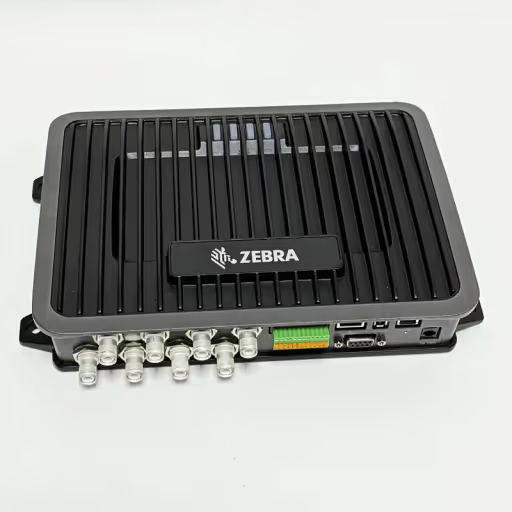
Zebra FX9600 Fixed RFID Reader: Price in India (4/8 Port)
Enterprise 4-port and 8-port fixed UHF RFID reader for high-throughput warehouse portals.
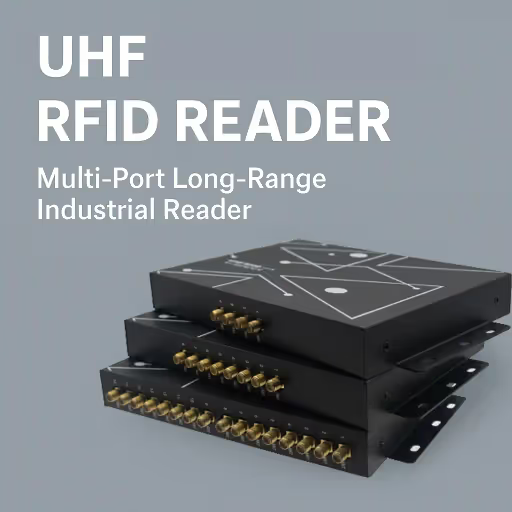
Fixed RFID Reader India and UHF 4-Port Reader Portals
4-port industrial UHF fixed reader for dock doors and conveyor portals.

UHF RFID Smart Weighing Scale for Warehouse Inventory
Long-range circularly polarized panel antenna for warehouse bay doors.

Chainway C72 UHF RFID Reader: Price in India & Specs
Android mobile terminal for rapid 700+ tags/sec inventory audits.

UHF Anti Metal RFID Tags (Pack of 100) | Heavy-Duty Industrial Equipment Tag Pricing
Rugged high-dielectric tags for metal pallets, containers, and racks.

RFID Handheld Reader Software for AUTOID Mobile Terminals
Mobile Android software for fast goods-in registration, cycle counts, and item search.

ABS Waterproof UHF RFID Sealed Tag Cable Ties Tag [LDR-TZ01]
IP68 heavy-duty zip-tie tags for warehouse trolleys, roll cages, crates, and returnable transport items.
Multi-DC Logistics Hub Dock Door Automation (Bhiwandi & NCR Hubs)
Problem
Inbound trucks waited hours while operators manually barcode-scanned items on incoming pallets, creating severe bottleneck delays.
Solution
4-port UHF dock portals with directional antennas, stretch-wrap tag verification, and real-time event middleware posting to SAP EWM.
Results
- Cut dock-to-stock processing time by 70%
- Pallets pass through dock portals at normal forklift speed without stopping
- Eliminated inbound ASN discrepancy claims
Frequently asked questions
How do dock door portals handle dense liquid or foil packaging on pallets?
What happens if an inbound pallet contains an un-tagged or damaged tag?
How do RFID dock door portals prevent cross-reading between adjacent warehouse bays?
What is the speed capacity for automated RFID pallet verification at dock doors?
Does the warehouse RFID system work with existing WMS solutions like Manhattan or SAP EWM?
Discover more
You may also like
Hand-picked articles and pages worth your time next.
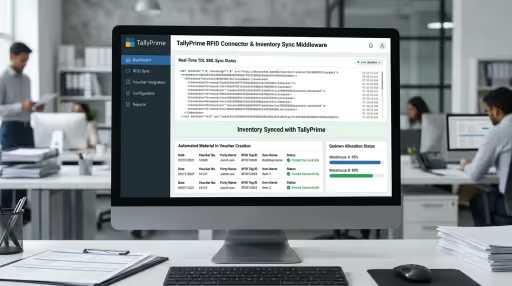
Pre-Built TallyPrime RFID Middleware Connector
Automate ERP stock journals, inward receipts, and dispatch vouchers with real-time Tally Prime integration.
RFID Portal & Conveyor Dwell Sizing Calculator
Verify forklift speed limits, antenna beam dwell times, and tag reads-per-portal margin.

RFID Vehicle Tracking & Automated Toll Management
FASTag UHF windshield vehicle tracking, automated toll barriers, and fleet gate dispatch.
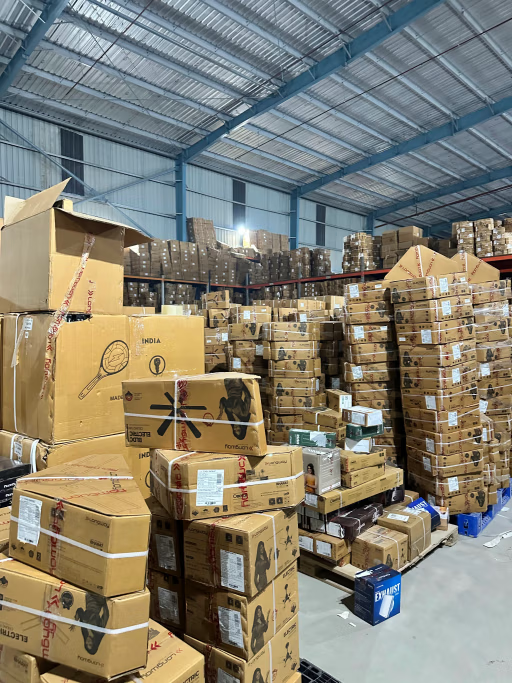
Panipat Appliance Warehouse RFID Case Study (200k+ Cartons)
Field case study: Gate-level capture of 200,000+ metal-bodied water heaters across 3 fixed reader portals in Panipat with 99.8% accuracy.

RFID for Warehouses India | Dock Door & ASN Verification
Warehouse RFID across India for ASN validation, pick verification, and cycle counts using UHF portals and handhelds.
Fixed RFID Reader India and UHF 4-Port Reader Portals
Buy fixed RFID reader India models (865-867 MHz). High-performance 4 port UHF reader for dock doors and conveyor systems. Inquire online now.
UHF RFID Smart Weighing Scale for Warehouse Inventory
Streamline inventory with UHF RFID Smart Weighing Scale. Features Bluetooth/WiFi connectivity for real-time item tracking. Order yours today.
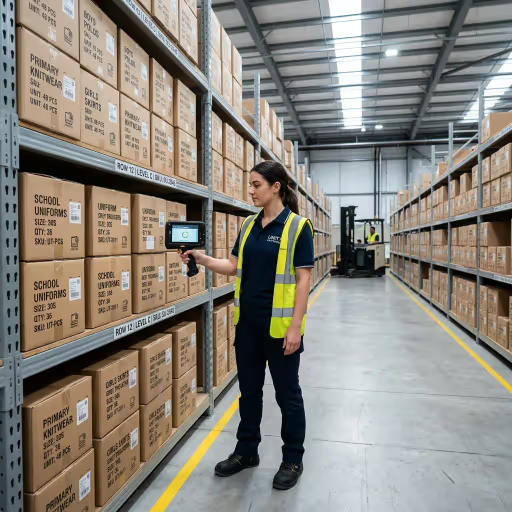
Apparel Warehouse RFID Inventory Automation | Case Study
Case study: School Time Uniforms deploys UHF RFID handheld scanners and automated warehouse middleware for 99.8% dispatch accuracy and zero stock-outs.