
Enterprise SAP RFID Integration for S/4HANA & Business One
Bridge physical dock door portals and industrial conveyor readers directly into SAP S/4HANA, EWM, and Business One. Decompose 96-bit GS1 SGTIN EPC tags into validated material documents, automated Goods Movement 101 postings, and serialized audit trails.
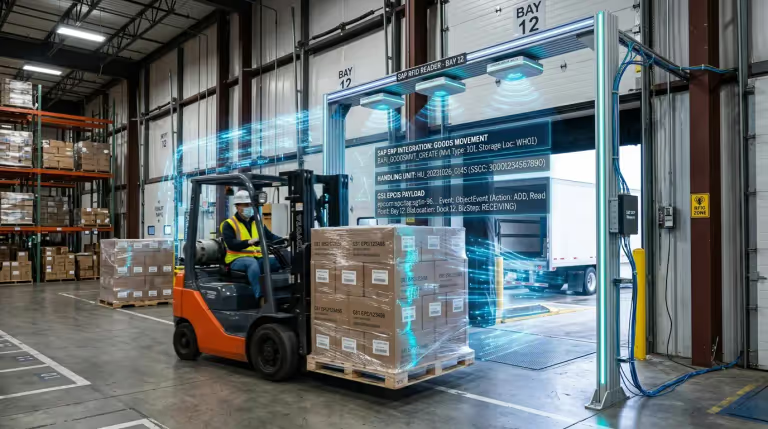
How RFID EPC Tags Map to SAP Materials (MATNR)
Physical RFID chips do not store verbose descriptions. They encode a binary 96-bit SGTIN identifier. Our edge gateway decomposes the binary stream into enterprise GS1 and SAP entities:
Rejecting Adjacent Dock Door Cross-Reads
In enterprise distribution centers, dock doors are spaced only 3–4 meters apart. Without edge filtering, an RFID portal at Dock Door 3 will accidentally capture tags passing through Dock Door 4. OpenRFID applies multi-variable physics filtering:
RSSI Signal Gradient
Tags in the active portal exhibit a steep Bell-curve signal trajectory exceeding -55 dBm. Crosstalk from neighboring doors remains diffuse below -72 dBm and is stripped at the hardware buffer.
Phase Angle Delta (Δθ)
As a forklift transits through the portal, the radio wave phase angle rotates predictably (Δθ = 2π × 2d / λ). Tags on stationary pallets or adjacent doors produce zero phase rotation and are suppressed.
Beam-Break Interlock
Industrial retro-reflective photo-eye sensors mounted on the dock frame trigger RF transmission only when the vehicle body enters the portal, eliminating continuous RF pollution.
GS1 EPCIS 2.0 JSON-LD Supply Chain Event Schema
Our gateway serializes pallet transactions into W3C JSON-LD EPCIS 2.0 events for SAP Advanced Track and Trace (ATTP) and global regulatory compliance:
{
  "@context": ["https://ref.gs1.org/standards/epcis/2.0.0/epcis-context.jsonld"],
  "type": "EPCISDocument",
  "schemaVersion": "2.0",
  "creationDate": "2026-09-12T11:45:00.000Z",
  "epcisBody": {
    "eventList": [
      {
        "type": "AggregationEvent",
        "eventTime": "2026-09-12T11:44:32.410Z",
        "eventTimeZoneOffset": "+05:30",
        "parentID": "urn:epc:id:sscc:8901234.0001847291",
        "childEPCs": [
          "urn:epc:id:sgtin:8901234.056789.100045892",
          "urn:epc:id:sgtin:8901234.056789.100045893"
        ],
        "action": "ADD",
        "bizStep": "urn:epcglobal:cbv:bizstep:packing",
        "disposition": "urn:epcglobal:cbv:disp:in_progress",
        "readPoint": { "id": "urn:epc:id:sgln:8901234.00001.DOCK_04" },
        "bizLocation": { "id": "urn:epc:id:sgln:8901234.00001.0" },
        "bizTransactionList": [
          { "type": "urn:epcglobal:cbv:btt:po", "bizTransaction": "PO-992014" }
        ]
      }
    ]
  }
}
SAP S/4HANA (BAPI RFC) & Business One (Service Layer) Connectors
Depending on your SAP platform, our gateway executes the appropriate native transaction interface:
BAPI_GOODSMVT_CREATE
Executes Goods Movement 101 (Receipt against Purchase Order) or 311 (Plant-to-Plant Transfer) with handling units and serial number assignments directly in SAP core.
GOODSMVT_HEADER-PSTNG_DATE = '20260912'
GOODSMVT_ITEM-MOVE_TYPE = '101'
GOODSMVT_ITEM-MATERIAL = 'MAT-8901234'
GOODSMVT_ITEM-ENTRY_QTY = 50
GOODSMVT_SERIALNUMBER = ['SN1001', 'SN1002']
POST /b1s/v2/InventoryGenEntries
Connects via HTTPS REST with B1SESSION cookie auth. Automatically converts dock door scan bursts into Goods Receipts with serialized lot allocation.
{
"DocDate": "2026-09-12",
"DocumentLines": [{
"ItemCode": "ITEM-001",
"Quantity": 20,
"WarehouseCode": "WH01"
}]
}
import requests
from typing import List, Dict, Any

class SapB1ServiceLayerClient:
    """
    Connects to SAP Business One Service Layer via HTTPS.
    Maintains session state and executes automated Inventory Goods Receipts from RFID bursts.
    """
    def __init__(self, base_url: str, company_db: str, username: str, password: str):
        self.base_url = base_url.rstrip('/')
        self.company_db = company_db
        self.username = username
        self.password = password
        self.session = requests.Session()
        self.session.verify = True

    def login(self) -> bool:
        login_url = f"{self.base_url}/b1s/v2/Login"
        payload = {
            "CompanyDB": self.company_db,
            "UserName": self.username,
            "Password": self.password
        }
        res = self.session.post(login_url, json=payload, timeout=10)
        return res.status_code == 200

    def post_goods_receipt(self, warehouse_code: str, items: List[Dict[str, Any]]) -> Dict[str, Any]:
        endpoint = f"{self.base_url}/b1s/v2/InventoryGenEntries"
        doc_lines = []
        for it in items:
            line = {
                "ItemCode": it["item_code"],
                "Quantity": it["quantity"],
                "WarehouseCode": warehouse_code,
                "SerialNumbers": [{"InternalSerialNumber": sn} for sn in it.get("serials", [])]
            }
            doc_lines.append(line)

        payload = {"DocumentLines": doc_lines}
        res = self.session.post(endpoint, json=payload, timeout=15)
        if res.status_code in [200, 201]:
            return {"success": True, "doc_entry": res.json().get("DocEntry")}
        return {"success": False, "error": res.text}
Frequently Asked Questions: SAP RFID Integration
Technical guidance for SAP solution architects, ABAP developers, and supply chain directors.
How does physical RFID tag data map into SAP Material Masters?
How does RFID integrate with SAP Extended Warehouse Management (EWM) and Handling Units?
Does integrating RFID require modifying standard SAP ABAP tables?
What is the difference between integrating SAP S/4HANA vs. SAP Business One?
Does the gateway support GS1 EPCIS 2.0 event standards?
How do you prevent SAP from crashing when scanning 1,000+ tags per second at dock doors?
Can RFID automate SAP Goods Movement 101 and 311 postings?
How do you prevent cross-reads between adjacent dock doors?
Deploy Enterprise SAP RFID Architecture
Our certified integration team provides complete end-to-end implementation for SAP S/4HANA, EWM, and Business One. Includes fixed portal installation, high-speed LLRP daemons, and custom ABAP/BAPI connectors.