
Resource
WPC RFID Frequency India (865–867 MHz)
Complete engineering guide to India WPC 865-867 MHz UHF RFID band. 10 carrier channels table, 4W EIRP power formula, GSR 564(E) rules, and Saral Sanchar ETA certification.

Simulate, evaluate, or request turnkey hardware & middleware deployment
-
865–867 MHz
Operating Frequency Band
WPC license-exempt de-licensed window in India
-
4 Watts EIRP
Maximum Transmit Power
effective isotropic radiated power (+36 dBm EIRP / ~2.46W ERP)
-
10 Channels (200 kHz)
Channel Allocation
carrier spacing 865.1 to 866.9 MHz with FHSS
WPC Regulatory Framework: Gazette Notification GSR 564(E)
In India, the Wireless Planning & Coordination (WPC) wing of the Department of Telecommunications (DoT) regulates all radio frequency spectrum. Under Gazette Notification GSR 564(E) ('Use of Low Power and Very Low Power Radio Frequency Devices, Exemption from Licensing'), the UHF frequency band 865.0 MHz to 867.0 MHz is officially de-licensed for indoor and outdoor Radio Frequency Identification (RFID) installations. Enterprises, warehouses, and factories can deploy compliant RFID infrastructure across India without applying for a recurring wireless station operating license.
RF Power Limits & EIRP Calculation Formula (+36 dBm / 4 Watts)
WPC regulations mandate that passive UHF RFID reader transmissions must not exceed 4 Watts Effective Isotropic Radiated Power (EIRP), which equals +36 dBm EIRP (or approximately 2.46 Watts Effective Radiated Power / ERP). In practice, an engineering RF link budget is computed as: EIRP (dBm) = Conducted Transmit Power (dBm) + Antenna Gain (dBi) - Coaxial Cable Insertion Loss (dB). A standard compliant setup pairs a reader outputting +30 dBm (1 Watt) with an 8 dBi circular panel antenna over 10 meters of LMR-400 cable (-2 dB loss), delivering exactly +36 dBm EIRP.
India UHF 10-Channel Plan & 200 kHz Carrier Spacing (865.1 to 866.9 MHz)
The Indian UHF RFID spectrum allocation provides a 2.0 MHz total bandwidth divided into 10 discrete carrier channels spaced at 200 kHz intervals:
| Channel # | Center Frequency | Bandwidth | Recommended Deployment Use |
|---|---|---|---|
| **Ch 1** | 865.1 MHz | 865.0 - 865.2 MHz | Inbound Receiving Portal A |
| **Ch 2** | 865.3 MHz | 865.2 - 865.4 MHz | Inbound Receiving Portal B |
| **Ch 3** | 865.5 MHz | 865.4 - 865.6 MHz | Aisle Choke Point 1 |
| **Ch 4** | 865.7 MHz | 865.6 - 865.8 MHz | Aisle Choke Point 2 |
| **Ch 5** | 865.9 MHz | 865.8 - 866.0 MHz | Outbound Dispatch Dock 1 |
| **Ch 6** | 866.1 MHz | 866.0 - 866.2 MHz | Outbound Dispatch Dock 2 |
| **Ch 7** | 866.3 MHz | 866.2 - 866.4 MHz | Conveyor Sorting Line |
| **Ch 8** | 866.5 MHz | 866.4 - 866.6 MHz | Mobile Handheld Sleds |
| **Ch 9** | 866.7 MHz | 866.6 - 866.8 MHz | Automated Guided Vehicle (AGV) Gates |
| **Ch 10** | 866.9 MHz | 866.8 - 867.0 MHz | Return Merchandise (RMA) Station |
Industrial fixed readers (such as Zebra FX9600 or Impinj R700) leverage Frequency-Hopping Spread Spectrum (FHSS) and Listen-Before-Talk (LBT) algorithms across these 10 channels to eliminate cross-talk and channel blocking in dense multi-dock warehouses.
Equipment Type Approval (ETA) & Import Compliance via Saral Sanchar
While end-users do not need an operating license, manufacturers, distributors, and system integrators importing RFID readers into India must obtain an Equipment Type Approval (ETA) Certificate from WPC through the central Saral Sanchar portal. Requirements include:
- RF Test Report: Comprehensive RF conducted and radiated test reports from an ILAC-accredited international lab or NABL-accredited Indian test facility confirming strict operation within 865–867 MHz and < 4W EIRP.
- Firmware Locking: The manufacturer must certify that hardware cannot be altered via software/firmware to transmit in US FCC (902–928 MHz) or other licensed bands.
- Customs Clearance (HSN 84719000): Indian customs authorities require the valid WPC ETA certificate number on import shipping documentation to release RFID shipments.
India (865–867 MHz) vs US (902–928 MHz) vs EU (865–868 MHz) Standards
Global RFID regulations differ significantly across continents. Deploying overseas hardware in India without region locking leads to severe issues:
| Parameter | India (WPC GSR 564(E)) | US (FCC Part 15.247) | Europe (ETSI EN 302 208) |
|---|---|---|---|
| **Frequency Range** | **865.0 – 867.0 MHz** | 902.0 – 928.0 MHz | 865.0 – 868.0 MHz (Upper: 915–921 MHz) |
| **Available Bandwidth** | **2.0 MHz** | 26.0 MHz | 3.0 MHz (ETSI) / 6.0 MHz (Upper) |
| **Discrete Channels** | **10 Channels (200 kHz)** | 50 Channels (500 kHz) | 4 High-Power Channels (200 kHz) |
| **Max Radiated Power** | **4.0 Watts EIRP** | 4.0 Watts EIRP | 2.0 Watts ERP (3.28W EIRP) |
| **Telecom Legality in India** | **100% Legal & License-Free** | **Illegal** (Interferes with GSM/CDMA) | Illegal if transmitting above 867.0 MHz |
| **Tag Read Range (865 MHz)** | **100% (10–12 meters)** | 30%–50% drop (Impedance mismatch) | 95%–100% compatible |
Engineering Best Practices: RSSI Calibration & Portal Tuning in India
To achieve 99.8%+ read rates while maintaining strict WPC compliance in Indian industrial facilities (such as warehouse distribution hubs in Bhiwandi, Bilaspur, or Chennai):
- Transmitter Power Setting: Set reader power between +27 dBm and +30 dBm conducted output.
- Antenna Tilt Angle: Tilt circular polarized panel antennas 15 degrees downward toward the portal center to prevent RF leakage into adjacent forklift lanes.
- RSSI Threshold Cutoff: Configure edge middleware to filter out tag reads weaker than -70 dBm to eliminate stray backscatter from nearby staging pallets.
Interactive RFID Engineering Tools & Calculators
Use our free interactive calculators and simulators to model RF physics, calculate link budgets, estimate ROI, and configure EPC tags.
RFID ROI & Payback Calculator
Calculate 12-month return on investment, shrinkage reduction, and labor hours saved for your facility.
RFID Project Cost Estimator
Estimate turnkey budget breakdown including readers, antennas, tags, cloud software, and on-site engineering.
Site Survey Checklist Generator
Generate a customized engineering checklist covering RF noise floors, power drops, and portal mounting requirements.
Need a custom wpc rfid frequency india (865–867 mhz) | channel table, power limits & eta guide deployment?
Every environment has distinct RF absorption and ERP sync constraints. Let's review your exact workflow and design an end-to-end blueprint.
Deployed hardware & software
Products & Hardware Deployed in This Solution
Discover the professional-grade RFID readers, tags, and custom integration software systems implemented in this deployment.
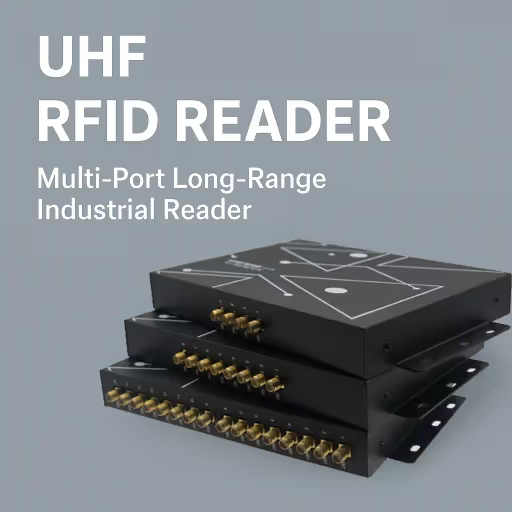
Fixed RFID Reader India and UHF 4-Port Reader Portals
Four-port readers for portals and lines

RFID Handheld Reader Software for AUTOID Mobile Terminals
Android app for seamless RFID data capture

NXP U9 Flexible Printable On-Metal RFID Label 80x40mm
1.0mm Flexible Foam On-Metal Smart Label with 6.5m Read Range for IT Assets & Metallic Surfaces
Frequently asked questions
What is the legal UHF RFID frequency range in India?
Is an individual wireless station license required to use RFID in India?
What is the maximum allowed transmit power for RFID readers in India?
How do I apply for WPC ETA certification for an RFID reader?
Can I use a US frequency (902–928 MHz) RFID reader in India?
How many carrier channels are available in the Indian 865–867 MHz band?
Discover more
You may also like
Hand-picked articles and pages worth your time next.

RFID Standards Guide India | WPC, GS1 & ISO 18000-6C
Complete guide to RFID standards in India: WPC 865-867 MHz notification GSR 564(E), GS1 SGTIN-96 encodings, ISO 18000-6C & HL7 healthcare protocols.
Fixed RFID Reader India and UHF 4-Port Reader Portals
Buy fixed RFID reader India models (865-867 MHz). High-performance 4 port UHF reader for dock doors and conveyor systems. Inquire online now.
RFID RSSI & Read Zones Explained: Signal Thresholds (-30 to -80 dBm) & Tuning Guide
Master RFID RSSI signal strength measurement, read zone tuning, and antenna power floors. Learn how to eliminate stray ghost reads with middleware filters.