
Comparison & Teardown
Active RFID vs Passive UHF RFID: Range, Battery Life, Tag Costs & Use Cases
Compare Active RFID (battery-powered, 100m range, ₹800+/tag) vs Passive UHF RFID (battery-free, 12m range, ₹3/tag). Find the right tracking tech for your ROI.

-
Battery vs RF Energy
Tag Power Source
Active tags have battery; Passive tags harvest RF power
-
100m+ vs 10–15m
Read Distance
Active reaches entire yards; Passive covers gates & aisles
-
₹800–2,500 vs ₹3.50–8
Tag Unit Cost
Passive tags cost 99% less for high-volume asset tracking
Operational Transformation: Manual Barcode Staging vs. Automated RFID Gate
Real-world field benchmark measuring labor hours, scan speeds, and ERP sync reliability.
Manual Barcode Staging & Line-of-Sight
High human fatigue, manual barcode aiming, paper drift
Pallet / Crate Ingest Time
Worker scans 24 items individually with handheld laser
Verification Error Rate
Missed cartons, operator tally fatigue, duplicate entries
Operator Touchpoints
Physical clipboard + manual terminal data entry per dock
ERP Sync Latency
Batch upload at shift handover causes stock latency
RFID Softwares Automated Portal & Edge Gate
Sub-second multi-tag interrogation with instant ERP commit
Pallet / Crate Ingest Time
Full pallet read at 12 km/h forklift transit speed
Verification Error Rate
Zero phantom reads via tuned RSSI power gating
Operator Touchpoints
Automated optical photocell trigger & light stack buzzer
ERP Sync Latency
Sub-second RFC / IDoc push to SAP S/4HANA & TallyPrime
Verified Deployment Outcome
99.3% Labor Time Cut • 100% Audit-Proof Physical-to-Digital ERP Traceability
At-a-Glance Comparison: Active vs. Passive RFID
The choice between Active RFID and Passive UHF RFID depends on asset value, required read distance, and tag economics:
- Passive UHF RFID (865–867 MHz): Tags have no internal battery. They harvest electromagnetic energy transmitted by the reader's antenna. Because passive tags cost just ₹3 to ₹8 each and have an indefinite lifespan, they are the undisputed choice for tracking millions of inventory SKUs, apparel, boxes, and library books.
- Active RFID (433 MHz / 2.4 GHz / BLE): Tags contain their own on-board battery and transmitter, continuously broadcasting beacon signals up to 100+ meters away. They are used for real-time location tracking (RTLS) of high-value equipment, shipping containers, and vehicles in open yards.
| Metric / Feature | Passive UHF RFID (RAIN) | Active RFID / BLE |
|---|---|---|
| Power Source | Internal Battery: ❌ None (RF energy harvesting) | Internal Battery: ✅ Yes (Lithium Coin/Pouch) |
| Tag Lifespan | Indefinite (20+ Years) — Zero maintenance | 3 to 7 Years (Requires battery swap or tag replacement) |
| Read Distance | Up to 10–15 meters (30–50 ft.) | Up to 100–300 meters (300–1,000 ft.) |
| Tag Unit Cost | ₹3.50 to ₹8.00 per label | ₹800 to ₹3,500+ per active beacon |
| Reader Cost | ₹55,000 to ₹1,50,000 per reader/portal | ₹25,000 to ₹85,000 per gateway/anchor |
| Best Application | High-volume retail, warehouse inventory, manufacturing WIP | Vehicle yard tracking, hospital crash carts, container ports |
Start with Passive UHF RFID: Enterprise Starter Kit (₹60,000)
For 95% of inventory and asset tracking applications, Passive UHF RFID delivers the optimal balance of range and ROI. Launch with our Enterprise RFID Starter Kit:
- 1x Chainway C72 UHF Handheld Scanner
- 1,000x NXP Ucode 9 Passive UHF Inlays
- 6 Months Cloud Inventory Software
Special Bundle Offer: ₹60,000 (Worth ₹96,000).
Looking for end-to-end multi-reader automation? Review our full suite of enterprise rfid software solutions.
Interactive RFID Engineering Tools & Calculators
Use our free interactive calculators and simulators to model RF physics, calculate link budgets, estimate ROI, and configure EPC tags.
EPC-96 Header & Serial Converter
Encode and decode SGTIN-96, SSCC-96, and GRAI-96 GS1 data structures to/from raw Hex and Binary EPC memory.
TID & Memory Bank Calculator
Inspect EPC Gen2 memory layouts (Reserved, EPC, TID, User memory) across Impinj, NXP, and Alien ICs.
RFID Tag Selection Wizard
Filter through on-metal, wet inlay, cryogenic, laundry, and apparel tags based on surface material and read distance.
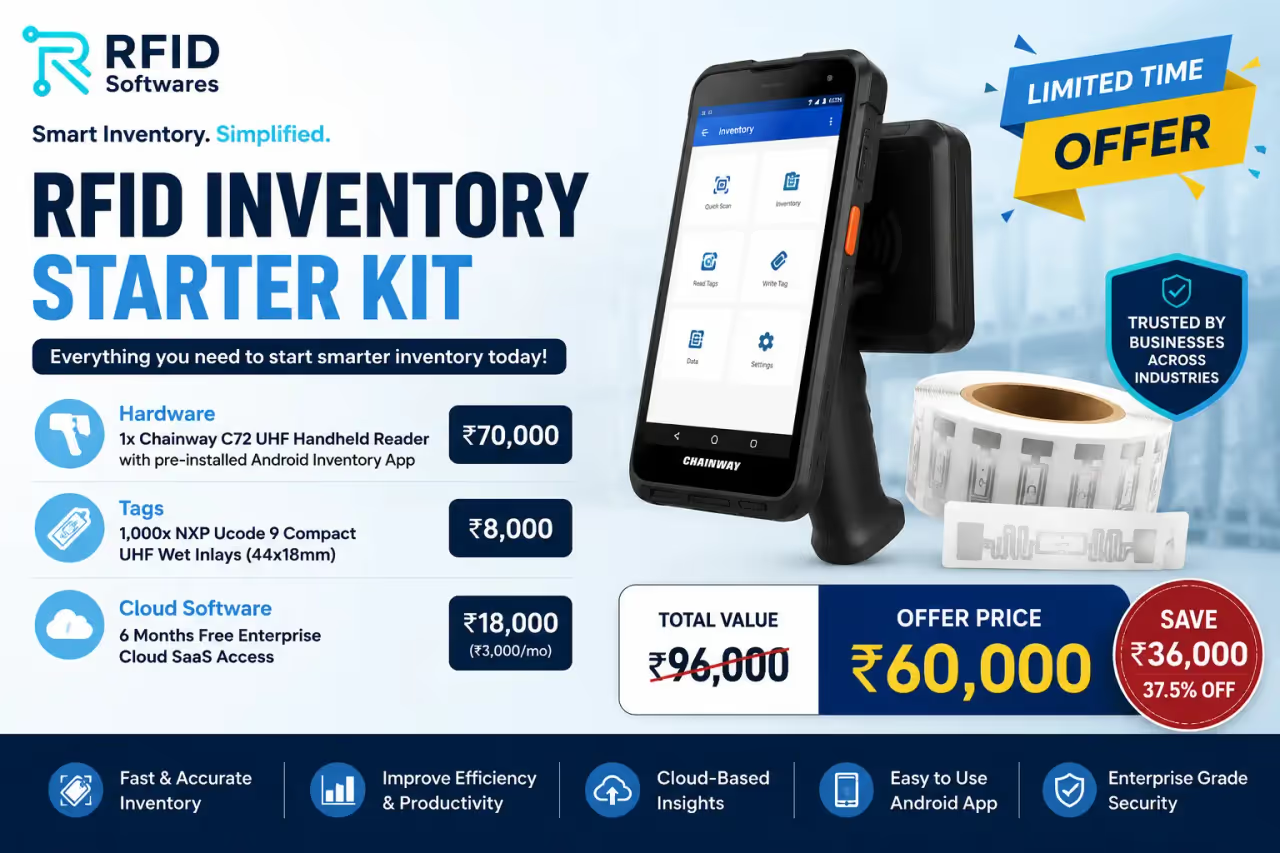
Enterprise RFID Starter Kit (POC Bundle)
Everything your warehouse, retail store, or factory needs to prove RFID feasibility. Complete with industrial hardware, certified tags, and 6 months of cloud platform access.
12–18m read range, IP65 rugged Octa-core Android terminal, 4GB/64GB, fast charger cradle. (C72 / Zebra upgrades available).
High-sensitivity EPC Gen2 inlays for cartons, totes, apparel, and asset tagging.
Real-time mobile sync, cycle counts, stock reconciliation, user roles, and CSV/Excel export.
Need a custom active rfid vs passive uhf rfid: range, battery life, tag costs & use cases deployment?
Every environment has distinct RF absorption and ERP sync constraints. Let's review your exact workflow and design an end-to-end blueprint.