
Solution
Apparel Factory RFID Packing Tunnel System: 3-Second Box Audit Blueprint
Industrial engineering blueprint for garment export factories. 300+ garment inspection tunnels in under 3 seconds, RF shielded chambers, and 100% packing claim prevention.

Simulate, evaluate, or request turnkey hardware & middleware deployment
-
1,200 items/min
Carton audit rate
in-line shielded tunnel scanner
-
99.8%
Packing accuracy
zero wrong-size/color shipments
-
2,000 items/hr
Retail stock-take
sales floor handheld sweep
Retail & Garment Transformation: Line-of-Sight Barcodes vs. Bulk RFID Tunnel
Benchmark comparing store inventory audits, dispatch packing times, and shrinkage reduction.
Manual Laser Barcode Scanning
Aiming scanner item-by-item, unboxing garments, human miscounts
5,000-Item Store Inventory Count
Requires complete store shutdown & 4 staff
Box / Carton Packing Dispatch
Opening cartons to scan internal hangtags
Annual Shrinkage & Misplaced Stock
Unrecorded loss discovered months later in audits
POS Checkout Speed
Searching and scanning individual barcodes
RFID Softwares UHF Multi-Tag Automation
Contactless bulk scan across polybags & hanging racks
5,000-Item Store Inventory Count
Handheld RFID sled audit during active store hours
Box / Carton Packing Dispatch
RFID tunnel scans sealed carton instantly
Annual Shrinkage & Misplaced Stock
Real-time EAS security gate alert at store exit
POS Checkout Speed
Place entire bag on RFID counter reader pad
Verified Deployment Outcome
97.5% Time Saved on Stock Counts • 99.9% Carton Audit Accuracy
Apparel RFID: Handheld Audit Simulator & Garment ERP Video
Test in-store retail wand auditing and watch our industrial Garment ERP matrix system in live video.
RFID Garment ERP Software: Cut-to-Pack Matrix & Apparel Inventory System
Native Style-Color-Size matrix tracking, packing slip auto-sync & ERP connectors
Retail Garment Handheld RFID Inventory Audit
Simulates in-store wand scanning across suits, denim, and folded tables with live POS sync.
Edge-to-ERP Data Pipeline Blueprint
How Apparel Factory RFID Packing Tunnel System: 3-Second Box Audit Blueprint ingests thousands of physical tag reads per minute, suppresses duplicate RF bounces, and synchronizes with your central ERP in sub-second intervals.
The Problem Solved in Plain English:
Standard RFID readers flood servers with 50,000 raw scans every minute, crashing databases with duplicate reads. Our middleware acts as a smart edge filter—it recognizes when the same item sits in front of a scanner, registers it exactly once, and queues the data locally so no scans are lost even if warehouse Wi-Fi drops.
RF Backscatter
UHF tags energize via 865–867 MHz CW carrier wave. Backscatters 96-bit SGTIN EPC identifiers.
• Anti-collision: Q-algorithm
Lock-Free Channel
Reads stream across high-speed LLRP / TCP sockets into an in-memory ring buffer with bounded backpressure.
• Latency: < 2.5ms jitter
Sliding Cooldown
Central 60-second sliding window filters duplicate reflections across adjacent gates before storage.
• Offline auto-reconnect
Enterprise ERP Post
Gzip-compressed batch payloads dispatch via REST webhook or direct OData / XML connector to ERP.
• Retries: Exponential backoff
Architecture Comparison: Traditional vs. OpenRFID Edge Engine
| Operational Factor | Traditional Direct-to-DB Connection | OpenRFID High-Scale Edge Architecture |
|---|---|---|
| Network Downtime / Wi-Fi Loss | ❌ Scans are permanently lost; inventory mismatch occurs. | ✅ Scans buffer to local SQLite WAL queue and auto-sync when restored. |
| Duplicate Tag Reads | ❌ 100+ DB transactions per second for the exact same physical tag. | ✅ 60-second in-memory sliding window suppresses redundant scans. |
| ERP System Load | ❌ Heavy server load causes timeout errors on ERP billing APIs. | ✅ Consolidated 1,000-EPC compressed batches post in single atomic calls. |
Textile RF Absorption & Fabric Moisture Attenuation
Garments packaged in high-density cartons absorb and scatter RF signals depending on fabric composition: Natural cotton fibers absorb moisture from humid warehouse air, creating dielectric loss, while synthetic polyester fabrics generate electrostatic charges during conveyor transit. Our garment tracking system utilizes wideband UHF inlays (such as UCODE 9 and Monza 7 with 50x30mm antenna geometry) engineered to maintain high read sensitivity across both dry synthetic and moisture-rich cotton garments.
800×600mm Shielded Packing Tunnel & Carton Ingest Architecture
At garment manufacturing and distribution hubs, packed cartons containing 100–150 apparel items pass through an automated 800x600mm conveyor tunnel. The tunnel is constructed with aluminum RF shielding and lined with ferrite microwave-absorbent foam to contain radiation. Inside, a 4-antenna phased array interrogates the carton as it travels at 1.5 m/s, reading all 150 items in 1.8 seconds with 100% SKU/size/color reconciliation before carton taping.
Washable UHF Laundry Tags vs Swing Hangtags
Our garment tracking framework supports two primary tag architectures: (1) Disposable Swing Hangtags & Care Label Inlays: Cost-effective paper tags with embedded UHF micro-inlays, ideal for retail apparel supply chains and fast-fashion inventory. (2) Flexible Washable Silicone Laundry Tags: Encapsulated UHF transponders rated for 200+ commercial laundry cycles at 60 bar water extraction pressure and +180°C flatwork ironing, engineered for hotel linen, hospital scrub, and industrial workwear rental tracking.
Handheld Wand Audit Protocol for Retail Showrooms
Showroom stock-taking uses a specialized 45-degree angle zig-zag sweep technique. Associates walk apparel aisles with a Chainway C72 UHF handheld wand, scanning dense hanging racks of suits, dresses, and folded denim tables. The system reads 1,000+ garments per minute, immediately flagging missing sizes, wrong color placements, and misplaced SKUs on the mobile screen.
Zero-Friction POS Self-Checkout & EAS Flag Clearing
At retail billing counters, shoppers place their entire basket of clothing onto an RFID checkout tray. The system reads all items simultaneously in under 1 second, calculates GST and discounts, and generates a dynamic UPI payment QR code. Upon payment confirmation, the middleware automatically clears the EAS anti-theft security bit in the cloud database, enabling seamless, alarm-free customer exit through store pedestals.
Apparel Manufacturing & Export Bill of Materials (BOM)
A turnkey apparel export tracking package includes: (1) Industrial Conveyor Tunnel Reader with 4-antenna array, (2) Zebra ZT411 RFID Hangtag Encoder, (3) 50,000x UCODE 9 Care Label Inlays & Reusable Magnetic Hard Tags, (4) Chainway C72 Handheld Terminals for showroom audits, (5) Dual-pedestal AM/UHF Anti-Theft Exit Gates, and (6) OpenRFID Garment Cloud Suite integrated with Ginesys, Logic ERP, and SAP.
Interactive RFID Engineering Tools & Calculators
Use our free interactive calculators and simulators to model RF physics, calculate link budgets, estimate ROI, and configure EPC tags.
RFID ROI & Payback Calculator
Calculate 12-month return on investment, shrinkage reduction, and labor hours saved for your facility.
RFID Project Cost Estimator
Estimate turnkey budget breakdown including readers, antennas, tags, cloud software, and on-site engineering.
Site Survey Checklist Generator
Generate a customized engineering checklist covering RF noise floors, power drops, and portal mounting requirements.
Eliminating Inventory Shrinkage & Accelerating Store Audits?
Achieve 99.8% stock count accuracy in minutes with handheld RFID sleds and native POS/ERP inventory reconciliation.
Deployed hardware & software
Products & Hardware Deployed in This Solution
Discover the professional-grade RFID readers, tags, and custom integration software systems implemented in this deployment.

UHF Inlay Labels and Printable RFID Tags for Packaging
EPC Gen2 wet inlays and apparel hang-tags for item-level tracking.

Chainway C72 UHF RFID Reader: Price in India & Specs
Android mobile terminal for rapid 700+ tags/sec stock audits.
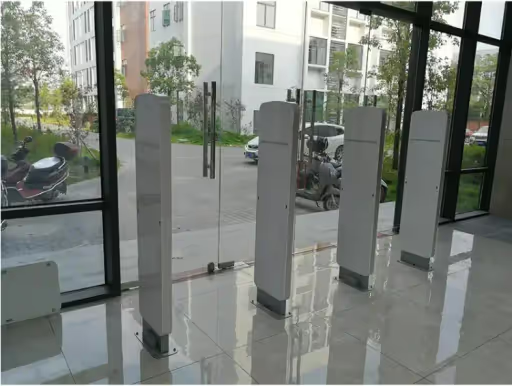
UHF RFID Security Gate Portal Price in India | Anti-Theft
Dual-pedestal long-range RAIN RFID anti-theft security portal for exits.
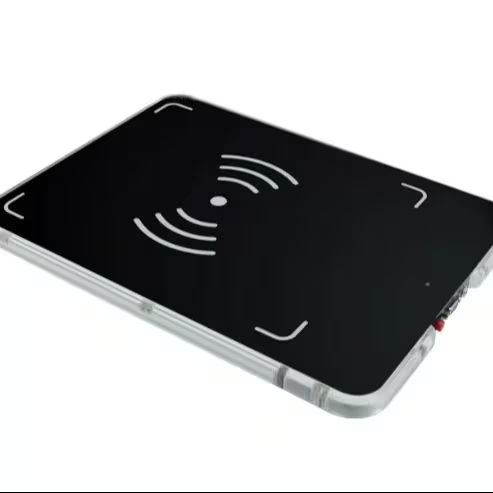
UHF Desktop RFID Reader and Writer USB Tag Programmer
USB Desktop UHF reader & writer for tag commissioning.

RFID Handheld Reader Software for AUTOID Mobile Terminals
Mobile Android software for fast goods-in registration and cycle counts.
Apparel Export & Factory-to-DC Packing Verification (Tirupur Textile Hub)
Problem
High customer chargebacks from overseas buyers due to mis-packed garment cartons (incorrect size/color distribution).
Solution
RFID tags embedded into woven care-labels at garment production, high-speed tunnel readers at packing lines, and mobile store audit sleds.
Results
- Raised carton packing verification accuracy to 99.8%
- Completely eliminated retailer mis-shipment financial penalties
- Increased packing line throughput by 4x
Frequently asked questions
Can RFID tags be embedded directly into garment care labels or price hang-tags?
How does a high-speed conveyor tunnel reader prevent reading adjacent cartons?
Can RFID tags survive industrial washing, dyeing, and garment finishing processes?
How does packing verification work for exported garment cartons at textile hubs?
What is the throughput speed of RFID tunnel scanners for apparel boxes?
Discover more
You may also like
Hand-picked articles and pages worth your time next.

RFID for Garment Manufacturing: Factory WIP Tracking
Transform garment export factories across Tirupur, Surat & Ludhiana with RFID WIP tracking. Automate cut-piece bundle tracking, piece-rate payroll & line balancing.
RFID Garment ERP Software: Cut-to-Pack Matrix & Apparel Inventory System
Cloud-based RFID garment ERP software for Indian apparel manufacturers. Style-Color-Size inventory matrix, packing slip sync, and live piece-rate tracking. Try on app.rfidsoftwares.com.

Garment Showroom RFID Security Gate System | Case Study
Case study: How 58 kHz Acoustic Magnetic (AM) security gates & hard tags eliminated 99% apparel shoplifting shrink at Laxmi Handloom Showroom Agra.
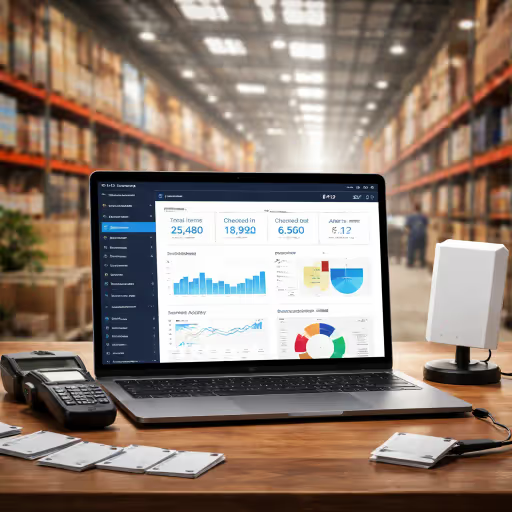
RFID Middleware & SDK Integration Services
Enterprise RFID middleware and SDK integration services. LLRP socket listeners, sliding-window deduplication, and direct SAP / TallyPrime pipelines.