
What is RFID? Full Form, Working Principles & Global Industry Guide (2026)
The RFID full form is Radio Frequency Identification. In simple terms, RFID means an automated wireless identification and data capture (AIDC) technology that uses electromagnetic radio waves (spanning LF, HF, UHF, and Microwave spectrums) to wirelessly identify, track, and transfer digital identity codes from a microchip tag (transponder) to an interrogator reader without requiring direct line-of-sight optical scanning.
Master Video: Complete RFID Architecture & Modulated Backscatter Pipeline
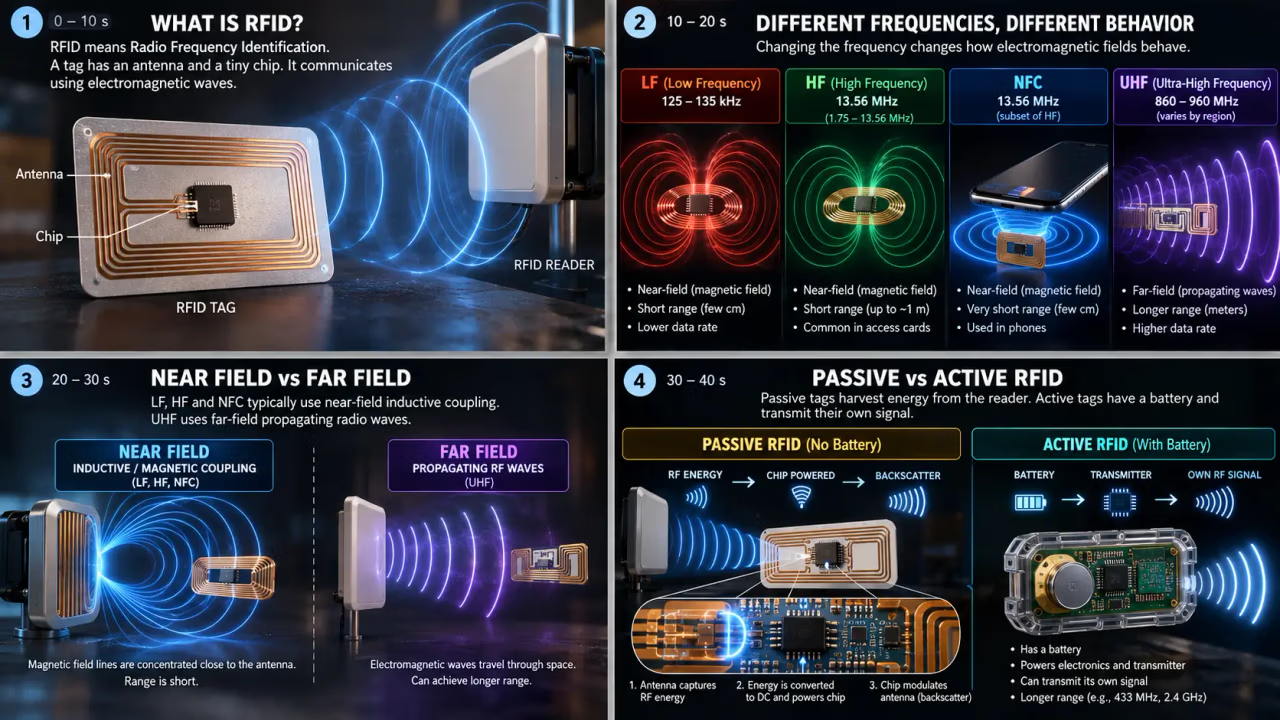
Watch how reader interrogators emit electromagnetic RF carrier waves that energize battery-free passive smart labels and stream live EPC inventory bursts into enterprise ERP databases.
Electromagnetic Physics
How Does RFID Work? Inductive Coupling vs. Radiative Backscatter
The scientific principles governing how radio frequency energy powers passive tags and transfers data through free space.
To understand how RFID works in real-world industrial environments, we must examine the physical interaction between three foundational components: an interrogator (reader), an antenna, and a transponder (tag). Unlike optical barcodes that require direct line-of-sight laser scanning, passive RFID works through electromagnetic field excitation.
1 Near-Field Inductive Coupling (LF & HF Bands)
Operating at 125 kHz (LF) and 13.56 MHz (HF/NFC), near-field systems rely strictly on Faraday's Law of Electromagnetic Induction. The reader antenna coil generates a localized magnetic field ($B$-field). When the tag's internal wire coil enters this magnetic flux, a voltage is induced across the tag microchip, powering its logic gates and transmitting its UID back by modulating the load impedance on the coil.
2 Far-Field Radiative Backscattering (UHF & Microwave)
Operating at 860–960 MHz (UHF RAIN) and 2.45/5.8 GHz, systems propagate true electromagnetic radiation ($E$-field). The reader transmits an electromagnetic carrier wave into free space. The tag antenna collects a portion of this RF power via the Friis Transmission Formula:
The tag chip rapidly switches its antenna input impedance ($\Delta Z$) between matched and mismatched states, reflecting a tiny modulated fraction of the wave back to the reader—known as modulated backscatter.
Electromagnetic Physics Demonstration: Near-Field Magnetic Flux vs Far-Field Transverse Waves

Visualizing magnetic flux loops ($H$-field) in near-field inductive coupling versus transverse electromagnetic waves ($E$-field) in UHF modulated backscattering.
Interactive Tool
What are the Different RFID Frequency Bands? (LF, HF, UHF, Active & Microwave)
Select any frequency band to visualize read range telemetry, physical coupling mechanisms, water/metal penetration immunity, and global regulatory compliance.
Ultra-High Frequency (UHF RAIN: 860 MHz – 960 MHz)
Far-field radiative modulated backscatter operating under the global GS1 EPC Gen2 standard. The global workhorse for supply chain logistics and retail apparel.
- • Coupling Mechanism: Radiative transverse electromagnetic backscatter ($E$-field).
- • Primary Standards: GS1 EPCglobal Gen2 v2 / ISO/IEC 18000-63.
- • Indian WPC Band: 865.0 – 867.0 MHz de-licensed up to 4 Watts EIRP.
- • Primary Deployments: FASTag highway tolling, warehouse pallet portals, retail apparel tracking.
Understanding how wavelength changes from 2.4 km (LF) down to 33 cm (UHF) and affects antenna sizing.
Global UHF RFID Regulatory Frequency Bands
| Country / Region | Frequency Range | Regulatory Body | Max Power |
|---|---|---|---|
| 🇮🇳 India | 865.0 – 867.0 MHz | WPC (De-licensed) | 4 Watts EIRP |
| 🇺🇸 United States (FCC) | 902.0 – 928.0 MHz | FCC Part 15 | 4 Watts EIRP (FHSS) |
| 🇪🇺 Europe (ETSI) | 865.6–867.6 & 915–921 MHz | ETSI EN 302 208 | 2W to 4W ERP |
| 🇨🇳 China | 920.5 – 924.5 MHz | SRRC Standard | 2 Watts ERP |
| 🇯🇵 Japan | 916.8 – 920.8 MHz | MIC (Telecommunications) | 4 Watts EIRP (LBT) |
| 🇦🇺 Australia & NZ | 920.0 – 926.0 MHz | ACMA Standard | 4 Watts EIRP |
RF Engineering Truth
What Factors Affect RFID Read Range & Signal Attenuation?
Understanding dielectric permittivity, metal reflection, and antenna polarization losses in real-world industrial deployments.
Liquid & Moisture Absorption
Water has an exceptionally high relative permittivity ($\epsilon_r \approx 80$). At UHF frequencies (865 MHz), water molecules undergo molecular dipole resonance, absorbing electromagnetic energy and converting it into thermal micro-losses, attenuating the read range.
Metal Boundary Reflection
Metals act as electromagnetic mirrors. When incident RF waves strike conductive steel or aluminum, they induce circular eddy currents that generate an opposing electromagnetic field shifted by 180°, completely cancelling the dipole antenna's impedance.
Antenna Polarization Alignment
Linear antennas require the tag to align along the same plane (vertical or horizontal). A 90° cross-polarization misalignment causes over 20 dB signal loss (complete blackout). Circular polarized antennas rotate the $E$-field, sacrificing 3 dB for 360° orientation freedom.
Hardware Anatomy
What are the Different Types of RFID Tags? (Passive vs. Active & Inlay Anatomy)
Comparing passive energy-harvesting tags against active beacons, along with the physical manufacturing layers of smart labels.
Active vs. Passive RFID: Power Source Architecture
Passive tags use zero batteries and operate indefinitely by harvesting RF energy. Active tags contain an internal lithium battery (3–8 yr lifespan) and continuously broadcast autonomous telemetry packets over 100+ meters.
Physical Tag Construction: Antenna & Silicon Microchip
An RFID inlay comprises five microscopic layers: PET Substrate Base, Etched Aluminum Antenna, Silicon Die (Microchip) attached via conductive epoxy flip-chip bonding, Pressure Sensitive Adhesive (PSA), and a siliconized release liner.
Bare PET roll with antenna + chip without adhesive backing. Sold in master rolls to label converters.
Adhesive-backed printable smart labels formatted for thermal barcode printers (Zebra, SATO).
Rugged FR4 PCB or Ceramic tags with magnetic ground-plane spacers for shipping containers and IT servers.
Flexible waterproof tags withstanding 200°C commercial drying and 60 Bar water extraction presses for hospital linen.
Global Technical Standards & Peer-Reviewed Specifications
Our engineering solutions adhere to strict academic and telecommunication standards recognized globally:
- ✔ GS1 EPC Tag Data Standard (TDS) & EPC Gen2 v2 (ISO/IEC 18000-63): Mandates memory bank structure (Reserved, EPC, TID, User Memory) and SGTIN-96 serialization.
- ✔ ISO/IEC 14443 & 15693: International standards for proximity (13.56 MHz, 10cm) and vicinity (1.5m) smart cards and library book tracking.
- ✔ IEEE Journal of Radio Frequency Identification: Peer-reviewed citations for microwave beamforming and non-line-of-sight backscattering algorithms.
- ✔ Government of India WPC Gazette Notification: Official de-licensing of 865.0 to 867.0 MHz band for Indian commercial operations.
Market Intelligence
What is the Current RFID Market Size and Projected Growth (2024–2032)?
Economic trajectory, adoption catalysts, and sector revenue distribution across the worldwide RFID ecosystem.
Global RFID Market Forecast & Inlay Volume Trajectory
Projections synthesized from GS1, IDTechEx, ABI Research, and enterprise regulatory mandates.
Adoption Share by Industry Vertical:
Enterprise Validation
Real-World RFID Deployments: Proven Case Studies & Measurable ROI
How world-class enterprises reduced audit time by 90% and achieved 99.8% inventory accuracy with RFID.
Inditex (Zara) Inventory Accuracy
Implemented item-level UHF RAIN tags on garments inside hard alarm tags. Stock counts that previously took 3 days with manual barcodes now take under 2 hours per store.
Delta Air Lines Baggage Tracking
Replaced optical laser baggage barcode scanners with RFID inlays in bag tags across 344 airports, streaming real-time tracking directly to passengers' mobile apps.
Indian National Highway FASTag
Equipped 98%+ of passenger and freight commercial vehicles with tamper-evident ceramic windshield UHF RFID tags, enabling automatic barrier debits at toll plazas.
Engineering Suite
Interactive RFID Engineering Tools, 3D Simulators & Hardware Gateway
Experiment with link budgets online or deploy verified enterprise hardware with our open-source middleware.
UHF Link Budget & Read Range
Adjust Reader Tx Power (dBm), Cable Loss, and Tag Sensitivity (-24 dBm) with live calculated range readouts.
EPC / TID Memory Bit Splitter
Convert hexadecimal EPC tags to decimal serial numbers and inspect GS1 SGTIN-96 filter values in real-time.
Full OpenRFID Warehouse Simulator
Simulate moving conveyors, pallet dock doors, tag collisions, and keyboard wedge serial emission.
Featured Industrial Hardware Compatible with Our Middleware
Factory-direct pricing, ready India WPC compliance, and native developer SDKs.
Got Questions?
Frequently Asked Questions About RFID
Clear, expert engineering answers to the most common questions about RFID technology, pricing, and system deployment.
Want a 60-Second Plain-English Summary of RFID?
Think of RFID like a supercharged wireless digital barcode. Instead of aiming a red laser line at every single sticker one by one, an RFID reader broadcasts invisible radio waves that energize hundreds of battery-free microchip tags hidden inside cartons, pallets, or clothes simultaneously — reading up to 1,200 items in a single second without opening any boxes!
What is the full form of RFID, and what does RFID mean?
How does an RFID tag get power if it has no battery?
What is the fundamental difference between RFID and Barcode?
Can RFID radio waves penetrate through water, liquid, and human body tissue?
Why do regular RFID tags fail when applied directly to metal surfaces?
What is the de-licensed and legal RFID frequency in India?
Can RFID tags be tracked by satellites or global GPS?
What is the typical read range of UHF RFID readers?
Is RFID technology safe for humans and pacemaker medical devices?
How do you connect an RFID reader to enterprise SAP or Tally ERP systems?
BAPI_GOODSMVT_CREATE), or Tally XML HTTP vouchers directly to the ERP database.Have a Specific Hardware or Frequency Question?
Our engineering team assists with on-site frequency surveys, antenna beam mapping, and ERP middleware integration.