
RFID Frequency Bands Compared: LF, HF, UHF, Microwave & Active Systems
An exhaustive engineering breakdown of the radio frequency identification spectrum. Compare near-field inductive coupling versus radiative far-field backscatter, dielectric absorption in liquids, eddy currents in metals, and global regulatory mandates across India (WPC 865–867 MHz), the United States (FCC), and Europe (ETSI).
RFID frequency bands are classified into five operating ranges: Low Frequency (LF: 125–134.2 kHz) for animal & liquid penetration; High Frequency (HF/NFC: 13.56 MHz) for secure tap payments & access cards; Ultra-High Frequency (UHF: 860–960 MHz RAIN) for bulk pallet & retail supply chain tracking up to 15m; Microwave (2.45/5.8 GHz) for high-speed tolling; and Active RFID (433 MHz/2.4 GHz) for battery-assisted 100m+ yard telemetry.
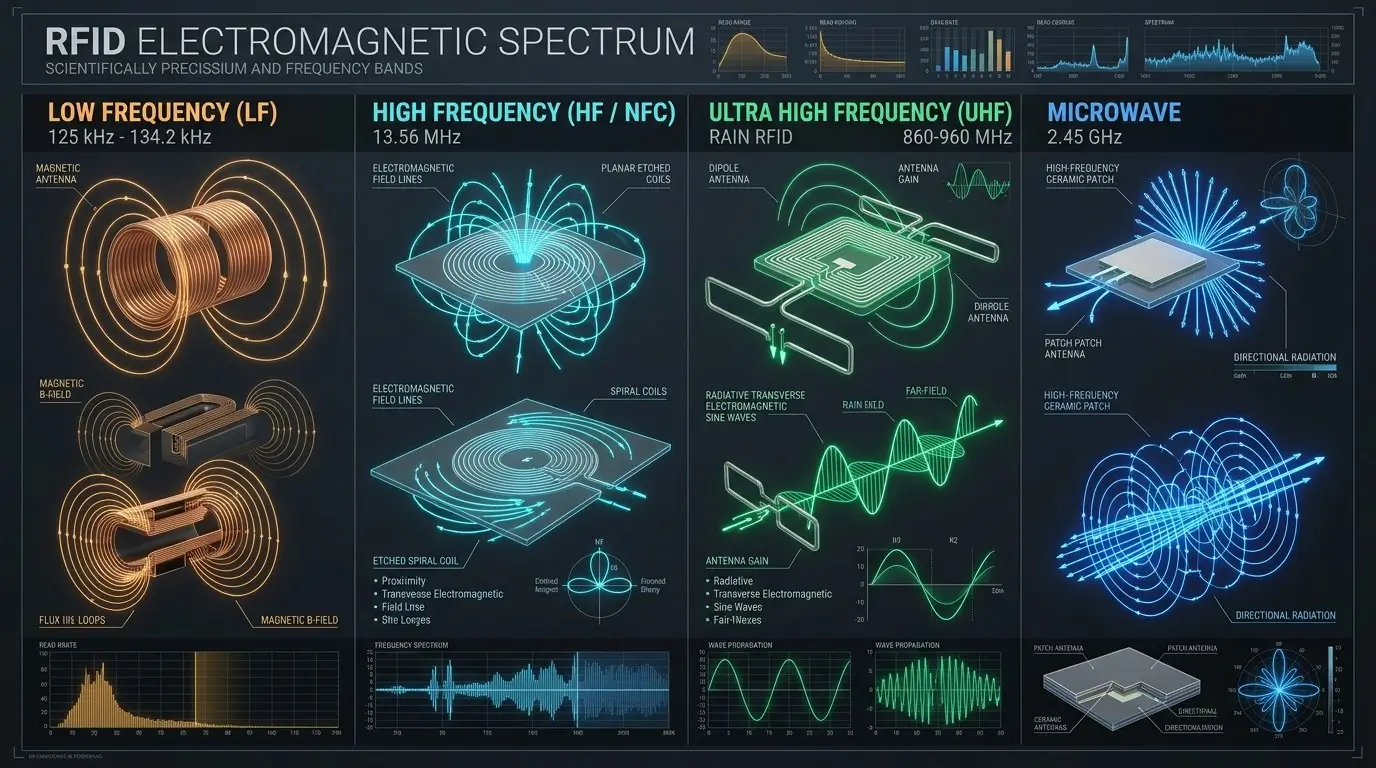
Electromagnetic Field Visualization
Visual demonstration of magnetic B-field induction loops in LF/HF versus oscillating transverse electric waves in UHF Gen2.
Comprehensive RFID Frequency Band Comparison Matrix
Parametric engineering specifications across wavelength, physical coupling, data transmission rate, and material tolerance.
| Frequency Band | Frequency Range | Wavelength (λ) | Typical Read Range | Coupling Physics | Liquid / Water Tolerance | Metal Tolerance | Governing Standards |
|---|---|---|---|---|---|---|---|
| Low Frequency (LF) | 125 – 134.2 kHz | ~2,400 meters | 1 cm to 10 cm | Near-Field Magnetic Inductive ($B$-field) | Immune (Passes through) | High (Thin metal permeable) | ISO 11784/11785, ISO 18000-2 |
| High Frequency (HF / NFC) | 13.56 MHz ± 7 kHz | 22.12 meters | 2 cm to 1 meter (Gates) | Resonant Magnetic Induction ($B$-field) | High (Minor attenuation) | Moderate (Requires Ferrite Sheet) | ISO 14443 A/B, ISO 15693, NFC |
| Ultra-High Frequency (UHF RAIN) | 860 – 960 MHz | 31.2 – 34.7 cm | Up to 12 – 15 meters | Far-Field Radiative Backscatter ($E$-field) | Severe Dielectric Loss (25 dB/m) | Blocked (Requires Standoff Tag) | ISO 18000-63, GS1 EPC Gen2v2 |
| Microwave RFID | 2.45 GHz & 5.8 GHz | 12.2 cm & 5.1 cm | 2 meters to 10 meters | Directional Microwave Beamforming | High Absorption (Resonance) | Severe Reflection | ISO 18000-4, IEEE 802.11, DSRC |
| Active RFID | 433.92 MHz & 2.4 GHz | 69 cm & 12.2 cm | 50 to 100+ meters | Battery-Powered Continuous Transmitter | Moderate | Moderate (Antenna standoff) | ISO 18000-7, DASH7, RTLS |
RFID Frequency Bands Benchmark & Regulatory Suite
Simulate real electromagnetic attenuation through matter, inspect legal WPC/FCC power limits, or run the Decision Wizard to identify the exact RFID band for your industrial workflow.
Electrolyte liquid and biological water with high dielectric loss and ionic conductivity. (Conductivity: 1.5 S/m, Relative Permittivity: 78)
Calculated Signal Attenuation & Readability Through Saline / Liquid / Beverage (5 cm)
Inductive Magnetic Flux ($B$-Field). Passes through water and living tissue without dielectric relaxation.
Resonant Magnetic Induction. High liquid immunity; requires ferrite backing on metal surfaces.
Radiative Far-Field Backscatter. Maximum read range (12m+), but absorbs heavily in water and reflects off metal.
Directional Microwave Beamforming. Highest data rates, but severe liquid absorption (microwave resonance zone).
In-Depth Engineering Guides by Frequency Band
Access dedicated protocol specifications, antenna geometry designs, RF hardware pinouts, and SDK drivers for each specific RFID band.
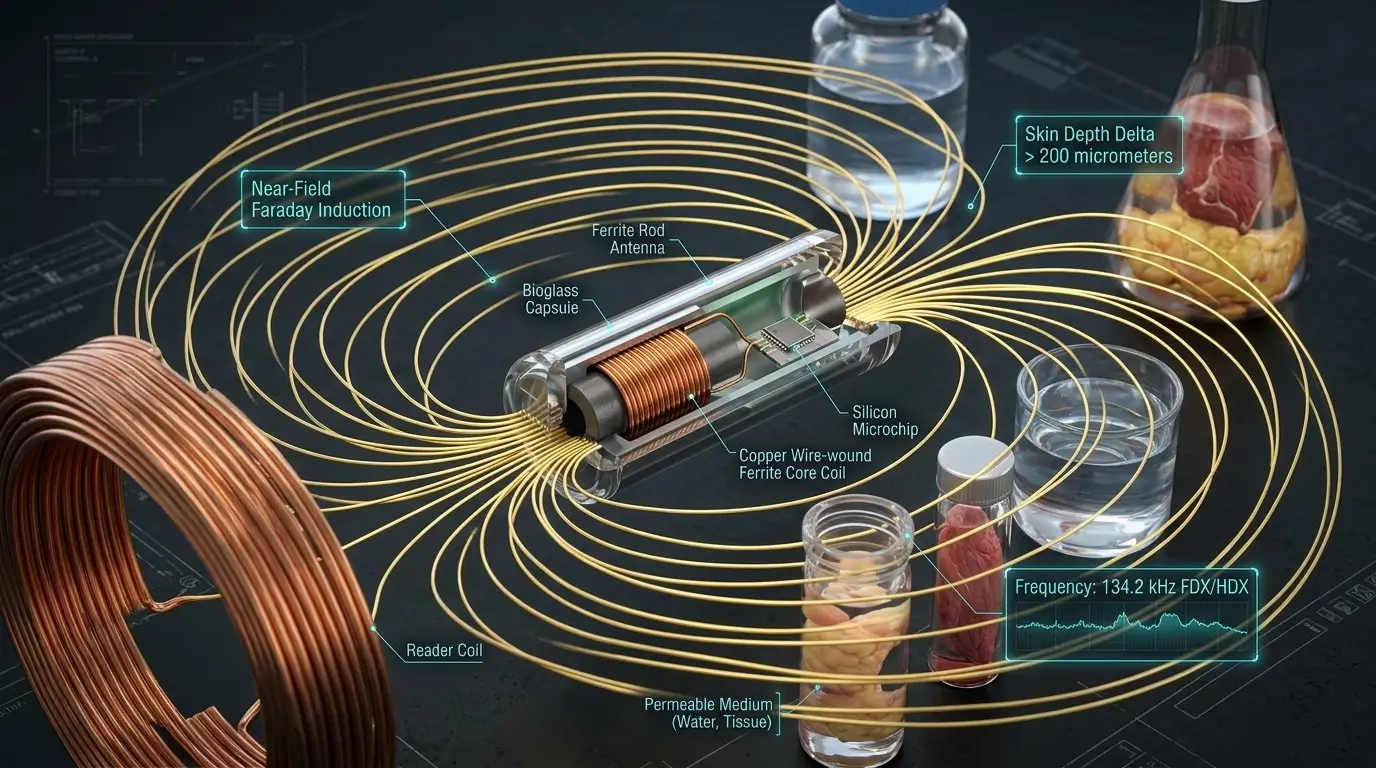
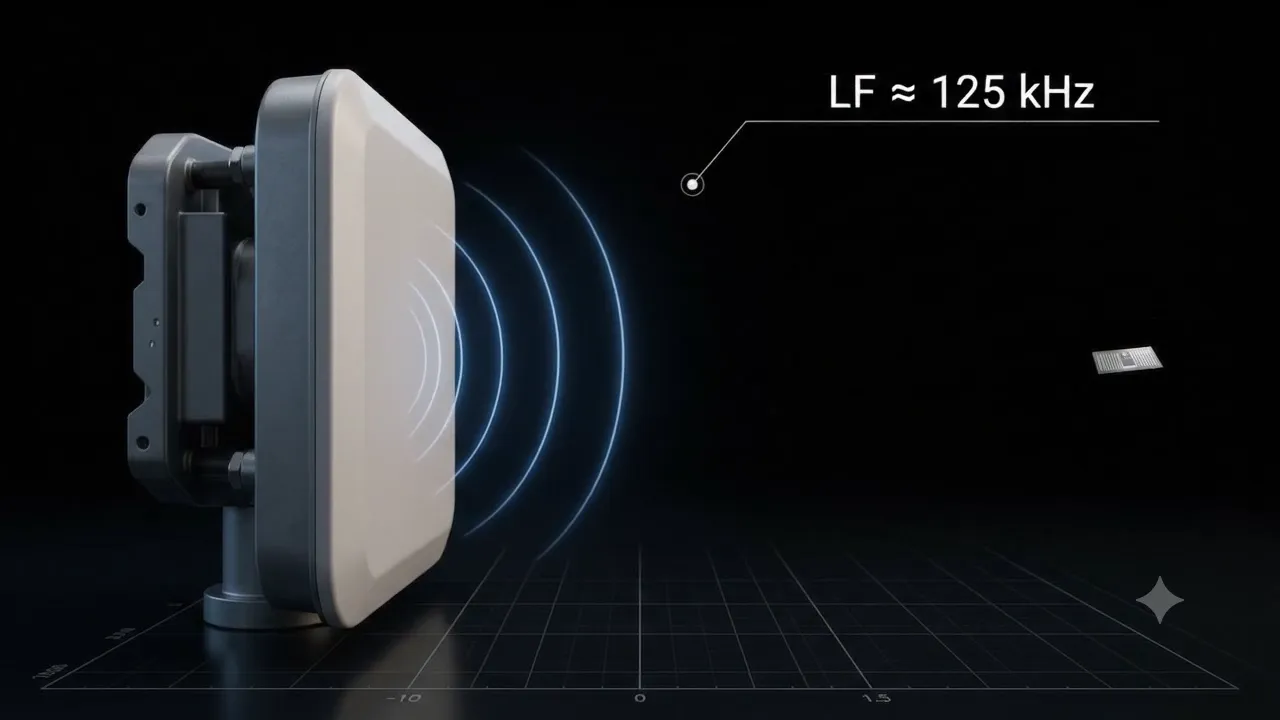
Low Frequency (LF 125 kHz) Guide: Inductive Coupling & Animal Implants
ISO 11784/11785 livestock tracking standards, FDX vs HDX modulation, bioglass capsule anatomy, and why LF passes through fluids where UHF fails completely.
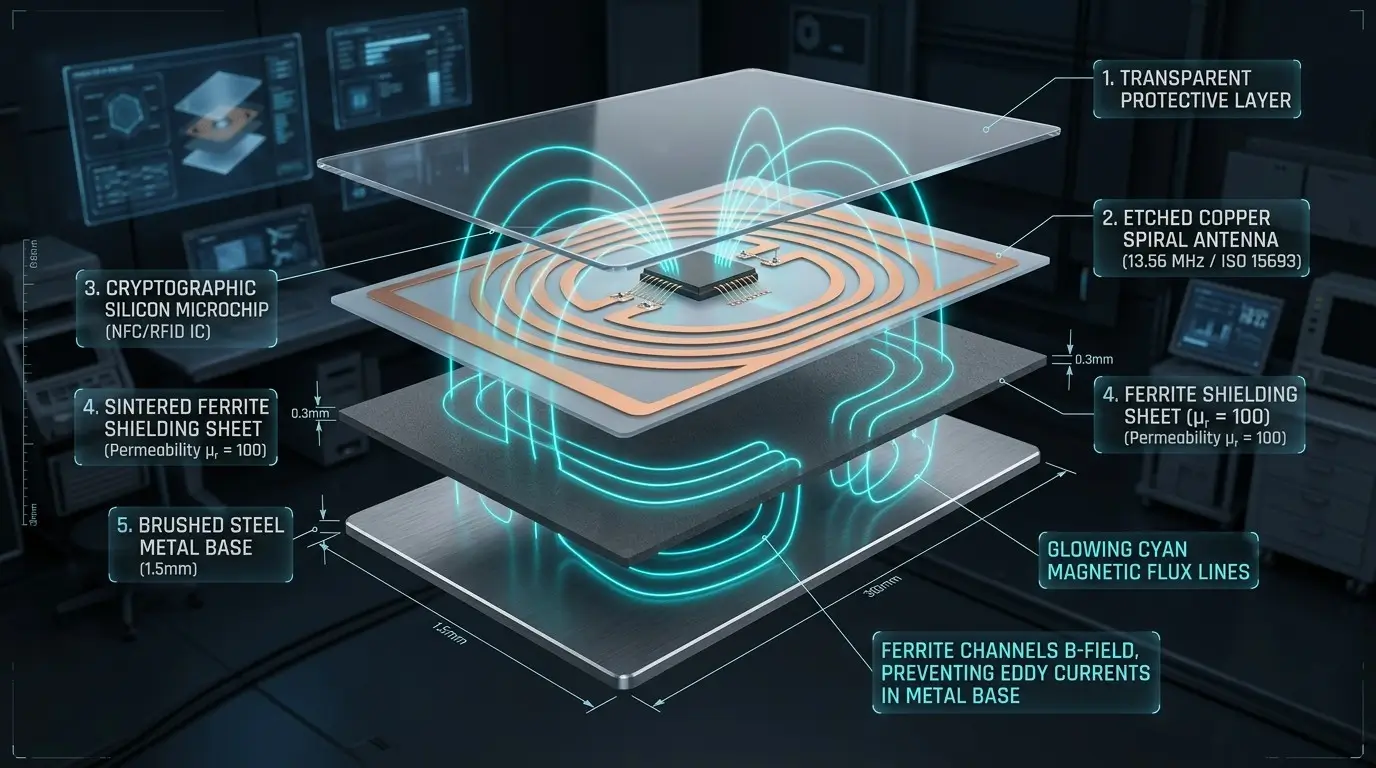
High Frequency (HF 13.56 MHz) & NFC: Smart Cards & Cryptography
ISO 14443 Type A/B versus ISO 15693 vicinity standards, NFC Forum Type 1–5 specifications, Mifare Classic vs DESFire EV3 crypto, and anti-metal ferrite shielding sheets.
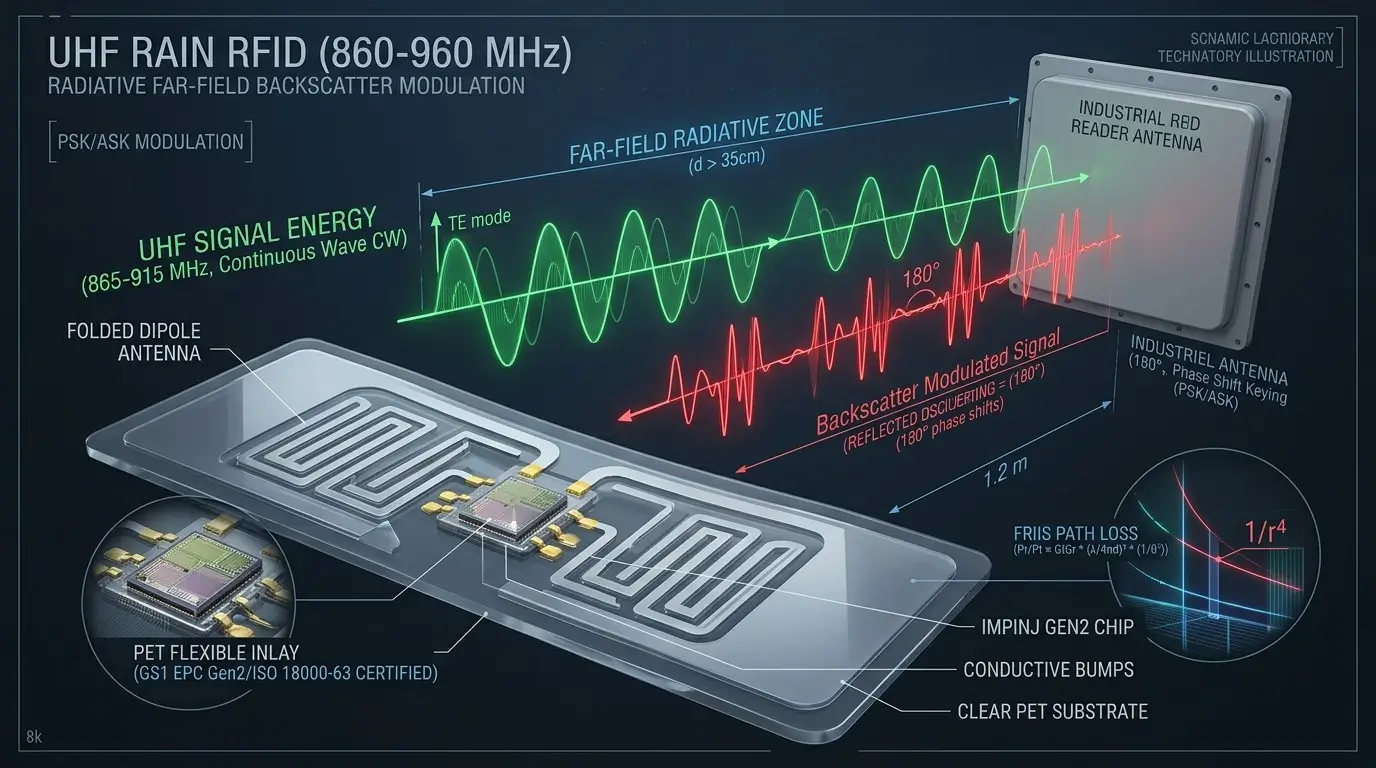
UHF RAIN RFID (860–960 MHz): Gen2 Radiative Backscatter & WPC
India WPC 865–867 MHz de-licensing rules (G.S.R. 564(E)), FCC Part 15 FHSS, Impinj Monza R6 & NXP UCODE 9 silicon chips, Friis path loss math, and high-speed multi-tag reading.
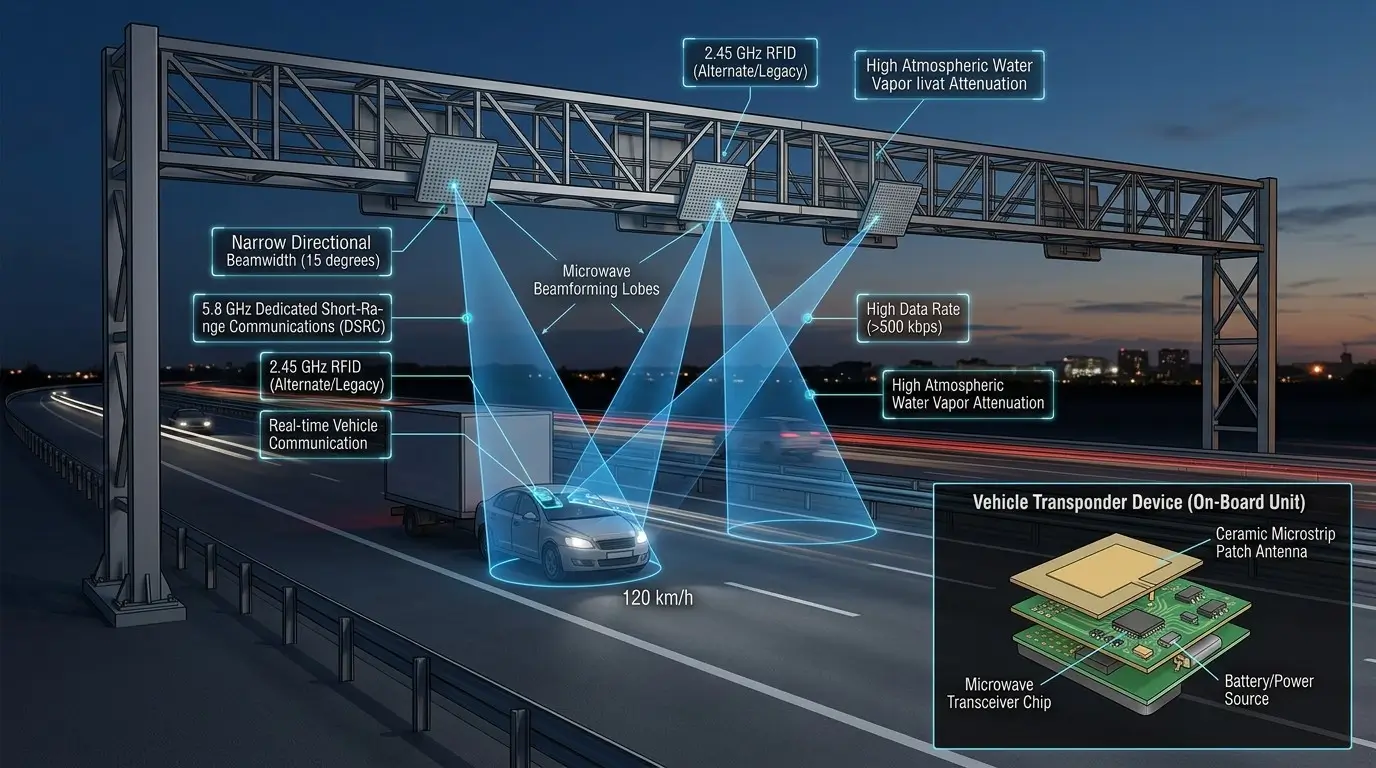
Microwave RFID (2.45 GHz & 5.8 GHz): High-Speed Electronic Tolling
Dedicated Short-Range Communications (DSRC), Multi-Lane Free-Flow (MLFF) highway gantries, narrow beamforming cones, and high data rate transmission specs.
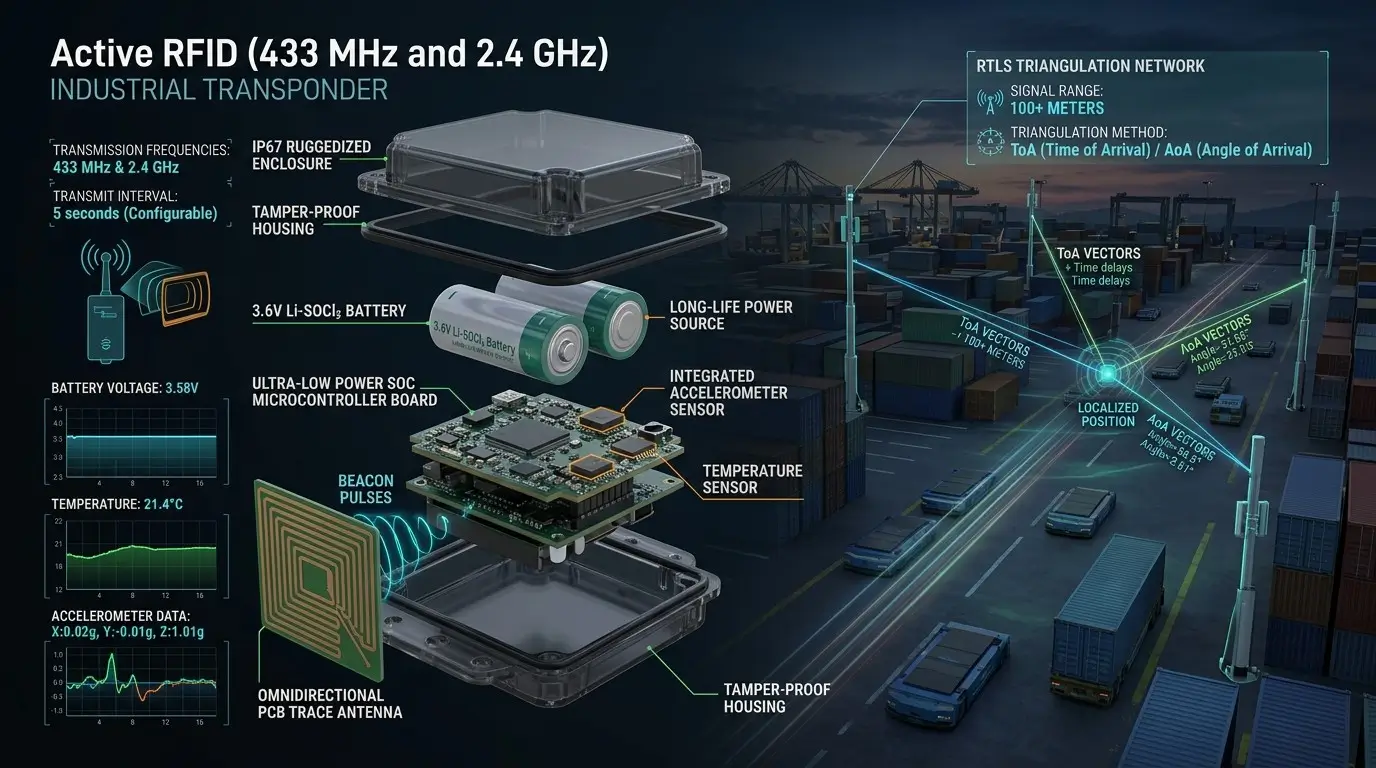
Active RFID (433 MHz & 2.4 GHz): RTLS Yard Tracking & Battery Beacons
ISO 18000-7 transponders, battery life calculations with Li-SOCl2 chemistry, Time-of-Arrival (ToA) and Angle-of-Arrival (AoA) triangulation across outdoor depot yards.
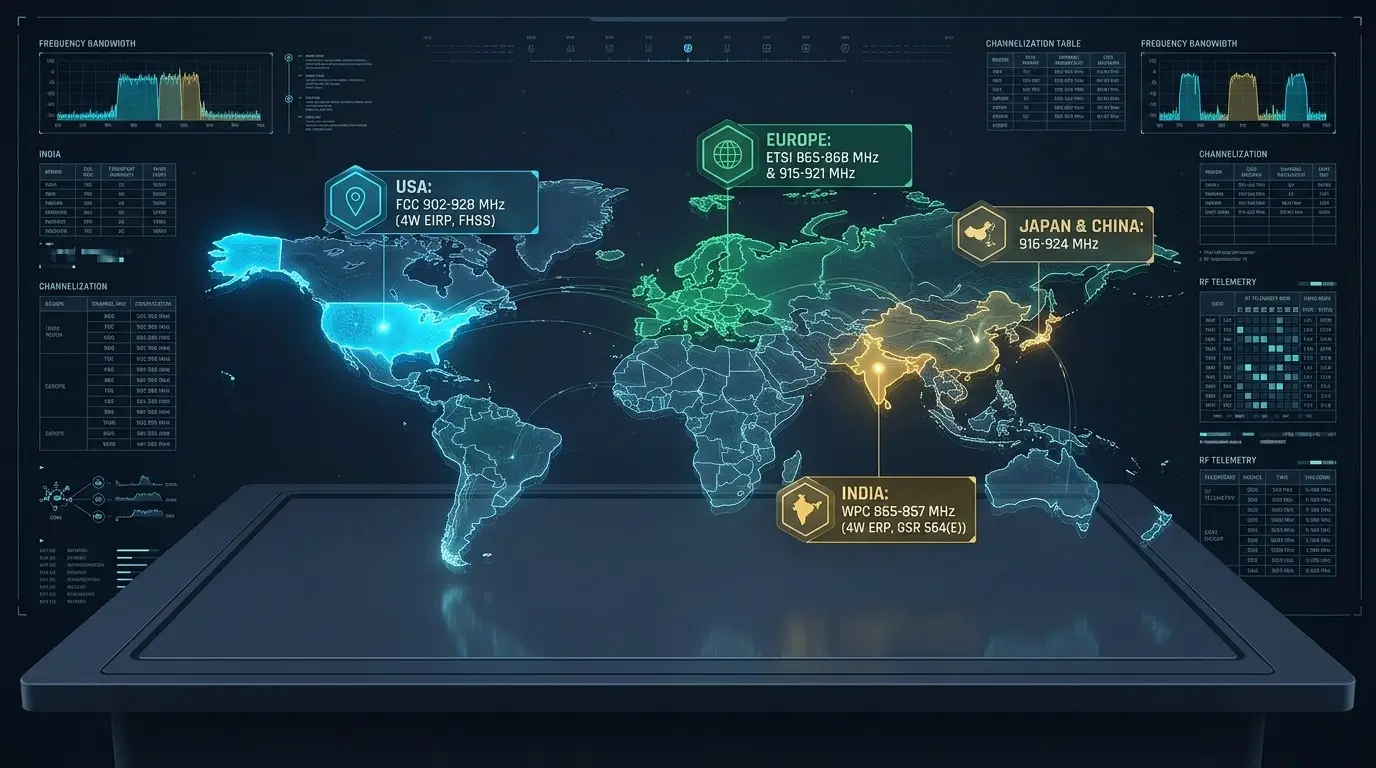
India WPC 865–867 MHz Compliance & ETA Certification Guide
Ministry of Communications G.S.R. 564(E) gazette provisions, Equipment Type Approval (ETA) import rules, and power test requirements for RFID readers in India.
Electromagnetic Wave Theory & Attenuation Physics
Understanding the transition between quasi-static near-field induction and propagating far-field radiation.
1. The Rayleigh Boundary: Transition from Near-Field to Far-Field
The fundamental demarcation between inductive RFID (LF & HF) and radiative RFID (UHF & Microwave) is governed by the Rayleigh Boundary ($r$):
At LF (125 kHz), wavelength λ = 2,400 meters, placing the transition boundary at 382 meters. Because all tag operations occur well within a few centimeters (d ≪ r), LF operates exclusively in the reactive near-field where electric (E) and magnetic (B) fields are uncoupled.
At UHF (865 MHz), wavelength λ = 34.7 cm, placing the Rayleigh boundary at merely 5.5 cm. Beyond 5.5 cm, the tag operates in the Fraunhofer far-field, where true transverse electromagnetic (TEM) waves radiate into space with orthogonal electric and magnetic field vectors.
Mathematical Coupling Formulas
V_tag = ω · M · I_reader · Q
Voltage induced in tag coil depends on mutual inductance M, reader current I, angular frequency ω = 2πf, and coil quality factor Q. Power decays as 1/r⁶.
P_rx = P_tx · G_reader² · G_tag² · (λ / 4πd)⁴ · Δσ_RCS
Received backscatter power at the reader decays with the fourth power of distance (1/d⁴), requiring high reader sensitivity (down to -85 dBm).
Skin Depth Equation in Conductors:
- • LF 125 kHz: δaluminum ≈ 230 μm. Magnetic flux penetrates non-ferrous metals with minimal loss.
- • HF 13.56 MHz: δaluminum ≈ 22 μm. Eddy currents cancel the tag field unless a sintered ferrite sheet (μr ≈ 100) shields the coil.
- • UHF 865 MHz: δaluminum ≈ 2.8 μm. Metal acts as a Perfect Electric Conductor (PEC), reflecting incoming waves with a 180° phase flip that shorts out adjacent tag dipoles without a 3–5mm dielectric spacer.
2. Why Metal and Water Dictate Frequency Selection
Deploying RFID in industrial environments requires respecting material physics. Liquid water consists of polar molecules with high relative permittivity (εr ≈ 78). At UHF frequencies, water molecules absorb RF energy through dielectric relaxation, rendering standard adhesive dipole tags unreadable when attached directly to beverage bottles or blood bags.
Conversely, conductive metals generate counter-rotating Eddy currents that produce an opposing magnetic field (Beddy = -Bext), collapsing the tag's inductance.
High-Speed UHF Dock Door Pallet Reading in Action
Observe a forklift moving through an industrial warehouse dock door equipped with circular 9 dBi antennas. Operating at WPC 865–867 MHz, the portal reads over 150 individual Gen2 carton inlays in under 1.2 seconds, despite rapid movement and packaging obstructions.
Forklift Pallet Verification via UHF RFID

Real-time dock door portal reading 100+ cartons per pallet at 12 km/h forklift transport speeds.
In-Stock Multi-Frequency Readers, Inlays & Starter Kits
AM 58kHz Clothing Store Anti-Theft Security Gate
Acousto-Magnetic 58 kHz pedestal gate with digital noise filtering for retail clothing boutiques and apparel showrooms.
HF Desktop RFID Reader & Writer USB Scanner
Plug-and-play USB scanner supporting Mifare 1K, NTAG213, and DESFire EV3 smart cards with Web Serial support.
Chainway C72 UHF Handheld Reader Terminal
WPC 865–867 MHz certified Android 11 terminal with built-in Impinj E710 engine and up to 15m read range.
Frequently Asked Questions: RFID Frequency Bands
Answers to common engineering inquiries regarding spectrum allocation, hardware compatibility, and deployment physics.
What are the primary frequency bands used in RFID systems? ▼
RFID systems operate across five primary electromagnetic frequency bands: Low Frequency (LF: 125 kHz – 134.2 kHz), High Frequency (HF: 13.56 MHz including NFC), Ultra-High Frequency (UHF: 860 MHz – 960 MHz RAIN RFID), Microwave (2.45 GHz & 5.8 GHz), and Active RFID (433 MHz & 2.4 GHz). Each band utilizes distinct physical coupling mechanisms—near-field magnetic induction for LF/HF versus far-field radiative electromagnetic backscatter for UHF and Microwave.
What is the legal UHF RFID frequency band in India? ▼
In India, the Wireless Planning and Coordination (WPC) wing of the Ministry of Communications de-licensed the 865.0 MHz – 867.0 MHz band for RFID under Gazette Notification G.S.R. 564(E). Fixed and handheld RFID equipment is permitted up to 4 Watts ERP (Equivalent Radiated Power, ~6.56W EIRP) with 200 kHz channel bandwidth. Commercial importers and manufacturers must secure a WPC Equipment Type Approval (ETA) certificate.
Why does UHF RFID struggle with liquid and metal compared to LF or HF? ▼
UHF signals (860–960 MHz) propagate as electromagnetic transverse waves. Water possesses a high dielectric constant (ε_r ≈ 78) and ionic conductivity that absorbs UHF energy into molecular polarization heating, causing 15 to 30 dB/m attenuation. Conductive metals reflect UHF waves with a 180° phase inversion, destructively canceling the tag's tangential electric field. In contrast, LF (125 kHz) and HF (13.56 MHz) utilize quasi-static magnetic field coupling (Faraday induction), which penetrates water and living tissue with virtually zero signal loss.
How do ETSI (Europe) and FCC (USA) UHF RFID frequency bands differ? ▼
The US FCC operates in the 902.0 MHz – 928.0 MHz band (26 MHz bandwidth) and mandates pseudo-random Frequency Hopping Spread Spectrum (FHSS) across 50 channels with up to 4 Watts EIRP. Europe (ETSI) historically utilized 865.6 MHz – 867.6 MHz (2 MHz bandwidth, 4 channels at 2W ERP), but ETSI EN 302 208 has opened an upper band at 915.0 MHz – 921.0 MHz permitting 4 Watts ERP for high-throughput logistics portals.
When should an enterprise choose Active RFID over Passive UHF RFID? ▼
Choose Active RFID (433 MHz or 2.4 GHz) when assets require continuous real-time tracking across large outdoor yards (50 to 100+ meters), telemetry from onboard environmental sensors (temperature, shock, humidity), or high-velocity moving vehicles where passive backscatter cannot energize tags fast enough. Choose Passive UHF Gen2 when tagging high volumes of consumables, cartons, or pallets where cost-per-tag (₹5 to ₹15) and maintenance-free zero-battery lifespan are essential.
Can an RFID reader read multiple frequency bands simultaneously? ▼
Standard readers operate on a single frequency band because internal RF synthesizer circuits, local oscillators, and antenna dimensions are tuned to specific wavelengths (e.g., 34.7 cm for UHF vs. 22.1 m for HF). However, dual-frequency combo cards exist (e.g., combining a 13.56 MHz Mifare chip for access control with an 865 MHz Impinj Monza chip for vehicle boom barriers inside a single PVC card) that can be read by respective dedicated readers.
Need Guidance Choosing the Right RFID Frequency Band?
Our RF engineering team provides link-budget audits, antenna placement blueprints, and turnkey hardware integration across India and globally.