
High Frequency (HF) & NFC: Smart Cards, Cryptography & Anti-Metal Shielding
Explore the engineering mechanics of 13.56 MHz resonant induction: ISO 14443 Proximity vs ISO 15693 Vicinity standards, AES-128 mutual authentication, and how sintered ferrite magnetic sheets prevent destructive eddy current cancellation on metal surfaces.
EMV Contactless NFC Payment Tap
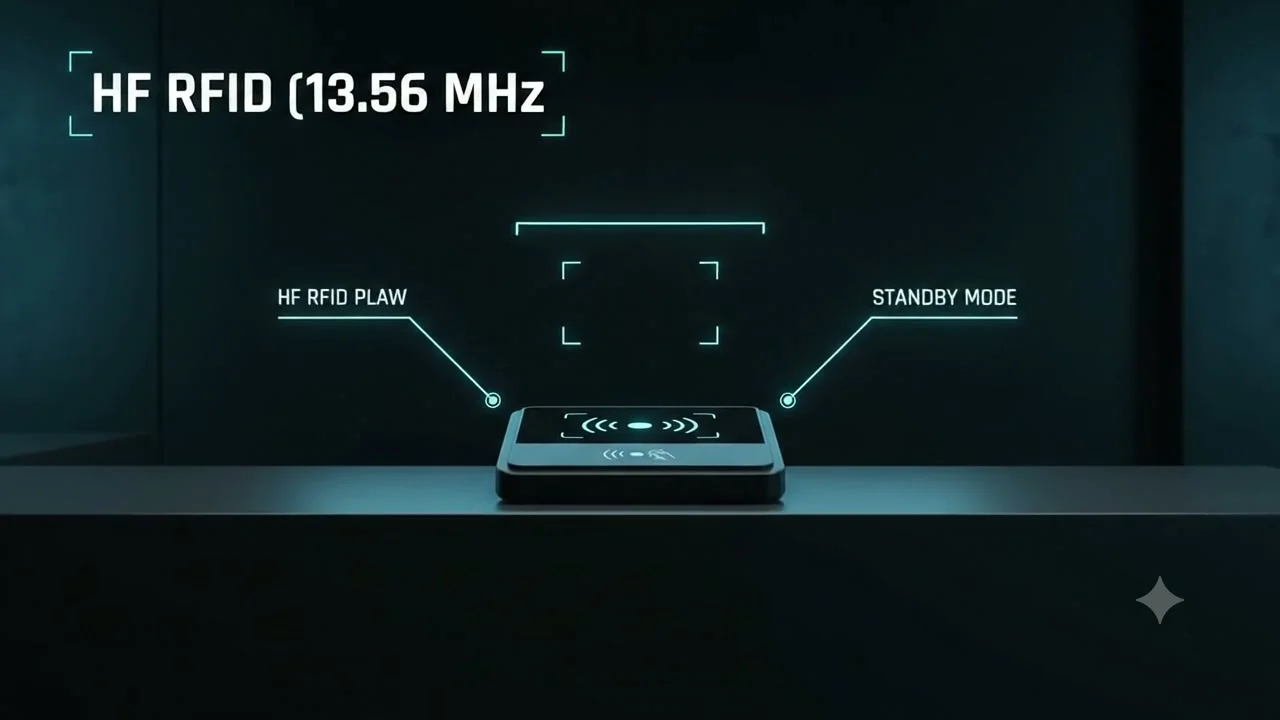
ISO 14443-4 contactless transaction demonstrating near-field magnetic coupling, cryptographic challenge-response, and dynamic load modulation within 300 ms.
Electromagnetic Engineering
Planar Antenna Resonant Coupling & The Physics of Anti-Metal Ferrite Shields
How Lenz's law eddy currents suppress 13.56 MHz resonance on metal surfaces, and how high-permeability ferrite sheets deflect magnetic flux.
Unlike LF RFID which relies on thick 500-turn wire bobbins, HF RFID transponders operate at 13.56 MHz where planar printed or etched copper coils (typically 3 to 6 turns) achieve resonant inductance values of L ≈ 1.5 μH to 2.5 μH. With an integrated tuning capacitance of C ≈ 17 pF to 50 pF, the tag LC tank circuit resonates at:
The Catastrophic Eddy Current Cancellation on Conductive Metal
When an HF antenna is placed directly against a conductive metallic substrate (steel, copper, aluminum), Faraday and Lenz's laws dictate that the reader's alternating magnetic field induces swirling surface eddy currents:
These eddy currents generate a counter-magnetic field Bcounter that opposes and cancels the primary magnetic field Breader. This produces two lethal failures:
- Inductance Collapse: The effective inductance collapses (Leff ≪ Lnominal), shifting the resonant peak upward to 16 – 20 MHz and completely de-tuning the transponder out of the reader's 13.56 MHz band.
- Q-Factor Destruction: The metal's finite conductivity dissipates energy as Joule heat (I2R), dropping the quality factor Q down below operational thresholds (Q < 5).
The Ferrite Shielding Solution (μ' ≈ 120, μ'' ≈ 0)
To enable HF operation on metal (e.g., smart posters, smartphones, metal shipping containers), a flexible sintered ferrite polymer composite sheet (thickness 0.1 mm to 0.3 mm) is inserted between the antenna coil and the metal surface.
Ferrite material possesses high complex magnetic permeability: μ = μ' - jμ''. The real component (μ' ≈ 100 to 150) acts as a low-reluctance magnetic conduit, trapping and redirecting magnetic flux lines parallel across the tag instead of penetrating the metal. Because the imaginary loss component is near-zero (μ'' ≪ 3 at 13.56 MHz), magnetic energy is not dissipated, preserving the Q factor and maintaining read distances of 4 to 8 cm.
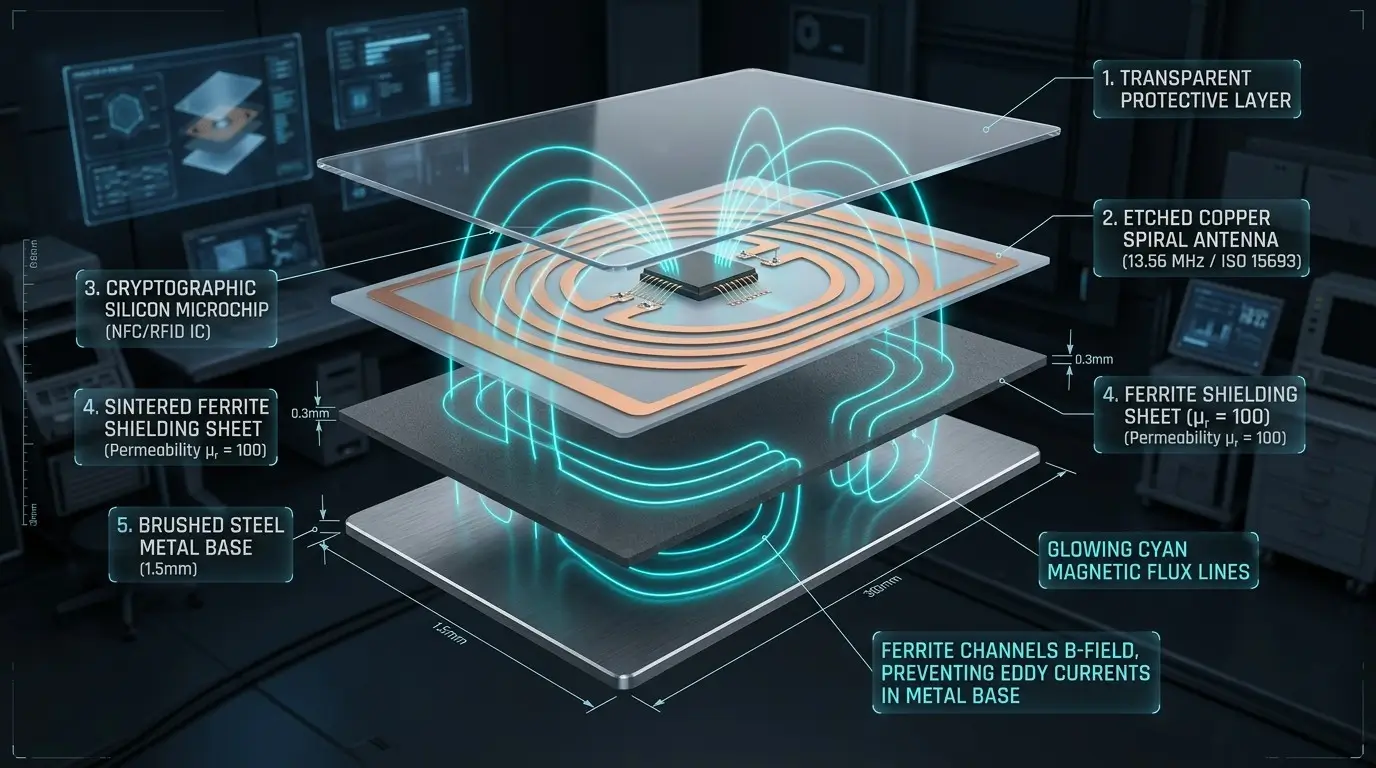
Layer 1: PET protective film • Layer 2: Etched aluminum spiral antenna • Layer 3: Sintered ferrite absorber film (150 μm) • Layer 4: 3M conductive acrylic adhesive • Substrate: Steel surface.
Because μr(ferrite) ≈ 120 while μr(air) = 1, the reluctance of the ferrite shield is 120× lower than free space. Flux naturally bends into the ferrite layer, completely bypassing the metal below.
Protocol Standards Architecture
ISO 14443 (Proximity) vs ISO 15693 (Vicinity): Architectural Comparison
Detailed comparison of modulation, field strength requirements, data transmission rates, and primary deployment cases.
| Technical Parameter | ISO/IEC 14443 (Type A) | ISO/IEC 14443 (Type B) | ISO/IEC 15693 (Vicinity) |
|---|---|---|---|
| Classification | PICC (Proximity) | PICC (Proximity) | VICC (Vicinity) |
| Nominal Read Range | 0 to 10 cm | 0 to 10 cm | Up to 1.0 – 1.5 meters |
| Downlink Modulation (Reader → Tag) | ASK 100% (Modified Miller) | ASK 10% (NRZ Encoding) | ASK 10% or 100% (1-out-of-4 or 1-out-of-256) |
| Uplink Modulation (Tag → Reader) | Load Modulation, 848 kHz Subcarrier (Manchester) | Load Modulation, 848 kHz Subcarrier (BPSK) | Load Modulation, 423.75 kHz Subcarrier (FSK / Manchester) |
| Transmission Data Rate | 106, 212, 424, 848 kbps | 106, 212, 424, 848 kbps | 26.48 kbps (Fast Mode) |
| Minimum Activation Field Strength | 1.5 A/m | 1.5 A/m | 0.15 A/m (10× more sensitive) |
| Primary Applications | Transit smart cards, EMV banking, Apple Pay, MIFARE DESFire | National e-Passports (ICAO 9303), national ID cards, Calypso transit | Library book circulation (Koha), industrial ski passes, medical vial tracking |
Security & Encryption Protocols
Cryptographic Architecture: MIFARE Classic Deprecation vs DESFire EV3
Understanding mutual authentication, 3DES/AES-128 cryptographic engines, and Proximity Check relay defense.
MIFARE Classic (1K / 4K)
Designed in 1994 using an undocumented 48-bit proprietary linear feedback shift register (LFSR) cipher called Crypto-1. In 2008, Dutch cryptanalysts proved that the pseudo-random number generator (PRNG) is predictable:
- DarkSide Attack: Recovers sector keys by measuring parity-error timing leaks in under 60 seconds without valid cards.
- Nested Attack: Given one known sector key, the attacker queries other sectors and extracts all remaining keys within 500 ms using modern devices like Proxmark3.
- No UID Randomization: Static 4-byte or 7-byte UID allows passive user movement tracking.
MIFARE DESFire EV3
Modern multi-application smart card IC powered by hardware crypto accelerators conforming to NIST SP 800-38B and FIPS PUB 197:
- Hardware AES-128 & 3DES: 3-pass mutual challenge-response authentication with 16-byte session keys.
- CMAC Message Integrity: 8-byte cryptographic checksum attached to every telegram preventing in-flight payload tampering.
- Proximity Check: Measures round-trip transit time with nanosecond precision; immediately terminates session if packet latency indicates an external proxy relay attack.
- Random ID (RID): Emits dynamically randomized pseudo-UIDs during anticollision, completely preserving bearer privacy against tracking.
Commercial Solutions Catalog
Explore Certified HF & NFC Hardware and Media
Access our portfolio of MIFARE DESFire EV3 credentials, ISO 15693 library antennas, and anti-metal ferrite tags.
MIFARE DESFire EV3 PVC Smart Cards
ISO 14443-4 cards with 2K/4K/8K EEPROM, pre-encoded with AES-128 custom keys for enterprise campus physical access.
Sintered Ferrite Anti-Metal NFC Labels
NTAG213 / ICODE SLIX labels with 150 μm high-permeability ferrite backing for asset tagging on laptops and metal equipment.
ISO 15693 RFID Library Gates & Pads
High-sensitivity walk-through 3D loop gate antennas integrated directly with Koha open-source ILS and SIP2 gateways.
Frequently Asked Questions
HF 13.56 MHz & NFC Engineering FAQ
Technical answers regarding resonant tuning, ferrite skin depths, and cryptographic security.
What is the exact frequency and wavelength of HF RFID? ↓
How do ISO 14443 and ISO 15693 differ technically? ↓
Why does placing an HF tag on metal kill communication, and how does ferrite fix it? ↓
Why was MIFARE Classic deprecated in favour of MIFARE DESFire EV3? ↓
What is the technical relationship between HF RFID and NFC? ↓
Animal implants, FDX vs HDX, and zero-attenuation biological tracking.
Friis backscatter physics, India WPC 865–867 MHz de-licensing, and warehouse logistics.