
Low Frequency (LF) RFID: Inductive Coupling & Biological Glass Implants
Why 125 kHz and 134.2 kHz RFID remains the gold standard for livestock tracking, automotive immobilizers, and high-fluid industrial environments where modern UHF RAIN RFID experiences catastrophic signal attenuation.
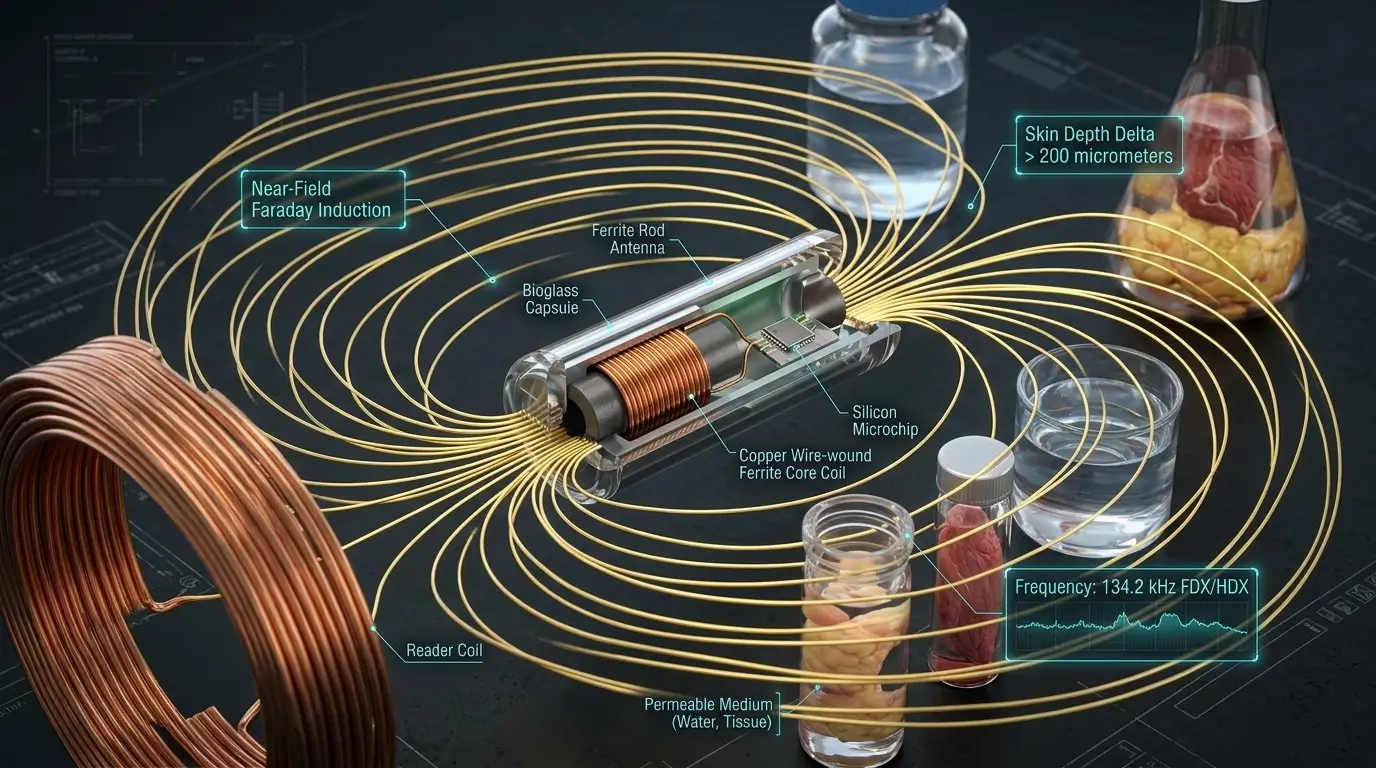
Cutaway showing 500-turn copper induction coil wound around a soft magnetic ferrite rod, bonded directly to an integrated microchip.
Electromagnetic Field Theory
The Physics of Inductive Coupling in the Rayleigh Near-Field
Why LF RFID behaves as an air-core transformer governed by Ampère and Faraday laws rather than electromagnetic wave radiation.
At an operating frequency of f = 125 kHz, the electromagnetic wavelength in free space is determined by the fundamental wave equation:
The boundary between the near-field (reactive storage zone) and far-field (propagating radiation zone) is defined by the Rayleigh boundary rboundary = λ / 2π ≈ 382 meters. Because every operational LF read range (1 cm to 10 cm) is negligible compared to 382 meters, LF RFID produces zero transverse electromagnetic propagation. Instead, it operates strictly via quasi-static magnetic induction governed by Faraday's Law:
Where:
- Vind: Induced voltage across the transponder coil terminals.
- N: Number of turns of wire on the transponder coil (typically 300 to 800 turns).
- M: Mutual inductance between reader coil and tag coil.
- ω: Angular frequency (2πf ≈ 785,398 rad/s at 125 kHz).
- Q: Quality factor of the tag's tuned LC resonant tank circuit.
B(r) ∝ μ0 I R2 / (2 (R2 + r2)3/2). Consequently, received power drops at 1/r6, strictly limiting LF passive read range to under 15 cm.
LF LC Tank Resonance Circuit
To maximize induced voltage Vind, the transponder coil inductance (L) is paired with an on-chip integrated silicon capacitor (C) tuned precisely to resonate at 125 kHz:
Typically, L ≈ 1.0 mH to 4.7 mH, requiring C ≈ 345 pF to 1.6 nF. The circuit Quality Factor (Q = ωL / Rcoil) is maintained between 15 and 30 to balance voltage amplification with bandwidth for data transmission.
Liquid & Tissue Penetration Advantage
Water has a high relative permittivity (εr ≈ 80) and conductivity (σ ≈ 0.05 to 5 S/m), destroying UHF electric waves through dielectric polarization loss. In contrast, water's relative magnetic permeability is μr = 0.999992 (≈ 1.0). Magnetic fields pass through water, blood, milk, and muscle without dielectric dissipation!
Global Livestock Architecture
ISO 11784 & ISO 11785: The Engineering Protocol of Animal RFID
Technical deep dive into the 64-bit code structure, FDX-B differential bi-phase, and HDX charge-burst frequency shift keying.
Continuous Load Modulation at 134.2 kHz
In FDX-B systems, the transponder modulates the reader's active electromagnetic field continuously while the reader is powered. The tag dynamically switches a load resistor across its resonant coil, altering the reader's antenna impedance via mutual inductance.
Commonly deployed in pets (dogs, cats, horses) and zoo animals inside 2.12 × 12 mm bioglass capsules injected subcutaneously.
Capacitive Energy Storage & FSK Bursts
HDX uses a two-phase cycle. The reader emits an unmodulated 134.2 kHz RF pulse for approximately 50 milliseconds to charge an internal capacitor inside the tag. When the reader pauses its carrier, the tag uses its stored capacitive charge to broadcast into a silent channel.
Industry standard for cattle, sheep, and swine ear tags because the silent return channel yields significantly longer read ranges (up to 1.0 meter with walk-through race antennas).
| Bit Position | Field Name | Bit Count | Description & Standard Encoding |
|---|---|---|---|
| Bit 1 | Animal Flag | 1 bit | 1 = Animal application, 0 = Non-animal industrial application. |
| Bits 2 – 15 | Reserved / Retagging | 14 bits | Species classification and retagging counter counter-bits. |
| Bits 16 – 26 | Country Code | 10 bits | ISO 3166 3-digit numeric country code (e.g., 356 for India, 840 for USA). |
| Bits 27 – 64 | National Identification | 38 bits | Unique animal individual identification number (up to 274 billion unique IDs). |
Access Control Security
125 kHz Proximity Cards: EM4100 Architecture & Cloning Vulnerabilities
Why unencrypted 64-bit Manchester proximity cards should be deprecated in enterprise access control.
The most widely deployed 125 kHz access credentials historically are the EM Microelectronic EM4100 and TK4100 architectures. These transponders contain a total of 64 bits of ROM programmed at manufacture:
- 9 Header Bits: Continuous logic '1' synchronizing preamble.
- 40 Customer & Serial Bits: 8-bit Version/Customer ID + 32-bit unique serial number.
- 14 Parity Bits: 10 row parity bits + 4 column parity bits for parity checking.
- 1 Stop Bit: Fixed logic '0'.
When energized by a 125 kHz reader field, the chip immediately begins transmitting its 64-bit string repeatedly via Manchester encoding at RF/64 (1,953 bps) or RF/32 (3,906 bps).
Migration to Cryptographic Credentials
For high-security enterprise facilities, 125 kHz legacy proximity cards should be replaced with high-frequency ISO 14443-4 cards utilizing AES-128 cryptographic mutual authentication.
Storefront Hardware Catalog
Industrial Hardware & Tag Integrations for LF Systems
Explore certified LF 134.2 kHz readers, ISO 11784 handheld wands, and bioglass injection transponders.
Biocompatible Bioglass Transponders
2.12 × 12 mm and 1.4 × 8 mm Schott 8625 medical glass capsules with parylene anti-migration coating and EM4305 chip.
ISO 11784/85 Handheld Wand Scanners
Rugged Bluetooth handheld stick readers capable of decoding both FDX-B and HDX ear tags at up to 35 cm distance.
RFID Penetration Simulator
Calculate attenuation through saltwater, steel, aluminum, and biological tissue across LF, HF, and UHF frequencies.
Frequently Asked Questions
LF 125 kHz Engineering FAQ
Technical answers regarding skin depth, antenna coil winding, and standard compliance.
What is the operating frequency and wavelength of LF RFID? ↓
Why can LF RFID penetrate water and biological tissue when UHF cannot? ↓
What is the difference between ISO 11784/11785 FDX-B and HDX? ↓
Why are legacy 125 kHz EM4100 badges considered insecure? ↓
Why do LF RFID antennas require hundreds of coil turns? ↓
Smart card cryptography, ISO 14443 vs ISO 15693, and anti-metal ferrite shielding.