
Cybersecurity & Physical Access Engineering
Enterprise RFID Security & Anti-Cloning Architecture Guide
Understand how RFID credentials are compromised, why operating frequency alone does not prevent duplication, and how mutual cryptographic challenge-response and physical loop-break inlays deliver uncloneable security.
The Fundamental Rule: RF Frequency Is Not Security
A widespread misunderstanding across facility management and IT procurement is that changing radio frequency—for example, switching from 125 kHz low-frequency cards to 13.56 MHz HF or 865 MHz UHF—inherently makes a system secure. RF frequency only governs physics: read distance, wave penetration, and antenna geometry.
How Cloning Resistance Actually Works
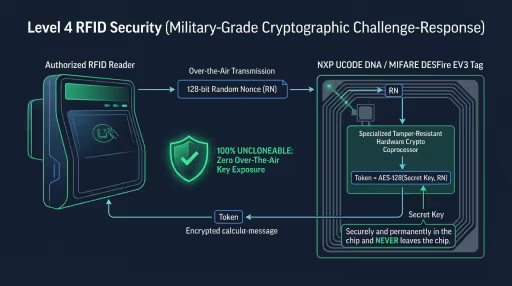
True cloning resistance depends solely on what happens after the reader energizes the tag microchip. If the tag merely replies with a static number (Card ID = 12345 or EPC = 3074...), an attacker can easily record that number and replicate it on a blank card. True protection requires on-chip cryptographic proof where the tag solves mathematical challenges using a secret key that is never transmitted over the air.
The 4 Levels of RFID Cloning Resistance
RFID security is categorized into four distinct hardware and cryptographic tiers, spanning legacy unencrypted tokens to modern AES-128 challenge-response silicon:
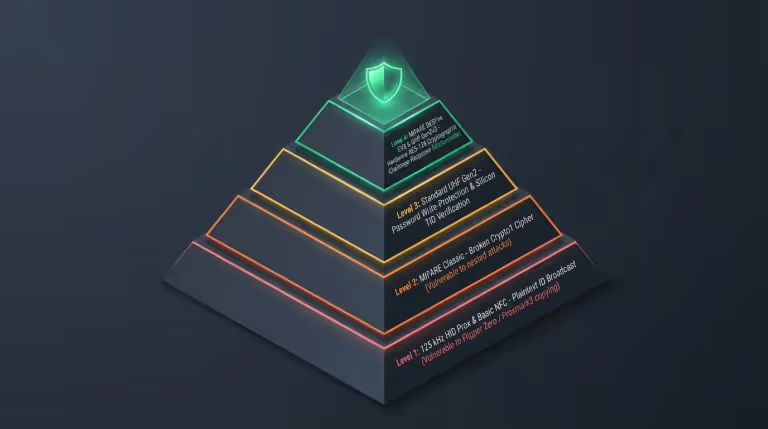
125 kHz HID Prox (1326 ProxCard II) & Basic Unencrypted NFC
Mechanism: Continuous plaintext broadcast. The card energizes in the 125 kHz field and transmits its unencrypted 26-bit or 37-bit Wiegand ID.
Attack Vector: Inexpensive handheld copiers (₹500), Proxmark3, or Flipper Zero can capture the ID from 10 cm away and write it onto rewritable T5577 cards. The reader cannot verify physical authenticity.

MIFARE Classic (1k / 4k) & Proprietary Crypto1
Mechanism: Uses a 48-bit proprietary Crypto1 algorithm. While it requires an authentication handshake, the cipher’s pseudo-random number generator was mathematically broken in 2008.
Attack Vector: Darkside and Nested mathematical attacks crack all 16 sector keys in seconds using open-source tools (mfkey32 / nfc-mfclassic). The cloned data is written to "Chinese Magic" UID-changeable cards.

Standard RAIN UHF (EPC Gen2) with Password Lock & Silicon TID Verification
Mechanism: EPC memory is locked with a 32-bit PIN to prevent rewriting. The access control middleware checks both the user-programmed EPC and the factory-burned, unalterable 96-bit Silicon TID (Mask Designer ID).
Limitation: Prevents simple tag reprogramming, but advanced attackers using software-defined radio (SDR) transmitters or active tag emulators can still spoof both the EPC and TID over the air.

MIFARE DESFire EV3, HID Seos & RAIN UHF Gen2v2 (NXP UCODE DNA)
Mechanism: Hardware cryptographic coprocessors executing AES-128 / 3DES Mutual Authentication (ISO/IEC 29167-10). The reader transmits a fresh random nonce challenge ($R_N$). The tag computes an encrypted signature inside protected silicon memory.
Uncloneable Security: The secret key resides in tamper-resistant silicon hardware and is never transmitted over the air. Even if an attacker records millions of communications, they cannot predict the response to a new challenge.
The 3 Distinct Security Threats: Data Copying vs Cloning vs Tampering

Data Copying (Eavesdropping)
Attacker scans an item from 5 meters away to snoop on serialized inventory data.
Credential Cloning (Forgery)
Attacker creates a counterfeit card/tag to gain unauthorized building or gate access.
Physical Tampering (Tag Peeling)
Insider peels a genuine tag off a corporate laptop and transfers it to a dummy asset.
Explore Related Engineering Guides & Tools
Dive deeper into cryptographic standards, memory bank layout tools, and high-value asset protection blueprints:
Deep Technical Guide →
EPC Gen2v2 & Cryptographic UHF Handshake
UML sequence diagrams and NXP UCODE DNA AES-128 protocols.
Credential Comparison →
HID Prox vs MIFARE DESFire EV3 vs Gen2v2
Side-by-side security matrix and Flipper Zero vulnerability analysis.
Deployment Architecture →
Laptop & IT Asset Anti-Tamper Blueprint
4-layer multi-factor verification pipeline for enterprise hardware.
Interactive Developer Tool →
TID / EPC Memory Bank Layout Calculator
Calculate PC words, decode silicon TIDs, and construct Gen2 lock masks.
Frequently Asked Questions on RFID Cloning & Security
Direct, authoritative engineering answers to common access control and asset tracking security queries.
Does RF frequency (125 kHz vs 13.56 MHz vs 865 MHz) determine RFID security?
Can 125 kHz HID Prox cards (such as 1326 ProxCard II) be cloned with a Flipper Zero or Proxmark3?
What is the difference between data copying, credential cloning, and physical tampering?
How does cryptographic challenge-response stop RFID cloning?
Which RFID technologies provide the highest military-grade anti-cloning security?
Upgrade Your Facility from Vulnerable 125 kHz to Uncloneable AES-128 RFID
Our certified Auto-ID security engineers design turnkey cryptographic RFID access control, server rack anti-theft, and corporate laptop tracking systems across India and global enterprises.