
Resource
RFID Cost & TCO Guide: Capex, Opex & Hardware Pricing (2026)
Complete RFID cost breakdown: tag price scaling ($0.04–$0.15), fixed dock portals vs handheld readers, middleware licensing, and 3-year TCO budgeting.

Step 1: Choose Your RFID Solution or Use Case
Step 2: Select Technology & Deployment Mode
Step 3: Customize Bill of Materials (BOM)
Adjust hardware quantities, RFID tags, software licenses, or turnkey services
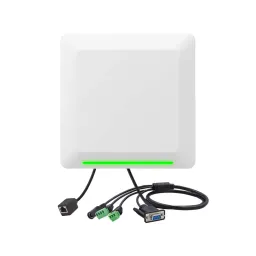
₹60,000
2 × ₹30,000

Unit: ₹1,499
₹1,499
1 × ₹1,499

Unit: ₹20
🏷️ Volume Tier (1k – 4,999 pcs) Applied₹20,000
1,000 × ₹20
PVC Card Printing & Encoding
Unit: ₹20 (per card)
₹20,000
1000 × ₹20
School / Corporate Card Ribbon (Lanyard)
Unit: ₹15 (per lanyard)
₹15,000
1000 × ₹15
School / ID Card Cover (Holder)
Unit: ₹8 (per holder)
₹8,000
1000 × ₹8
Turnkey On-Site Cabling & Installation
Unit: ₹25,000 (per lane)
₹25,000
1 × ₹25,000
⚡ 1-Click Quick-Add Turnkey Services & Accessories
RFID School Attendance & Student Tracking Blueprint
View full technical architecture, ERP integration specifications, and deployment guide.
Quotation Summary
7 Line Items Configured
Total Indicative Cost
(All taxes included)
₹1,76,409
Quotation Customization
Leave blank for auto-generated code, or enter your internal RFQ/PO reference.
Browse Hardware & Bulk Pricing
Inspect technical datasheets, certified frequency bands, and published quantity tier prices for readers, handhelds, and inlays.
Validate with Case Studies
See verified ROI payback timelines, tag read accuracy, and audit results from actual deployments across Indian enterprises.
Test in Virtual Simulator
Test your software logic, ERP webhooks, and tag stream deduplication in the browser without investing in test hardware first.
RFID Cost Economics & Implementation Guide
In-depth breakdown of tag volume price scaling, fixed portal vs mobile reader capex, software integration scoping, and ROI payback models in India.
How the RFID Solution Cost Estimator Works
Budgeting an enterprise RFID deployment requires evaluating both capital expenditure (Capex) and ongoing operational costs (Opex). Unlike traditional barcode systems where cost is concentrated in printer consumables, RFID investments are distributed across four distinct technology pillars:
- 1. Tag & Inlay Consumables (Recurring Opex): Unit price scales inversely with order volume and varies significantly between basic paper inlays (₹3.50–₹7.00) and rugged on-metal transponders (₹45.00–₹180.00).
- 2. Interrogation Hardware (Capex): Fixed dock portals, multi-port reader hubs, panel antennas, and mobile Android handheld terminals (Chainway C72).
- 3. Middleware & Edge Controller Licensing: Edge data aggregation, noise filtering, and bidirectional ERP synchronization (SAP, Oracle, Zoho).
- 4. Turnkey Engineering & Commissioning: RF site survey, antenna beam calibration, mounting brackets, cabling, and hypercare operator training.
Tag Volume Economics: Price Scaling Across Indian Industries
Tag volume is the primary driver of long-term total cost of ownership. The table below outlines standard 2026 price tiers across common RFID form factors in India:
| Tag Form Factor | 10,000 Units | 50,000 Units | 250,000 Units | 1,000,000+ Units | Typical Industry Application |
|---|---|---|---|---|---|
| Standard UHF Paper Inlay | ₹6.50 – ₹8.50 | ₹4.80 – ₹6.00 | ₹3.80 – ₹4.50 | ₹3.20 – ₹3.75 | Apparel hangtags, retail boxes, FMCG cartons |
| Dielectric Liquid Spacer Inlay | ₹9.00 – ₹12.50 | ₹7.50 – ₹9.50 | ₹5.80 – ₹7.20 | ₹4.90 – ₹5.80 | Edible oil, beverages, cosmetics, pharma |
| Flexible On-Metal UHF Tag | ₹55.00 – ₹75.00 | ₹42.00 – ₹55.00 | ₹35.00 – ₹42.00 | ₹28.00 – ₹34.00 | IT assets, servers, metal shelving, appliances |
| Rugged IP68 Screw-Mounted Tag | ₹145.00 – ₹195.00 | ₹110.00 – ₹145.00 | ₹85.00 – ₹110.00 | ₹68.00 – ₹85.00 | Automotive steel trollies, gas cylinders, returnable totes |
| 13.56 MHz HF / Mifare PVC Card | ₹28.00 – ₹40.00 | ₹20.00 – ₹28.00 | ₹16.00 – ₹20.00 | ₹12.50 – ₹15.00 | Corporate ID badges, smart lockers, university cards |
Hardware Capex Breakdown: Fixed Portals vs. Handheld Mobility
Selecting the optimal mix of fixed infrastructure versus mobile handhelds prevents over-spending while maximizing operational throughput:
- Automated Dock Door & Conveyor Portals (High Velocity): Installing an industrial 4-port Fixed RFID Reader with 4 circular polarized antennas across a warehouse dock door costs between ₹1,25,000 and ₹1,95,000 per portal (including mounting frame and light-stack indicator). Portals automate pallet intake without stopping forklifts.
- Mobile Handheld Scanners (High Flexibility): For aisle cycle-counts and retail audits, rugged Android handheld readers like the Chainway C72 UHF Handheld Reader cost ₹39,000 to ₹65,000 per unit, offering rapid deployment across multi-tier racking.
- Thermal RFID Desktop Printers: On-demand encoding and barcode printing using the Zebra ZD621R 300DPI RFID Printer costs ₹1,45,000 to ₹1,95,000, enabling seamless tag commissioning at packaging lines.
Software, Middleware & ERP Integration Scope
Raw tag reads generated by high-speed readers must be filtered and converted into business transactions:
- Edge Middleware Connector: Local device management, tag de-duplication, directional movement logic (Inward vs Outward), and MQTT broker integration typically costs ₹75,000 to ₹2,50,000 per facility.
- Two-Way ERP Synchronization: Connecting edge middleware with enterprise ERPs (SAP S/4HANA, Oracle NetSuite, Microsoft Dynamics 365, or custom WMS) via REST APIs, OData, or staging tables ranges from ₹1,50,000 to ₹5,00,000 depending on custom workflow complexity.
- Annual Maintenance & Support (AMC): Standard industry SLAs in India range between 12% and 18% of hardware/software value annually, covering firmware updates, reader RF retuning, and on-site emergency support.
TCO & Payback Period Calculation Formula
To justify RFID capital investment to executive finance committees, calculate the expected break-even horizon using the following standard ROI equation:
- Formula:
Payback Period (Months) = [(Total Capex + Year 1 Tag Opex) / Total Monthly Net Savings] × 12 - Monthly Net Savings:
(Labor Hours Saved × Hourly Wage) + Inventory Shrinkage Prevented + Mis-Ship Dispute Savings
Empirical Payback Benchmarks in India:
- Apparel & Retail Chains: Typically break even in 2.8 to 4.2 months through eliminated inventory shutdown days and higher on-floor size availability.
- Manufacturing & Returnable Asset Tracking (Trollies/Pallets): Typically break even in 3.5 to 5.0 months by eliminating lost steel trolley replacement costs and supplier disputes.
- Distribution Warehouses: Typically break even in 4.0 to 6.5 months via 85% faster truck turnaround and zero shipping errors.
How to Interpret Estimator Results & Plan Phased Deployments
When reviewing the interactive calculator output below, use the Min Band for clean RF environments (cardboard cartons, non-metallic items, open aisles, standard REST API connectors). Use the Max Band when budgeting for metal-heavy environments, liquid bottling, high-temperature manufacturing, or multi-site SAP customizations.
Strategic Phased Rollout Advice: Rather than attempting a full-scale multi-facility launch immediately, start with a 30-day single-dock or single-store Proof of Concept (POC). Prove tag read reliability, establish middleware filtering rules, and replicate the standardized blueprint across remaining Indian facilities to minimize capital risk.
Need a custom rfid cost & tco guide: capex, opex & hardware pricing (2026) deployment?
Every environment has distinct RF absorption and ERP sync constraints. Let's review your exact workflow and design an end-to-end blueprint.
Deployed hardware & software
Products & Hardware Deployed in This Solution
Discover the professional-grade RFID readers, tags, and custom integration software systems implemented in this deployment.
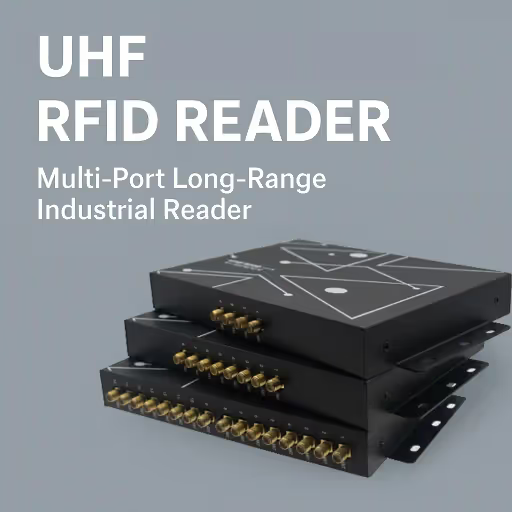
Fixed RFID Reader India and UHF 4-Port Reader Portals
Four-port readers for portals and lines

RFID Handheld Reader Software for AUTOID Mobile Terminals
Android app for seamless RFID data capture

NXP U9 Flexible Printable On-Metal RFID Label 80x40mm
1.0mm Flexible Foam On-Metal Smart Label with 6.5m Read Range for IT Assets & Metallic Surfaces
Frequently asked questions
How accurate is this RFID cost calculator for budgeting in India?
What is the minimum budget required to start an enterprise RFID pilot in India?
Why do on-metal and liquid RFID tags cost significantly more than paper inlays?
What is the typical return on investment (ROI) timeframe for industrial RFID?
Are there ongoing recurring fees after deploying an RFID system?
Can we start with mobile handheld scanners before investing in fixed dock portals?
Discover more
You may also like
Hand-picked articles and pages worth your time next.

RFID Warehouse Management System (WMS) & Inventory Tracking
Automated dock door portals and pallet verification for warehouses
Tally Prime RFID Middleware & Voucher Sync
Direct XML Port 9000 integration for automatic stock journal entries
Interactive RFID ROI & Payback Period Calculator
Calculate labor savings, tag capex, and payback timeline in months
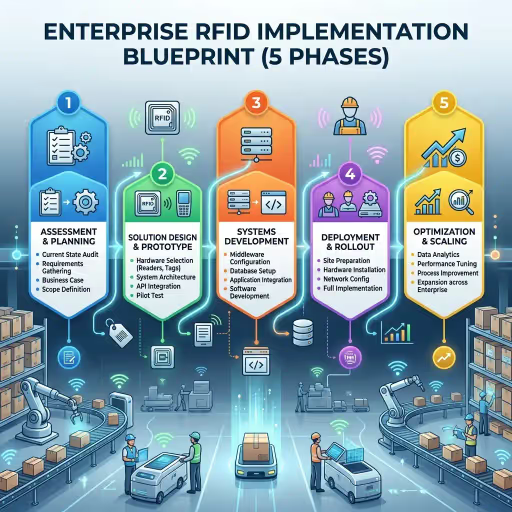
Step-by-Step RFID Implementation Guide India
Comprehensive 5-phase RFID implementation guide for India: RF site survey, tag surface selection, dock portal tuning, WMS sync & hypercare support.
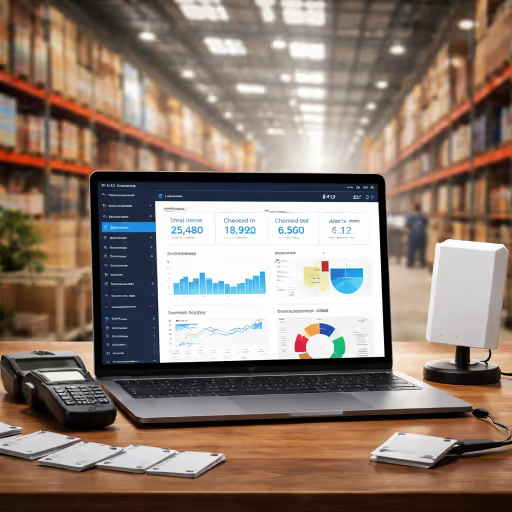
RFID Middleware & SDK Integration Services
Enterprise RFID middleware and SDK integration services. LLRP socket listeners, sliding-window deduplication, and direct SAP / TallyPrime pipelines.
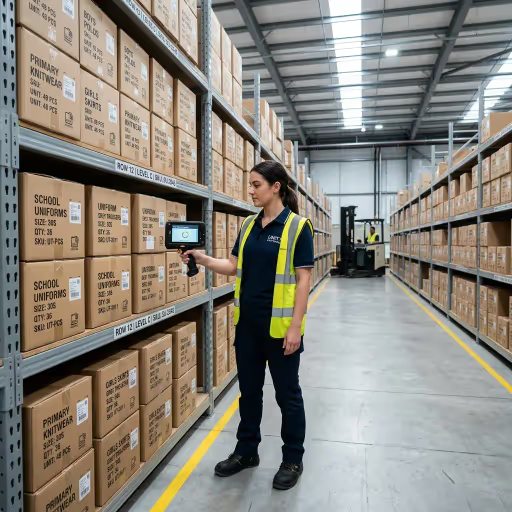
Apparel Warehouse RFID Inventory Automation | Case Study
Case study: School Time Uniforms deploys UHF RFID handheld scanners and automated warehouse middleware for 99.8% dispatch accuracy and zero stock-outs.

RFID Inventory Management Software & Systems in India (2026)
Enterprise RFID inventory management software for Indian warehouses. Sub-2s carton audits, real-time GST E-Way sync, and Tally/SAP ERP connectors. Book demo.