
Solution
RFID Inventory Management Software & Systems in India (2026)
Enterprise RFID inventory management software for Indian warehouses. Sub-2s carton audits, real-time GST E-Way sync, and Tally/SAP ERP connectors. Book demo.

Simulate, evaluate, or request turnkey hardware & middleware deployment
-
0% mismatch
Inter-branch variance
automated transit verification
-
10 minutes
GST audit prep
down from 3 days
-
99.2%
Inventory accuracy
across all Indian DC nodes
Operational Transformation: Manual Barcode Staging vs. Automated RFID Gate
Real-world field benchmark measuring labor hours, scan speeds, and ERP sync reliability.
Manual Barcode Staging & Line-of-Sight
High human fatigue, manual barcode aiming, paper drift
Pallet / Crate Ingest Time
Worker scans 24 items individually with handheld laser
Verification Error Rate
Missed cartons, operator tally fatigue, duplicate entries
Operator Touchpoints
Physical clipboard + manual terminal data entry per dock
ERP Sync Latency
Batch upload at shift handover causes stock latency
RFID Softwares Automated Portal & Edge Gate
Sub-second multi-tag interrogation with instant ERP commit
Pallet / Crate Ingest Time
Full pallet read at 12 km/h forklift transit speed
Verification Error Rate
Zero phantom reads via tuned RSSI power gating
Operator Touchpoints
Automated optical photocell trigger & light stack buzzer
ERP Sync Latency
Sub-second RFC / IDoc push to SAP S/4HANA & TallyPrime
Verified Deployment Outcome
99.3% Labor Time Cut • 100% Audit-Proof Physical-to-Digital ERP Traceability
Live Operations: Interactive Models & Video Walkthrough
Experience automated stocktaking, pallet-level dock reads, and live POS inventory synchronization.
Video Demo: Warehouse UHF RFID Pallet & Stock Audit
Full-Rack Inventory Verification in Seconds with Zero Line-of-Sight Scanning
3D Isometric Warehouse RTLS & Stock Depletion
Multi-zone overhead reader array tracking live stock depletion as order pickers retrieve boxes.
Retail Garment Handheld RFID Inventory Audit
Simulates in-store wand scanning across suits, denim, and folded tables with live POS sync.
Edge-to-ERP Data Pipeline Blueprint
How RFID Inventory Management Software & Systems in India (2026) ingests thousands of physical tag reads per minute, suppresses duplicate RF bounces, and synchronizes with your central ERP in sub-second intervals.
The Problem Solved in Plain English:
Standard RFID readers flood servers with 50,000 raw scans every minute, crashing databases with duplicate reads. Our middleware acts as a smart edge filter—it recognizes when the same item sits in front of a scanner, registers it exactly once, and queues the data locally so no scans are lost even if warehouse Wi-Fi drops.
RF Backscatter
UHF tags energize via 865–867 MHz CW carrier wave. Backscatters 96-bit SGTIN EPC identifiers.
• Anti-collision: Q-algorithm
Lock-Free Channel
Reads stream across high-speed LLRP / TCP sockets into an in-memory ring buffer with bounded backpressure.
• Latency: < 2.5ms jitter
Sliding Cooldown
Central 60-second sliding window filters duplicate reflections across adjacent gates before storage.
• Offline auto-reconnect
Enterprise ERP Post
Gzip-compressed batch payloads dispatch via REST webhook or direct OData / XML connector to ERP.
• Retries: Exponential backoff
Architecture Comparison: Traditional vs. OpenRFID Edge Engine
| Operational Factor | Traditional Direct-to-DB Connection | OpenRFID High-Scale Edge Architecture |
|---|---|---|
| Network Downtime / Wi-Fi Loss | ❌ Scans are permanently lost; inventory mismatch occurs. | ✅ Scans buffer to local SQLite WAL queue and auto-sync when restored. |
| Duplicate Tag Reads | ❌ 100+ DB transactions per second for the exact same physical tag. | ✅ 60-second in-memory sliding window suppresses redundant scans. |
| ERP System Load | ❌ Heavy server load causes timeout errors on ERP billing APIs. | ✅ Consolidated 1,000-EPC compressed batches post in single atomic calls. |
Pan-India Multi-Branch Distribution Topology & GST Compliance
Managing inventory across distributed distribution centers in Delhi NCR, Mumbai, Bengaluru, and Kolkata requires unified SKU-level tracking. Our RFID inventory architecture connects multi-tier warehouses into a centralized ledger, automatically validating incoming consignments against GST E-Way bills and inter-branch transfer orders (STOs). Physical tag scans captured at receiving docks instantly reconcile against dispatch manifests, eliminating stock variance before Goods Receipt Notes (GRN) are finalized in accounting software.
High-Density SKU Sweep & Anti-Collision Gen 2 Algorithms
In high-density retail stockrooms and industrial spare parts warehouses, thousands of SKUs are packed in close proximity. Utilizing EPC Class 1 Gen 2 (ISO 18000-6C) anti-collision protocols with Impinj E710 and Monza R6-P inlays, our mobile handheld terminals interrogate over 1,300 tags per second. Operators simply sweep storage aisles at normal walking speed; the software performs dynamic acoustic Geiger-counter searching to pinpoint misplaced items or verify entire shelf inventory in seconds.
Offline-First Edge Architecture for Tier-2 & Tier-3 Hubs
Internet connectivity in industrial hubs and remote tier-2/3 warehouses can be inconsistent. Our Android handheld application and edge middleware operate entirely offline-first. Audit transactions, cycle counts, and tag commissions are recorded locally in a high-performance SQLite database. As soon as Wi-Fi or 4G connectivity is re-established, the edge daemon synchronizes transaction journals with the central cloud ERP with full cryptographic idempotency, preventing duplicate stock movements.
Bidirectional ERP Synchronization Pipeline (Tally Prime & SAP)
Our inventory management software eliminates manual data entry by synchronizing directly with Indian enterprise ERPs. For Tally Prime, the middleware communicates over local Port 9000 XML sockets, auto-generating Physical Stock Vouchers and Stock Journal entries within 800ms of an audit sweep. For SAP S/4HANA, OData and RFC endpoints map scanned EPCs to master material numbers (MATNR) and storage locations (LGORT), providing real-time stock ledger alignment.
Inventory Tracking Bill of Materials & Turnkey Starter Kits
Our standardized inventory tracking starter kits include: (1) Chainway C72 Rugged Android Handheld RFID Terminal (5.5-inch touchscreen, 1D/2D barcode imager, 865–867 MHz UHF reader with 30 dBm output), (2) Zebra ZT411 Industrial RFID Thermal Transfer Printer for high-speed tag encoding, (3) 5,000x High-Sensitivity RAIN RFID printable UHF labels (Impinj Monza R6-P / UCODE 9), (4) OpenRFID Android Inventory Suite APK with Tally/Excel export, and (5) Turnkey remote onboarding and SOP training for warehouse staff.
Inventory Audit Benchmarks: 3 Days Down to 15 Minutes
Physical verification of a 25,000-SKU warehouse using optical barcode scanners typically requires a 4-person audit team working for 3 full business days, often requiring facility shutdown. With UHF RFID handheld wands, a single operator walks the aisles and completes the 100% cycle count in under 15 minutes with 99.8%+ accuracy. Discrepancies are flagged on-screen in real time, showing exact missing SKUs, surplus items, and misplaced shelf locations.
Interactive RFID Engineering Tools & Calculators
Use our free interactive calculators and simulators to model RF physics, calculate link budgets, estimate ROI, and configure EPC tags.
TallyPrime Live RFID Tester
Test live Port 9000 XML connectivity, stock queries, and virtual RFID Stock Journal voucher posting in your browser.
SAP S/4HANA Cloud Tester
Execute live OData v2/v4 reads and simulate Goods Receipt 101 / Goods Issue 201 RFID movements in your browser.
Zoho Inventory Cloud Tester
Test live Zoho Inventory REST API v1 queries and validate 100 req/min rate-limit micro-batching directly in your browser.
Need a custom rfid inventory management software & systems in india (2026) deployment?
Every environment has distinct RF absorption and ERP sync constraints. Let's review your exact workflow and design an end-to-end blueprint.
Deployed hardware & software
Products & Hardware Deployed in This Solution
Discover the professional-grade RFID readers, tags, and custom integration software systems implemented in this deployment.
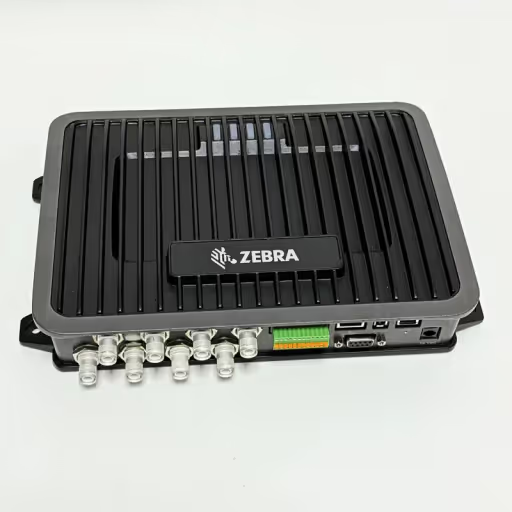
Zebra FX9600 Fixed RFID Reader: Price in India (4/8 Port)
Enterprise 4-port and 8-port fixed UHF RFID reader for high-throughput warehouse portals.

Chainway C72 UHF RFID Reader: Price in India & Specs
Android mobile terminal for rapid 700+ tags/sec inventory audits.
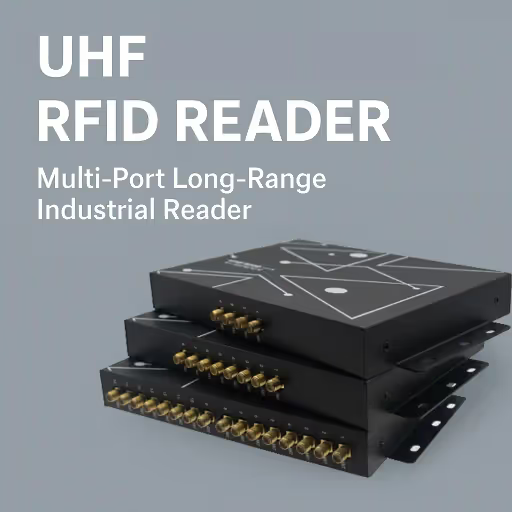
Fixed RFID Reader India and UHF 4-Port Reader Portals
4-port industrial UHF fixed reader for dock doors and conveyor portals.

UHF Inlay Labels and Printable RFID Tags for Packaging
High-sensitivity printable RAIN RFID adhesive labels.

RFID Handheld Reader Software for AUTOID Mobile Terminals
Mobile Android software for fast goods-in registration, cycle counts, and item search.
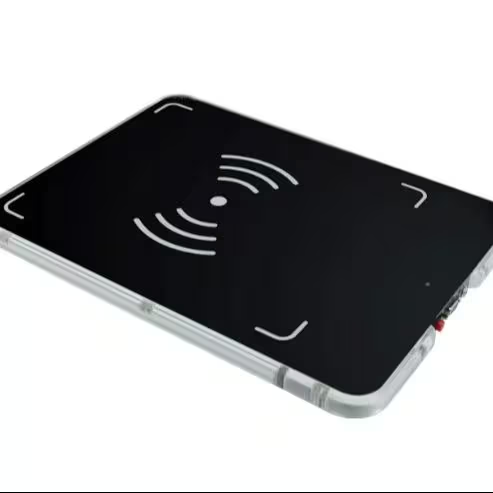
UHF Desktop RFID Reader and Writer USB Tag Programmer
USB Desktop UHF reader & writer for tag commissioning and item validation.
Pan-India Industrial Distribution Network Transfer Tracking
Problem
Goods moving between state warehouses faced tax sample discrepancies, inter-branch transfer variances, and slow paper reconciliations.
Solution
Rain RFID item tagging, GST E-way bill API mapping, and offline-capable edge sync for remote Indian distribution nodes.
Results
- Reduced tax audit preparation time from 3 days to 10 minutes
- Achieved zero stock variance across 20+ distribution hubs
- Shortened month-end financial closing by 4 days
Frequently asked questions
How does the system operate during internet downtime at remote tier-2/3 warehouse sites?
Can RFID item tracking reconcile directly with GST tax invoice filings?
What is the read range of UHF RFID handheld scanners in Indian warehouse conditions?
How does passive RAIN UHF RFID handle metal surfaces or liquids in inventory tracking?
Can the RFID inventory management software integrate with existing Tally, SAP, or custom ERP systems?
Discover more
You may also like
Hand-picked articles and pages worth your time next.

RFID Vehicle Tracking & Automated Toll Management
FASTag UHF windshield vehicle tracking, automated toll barriers, and fleet gate dispatch.

RFID for Warehouses India | Dock Door & ASN Verification
Warehouse RFID across India for ASN validation, pick verification, and cycle counts using UHF portals and handhelds.
Fixed RFID Reader India and UHF 4-Port Reader Portals
Buy fixed RFID reader India models (865-867 MHz). High-performance 4 port UHF reader for dock doors and conveyor systems. Inquire online now.
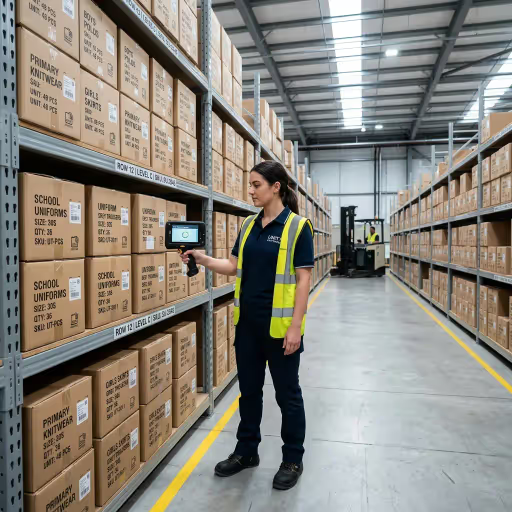
Apparel Warehouse RFID Inventory Automation | Case Study
Case study: School Time Uniforms deploys UHF RFID handheld scanners and automated warehouse middleware for 99.8% dispatch accuracy and zero stock-outs.

RFID Cost & TCO Guide: Capex, Opex & Hardware Pricing (2026)
Complete RFID cost breakdown: tag price scaling ($0.04–$0.15), fixed dock portals vs handheld readers, middleware licensing, and 3-year TCO budgeting.