
Industry
RFID for Warehouses India
Warehouse RFID across India for ASN validation, pick verification, and cycle counts using UHF portals and handhelds.

Simulate, evaluate, or request turnkey hardware & middleware deployment
-
up to 99%
Inventory accuracy (typical UHF rollout)
with tuned tags and processes
-
25–45%
Labor efficiency
vs manual cycle counts (varies by baseline)
-
hundreds/sec
Read throughput
fixed reader portals, SKU dependent
Operational Transformation: Manual Barcode Staging vs. Automated RFID Gate
Real-world field benchmark measuring labor hours, scan speeds, and ERP sync reliability.
Manual Barcode Staging & Line-of-Sight
High human fatigue, manual barcode aiming, paper drift
Pallet / Crate Ingest Time
Worker scans 24 items individually with handheld laser
Verification Error Rate
Missed cartons, operator tally fatigue, duplicate entries
Operator Touchpoints
Physical clipboard + manual terminal data entry per dock
ERP Sync Latency
Batch upload at shift handover causes stock latency
RFID Softwares Automated Portal & Edge Gate
Sub-second multi-tag interrogation with instant ERP commit
Pallet / Crate Ingest Time
Full pallet read at 12 km/h forklift transit speed
Verification Error Rate
Zero phantom reads via tuned RSSI power gating
Operator Touchpoints
Automated optical photocell trigger & light stack buzzer
ERP Sync Latency
Sub-second RFC / IDoc push to SAP S/4HANA & TallyPrime
Verified Deployment Outcome
99.3% Labor Time Cut • 100% Audit-Proof Physical-to-Digital ERP Traceability
Warehouse & Logistics: Interactive Physics Models & Video Demos
Experience dock door ingest, dispatch loading, and watch carton tracking and on-metal trolley videos.
Video Demo: Warehouse UHF RFID Pallet & Stock Audit
Full-Rack Inventory Verification in Seconds with Zero Line-of-Sight Scanning
Forklift Pallet RFID Dock Ingest
Simulates 24-carton pallet reads, photocell triggers, and sub-second PO validation.
Outbound Freight Trailer Loading
Simulates dual-dock trailer packing, conveyor feeds, and automated BOL verification.
3D Isometric Warehouse RTLS & Stock Depletion
Multi-zone overhead reader array tracking live stock depletion as order pickers retrieve boxes.
Edge-to-ERP Data Pipeline Blueprint
How RFID for Warehouses India | Dock Door & ASN Verification ingests thousands of physical tag reads per minute, suppresses duplicate RF bounces, and synchronizes with your central ERP in sub-second intervals.
The Problem Solved in Plain English:
Standard RFID readers flood servers with 50,000 raw scans every minute, crashing databases with duplicate reads. Our middleware acts as a smart edge filter—it recognizes when the same item sits in front of a scanner, registers it exactly once, and queues the data locally so no scans are lost even if warehouse Wi-Fi drops.
RF Backscatter
UHF tags energize via 865–867 MHz CW carrier wave. Backscatters 96-bit SGTIN EPC identifiers.
• Anti-collision: Q-algorithm
Lock-Free Channel
Reads stream across high-speed LLRP / TCP sockets into an in-memory ring buffer with bounded backpressure.
• Latency: < 2.5ms jitter
Sliding Cooldown
Central 60-second sliding window filters duplicate reflections across adjacent gates before storage.
• Offline auto-reconnect
Enterprise ERP Post
Gzip-compressed batch payloads dispatch via REST webhook or direct OData / XML connector to ERP.
• Retries: Exponential backoff
Architecture Comparison: Traditional vs. OpenRFID Edge Engine
| Operational Factor | Traditional Direct-to-DB Connection | OpenRFID High-Scale Edge Architecture |
|---|---|---|
| Network Downtime / Wi-Fi Loss | ❌ Scans are permanently lost; inventory mismatch occurs. | ✅ Scans buffer to local SQLite WAL queue and auto-sync when restored. |
| Duplicate Tag Reads | ❌ 100+ DB transactions per second for the exact same physical tag. | ✅ 60-second in-memory sliding window suppresses redundant scans. |
| ERP System Load | ❌ Heavy server load causes timeout errors on ERP billing APIs. | ✅ Consolidated 1,000-EPC compressed batches post in single atomic calls. |
What is RFID for warehouses in India?
Deploying a pan-India RFID for warehouses India solution streamlines dock door receiving, pallet verification, and cycle counting for high-velocity distribution centers. Based on enterprise logistics benchmarks at US Army logistics hubs and CoreRFID integrated sites, fixed UHF RFID portals operating on the 865-867 MHz band verify hundreds of tagged cases on moving forklifts with zero manual barcode scanning.
How does RFID for warehouses in India work in India?
Operationally, reads move from antennas to reader firmware, then to edge or cloud middleware where duplicate reads collapse, RSSI helps pick a winning observation, and state machines decide when a tag transition counts as a move, ship, or receipt. For RFID for warehouses in India, the workflow usually starts with encode-and-print (or pre-encoded inbound tags), continues through portal or handheld verification at choke points, and ends with reconciliation jobs that post only when confidence thresholds are met. Handheld sleds remain essential for exceptions: damaged labels, shielded metals, or rework benches where operators need a human-readable tie to the EPC. Across Noida, Delhi NCR, and pan-India rollouts, we stage go-live in waves so hypercare overlaps with your peak season only when the system is already stable on pilot lanes.
Benefits for Indian operations
DC teams measuring RFID for warehouses in India lead with dock-to-stock gains, fewer ASN mismatch investigations, and cycle-count labor that stops growing linearly with SKU breadth. Teams that measure before and after typically cite fewer mis-picks, shorter cycle-count windows, and clean month-end samples—often landing in the high nineties for inventory accuracy when processes, not only hardware, are tuned. Labor efficiency gains of roughly twenty-five to forty-five percent show up when operators stop line-scanning barcodes on fast movers and instead sweep zones with validated RFID paths—exact uplift depends on SKU complexity and discipline. GST-era audits and inter-branch transfers benefit when each movement has a timestamped RFID trail that reconciles to invoices without manual re-keying.
India-specific use cases
Warehouse scenarios center on dock portals, mixed-SKU pallets, returns processing, and WMS exception codes your supervisors already recognize. On the ground, RFID for warehouses in India rollouts layer in humid monsoon seasons that affect label adhesives, dust in northern plains warehouses, and integration with local ERP habits (batch postings, tolerance rules, and offline store sync). Retail backrooms in metros, pharma cold-chain handoffs, and automotive spare parts hubs each demand different tag families and reader densities; copy-paste layouts from other countries usually fail RF validation here. RFID Softwares documents SOPs in English and Hindi where teams need them, and we align exception codes with how your supervisors already think about shrink and adjustments.
Hardware integration (Zebra, Impinj, UHF RFID)
Hardware is deliberately multi-vendor: Zebra fixed and handheld readers, Impinj RAIN reader ecosystems, and complementary antennas are common anchors because spare availability and SDK maturity matter for Indian SLAs. We specify circular versus linear polarization, cable loss budgets, and mounting hardware for dock portals, tunnel readers, or aisle choke points—then tune LLRP power floors so neighboring lanes do not cross-read. On-metal and liquid-rich SKUs may need specialized tags; HF/NFC at 13.56 MHz still wins for short-range identity in some library, badge, or kiosk flows. Printers that encode-and-verify EPCs at the edge reduce bad tags entering the supply chain, especially important for garment and jewelry programs where returns are costly.
Pricing overview (indicative)
Warehouse deployment costs weight dock portals, handheld exception ratios, middleware filters, and WMS person-days for idempotent posting rules. Indicative budgets split into tags (recurring volume), readers and antennas (capex with depreciation), middleware and software (annual or per-site), plus integration services sized in person-days—not generic per-device guesses. Use the RFID solution estimator under Resources for a non-binding range; formal quotes follow a BOM review, site survey, and clarification on ERP adapters. Taxes, freight, AMC, and training are line-itemed separately so procurement committees see where flexibility exists without compromising read reliability.
How to implement RFID for warehouses in India step-by-step?
A practical implementation plan for RFID for warehouses in India starts with a narrow pilot charter: define success metrics (accuracy, cycle-count hours, mis-ship rate) and pick one lane or SKU family that represents real RF constraints. Next, lock tag selection (on-metal vs paper, adhesive behavior, print/encode discipline) and do a site RF survey to set antenna geometry and power floors that avoid cross-reads. Then, configure middleware rules: de-duplication windows, read confidence thresholds, and idempotent ERP/WMS posting so retries don’t create duplicate movements. Finally, train operators on exceptions and run a phased go-live with hypercare, so the workflow stabilizes before expanding tag volumes across additional sites in India.
RFID vs barcode: which is better?
RFID and barcode are often complementary. Barcode is cost-effective when you can enforce line-of-sight scanning and item volumes are manageable. UHF RFID becomes compelling when you need faster throughput, bulk visibility, or reduced manual scanning—especially at dock doors, high-velocity picking, and store replenishment cycles. A good decision test is operational: if humans routinely skip scans or scan errors remain high, RFID’s automated reads and audit trail can materially reduce exceptions in Indian operations.
Case study snapshot
Warehouse case studies anchor on dock ASN match rates, mis-ship samples, and supervisor hours reclaimed during peak festive loads. A representative deployment pattern starts with one high-value lane or SKU family, proves read stability and middleware rules, then expands tagging rates while keeping WMS posting latency within agreed SLAs. RFID Softwares keeps an executive-friendly readout—exceptions per thousand reads, recount hours avoided, and dock turnaround—so expansion decisions are evidence-led rather than faith-led.
What is RFID for warehouses in India in practice?
In DCs, warehouse automation is portal confidence on mixed pallets, handheld fallbacks that supervisors trust, and WMS events that do not duplicate under retries. When teams ask what RFID for warehouses in India means in day-to-day operations, the answer is almost always about event design: which reads count as inventory, which reads are ignored as jitter, and how your ERP tolerates idempotent posts. Pilots should script those answers in middleware before scaling tag volumes, otherwise finance sees noise instead of signal.
How RFID improves warehouse and logistics efficiency
For warehouse and logistics throughput, RFID for warehouses in India improves efficiency because it changes where humans spend time: less line-scanning, fewer exception hunts, more time on exceptions that truly need judgment. Portals and handheld exceptions together attack mis-ship rates and cycle-count labor where barcode-only models plateau. Zebra and Impinj-class reader platforms simply provide dependable physics; the efficiency win is in the workflow redesign and middleware discipline that RFID Softwares ships with the hardware.
Interactive RFID Engineering Tools & Calculators
Use our free interactive calculators and simulators to model RF physics, calculate link budgets, estimate ROI, and configure EPC tags.
RFID ROI & Payback Calculator
Calculate 12-month return on investment, shrinkage reduction, and labor hours saved for your facility.
RFID Project Cost Estimator
Estimate turnkey budget breakdown including readers, antennas, tags, cloud software, and on-site engineering.
Site Survey Checklist Generator
Generate a customized engineering checklist covering RF noise floors, power drops, and portal mounting requirements.
Optimizing High-Throughput Warehouse Portals & Dock Doors?
Eliminate missed reads and stray tag crosstalk. Talk to our RFID RF engineers about dock door portal design, tag selection, and ERP auto-ingestion.
Representative deployment pattern
Problem
Manual counts and barcode exceptions slowed month-end close and audits.
Solution
Phased UHF tagging, portal readers at dock doors, middleware to WMS, and handheld exceptions.
Results
- Fewer stockouts after 90 days
- Faster cycle counts
- Cleaner audit samples
Frequently asked questions
How do fixed dock door portals read 800+ carton tags per second through shrink wrap?
What is the difference between S0 and S1 Gen2 sessions for forklift pallet scanning?
How does edge middleware prevent adjacent dock doors from cross-reading pallets?
What is RFID logistics tracking India used for?
How does RFID inventory tracking warehouse India improve accuracy?
Is RFID tracking system for warehouse India expensive?
Discover more
You may also like
Hand-picked articles and pages worth your time next.

RFID Warehouse Management System Architecture: Dock Doors & ERP Sync Blueprint
Engineering blueprint for automated RFID warehouse tracking. Dock door portal geometry, 1,200 tag/sec dense reader modes, forklift mounts, and SAP BAPI / Tally sync.
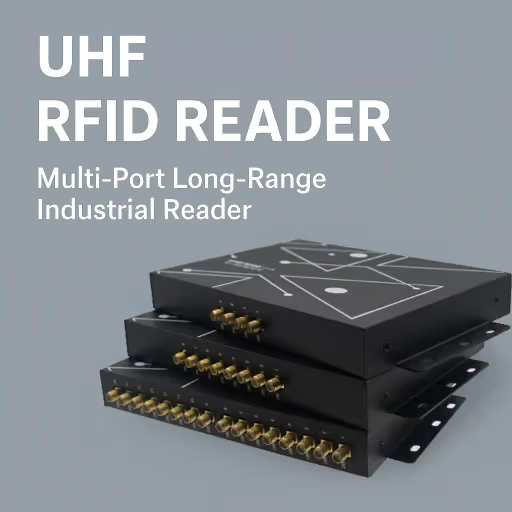
Fixed RFID Reader India and UHF 4-Port Reader Portals
Buy fixed RFID reader India models (865-867 MHz). High-performance 4 port UHF reader for dock doors and conveyor systems. Inquire online now.
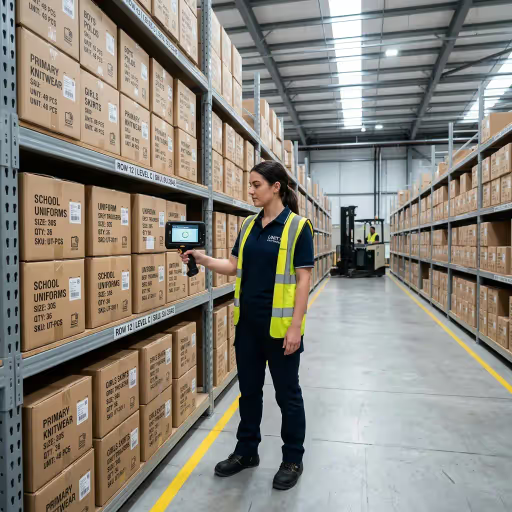
Apparel Warehouse RFID Inventory Automation | Case Study
Case study: School Time Uniforms deploys UHF RFID handheld scanners and automated warehouse middleware for 99.8% dispatch accuracy and zero stock-outs.

RFID Cost & TCO Guide: Capex, Opex & Hardware Pricing (2026)
Complete RFID cost breakdown: tag price scaling ($0.04–$0.15), fixed dock portals vs handheld readers, middleware licensing, and 3-year TCO budgeting.