
Solution
UHF RFID Software India: Edge Middleware & LLRP SDK
Enterprise UHF RFID software & LLRP middleware in India. Sub-10ms tag deduplication, SAP/Tally sync, WPC compliance & free developer trial. Pan-India support.
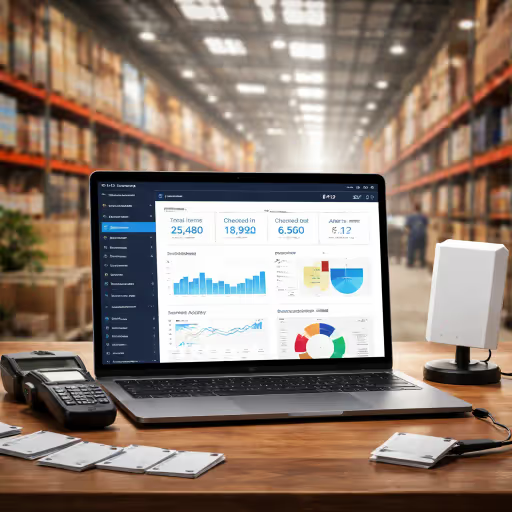
Simulate, evaluate, or request turnkey hardware & middleware deployment
-
<50ms
Edge latency
tag filtering and de-duplication
-
250,000+ reads/day
Throughput
per reader cluster
-
99.99%
System uptime
mission-critical operations
Operational Transformation: Manual Barcode Staging vs. Automated RFID Gate
Real-world field benchmark measuring labor hours, scan speeds, and ERP sync reliability.
Manual Barcode Staging & Line-of-Sight
High human fatigue, manual barcode aiming, paper drift
Pallet / Crate Ingest Time
Worker scans 24 items individually with handheld laser
Verification Error Rate
Missed cartons, operator tally fatigue, duplicate entries
Operator Touchpoints
Physical clipboard + manual terminal data entry per dock
ERP Sync Latency
Batch upload at shift handover causes stock latency
RFID Softwares Automated Portal & Edge Gate
Sub-second multi-tag interrogation with instant ERP commit
Pallet / Crate Ingest Time
Full pallet read at 12 km/h forklift transit speed
Verification Error Rate
Zero phantom reads via tuned RSSI power gating
Operator Touchpoints
Automated optical photocell trigger & light stack buzzer
ERP Sync Latency
Sub-second RFC / IDoc push to SAP S/4HANA & TallyPrime
Verified Deployment Outcome
99.3% Labor Time Cut • 100% Audit-Proof Physical-to-Digital ERP Traceability
Software Middleware: Interactive Models & Mobile Demo
See how our LLRP edge middleware and mobile scanner apps buffer and sync EPC data in real time.
RFID Handheld Reader Software for AUTOID Mobile Terminals
Android app for seamless RFID data capture
Forklift Pallet RFID Dock Ingest
Simulates 24-carton pallet reads, photocell triggers, and sub-second PO validation.
Edge-to-ERP Data Pipeline Blueprint
How UHF RFID Software India: Edge Middleware & LLRP SDK ingests thousands of physical tag reads per minute, suppresses duplicate RF bounces, and synchronizes with your central ERP in sub-second intervals.
The Problem Solved in Plain English:
Standard RFID readers flood servers with 50,000 raw scans every minute, crashing databases with duplicate reads. Our middleware acts as a smart edge filter—it recognizes when the same item sits in front of a scanner, registers it exactly once, and queues the data locally so no scans are lost even if warehouse Wi-Fi drops.
RF Backscatter
UHF tags energize via 865–867 MHz CW carrier wave. Backscatters 96-bit SGTIN EPC identifiers.
• Anti-collision: Q-algorithm
Lock-Free Channel
Reads stream across high-speed LLRP / TCP sockets into an in-memory ring buffer with bounded backpressure.
• Latency: < 2.5ms jitter
Sliding Cooldown
Central 60-second sliding window filters duplicate reflections across adjacent gates before storage.
• Offline auto-reconnect
Enterprise ERP Post
Gzip-compressed batch payloads dispatch via REST webhook or direct OData / XML connector to ERP.
• Retries: Exponential backoff
Architecture Comparison: Traditional vs. OpenRFID Edge Engine
| Operational Factor | Traditional Direct-to-DB Connection | OpenRFID High-Scale Edge Architecture |
|---|---|---|
| Network Downtime / Wi-Fi Loss | ❌ Scans are permanently lost; inventory mismatch occurs. | ✅ Scans buffer to local SQLite WAL queue and auto-sync when restored. |
| Duplicate Tag Reads | ❌ 100+ DB transactions per second for the exact same physical tag. | ✅ 60-second in-memory sliding window suppresses redundant scans. |
| ERP System Load | ❌ Heavy server load causes timeout errors on ERP billing APIs. | ✅ Consolidated 1,000-EPC compressed batches post in single atomic calls. |
High-Performance LLRP Edge Middleware & C#/.NET 8 Architecture
OpenRFID Middleware connects to any ISO 18000-6C compliant fixed reader via standard Low Level Reader Protocol (LLRP) or native vendor protocols (Zebra, Impinj, Chainway). Built on .NET 8, the engine processes 5,000+ tag reads per second per channel with sub-millisecond event dispatching and zero GC pressure.
Multi-Reader Orchestration & Zone State Machine Engine
The middleware abstracts physical reader hardware into logical business zones (e.g. Inward Dock, Staging Bay, Sorting Conveyor, Dispatch Gate). Configurable state machines track tag transit direction, apply RSSI threshold filters, and generate clean business events (Item_Received, Pallet_Loaded, Asset_Moved).
Enterprise REST Webhooks, MQTT & gRPC Streaming APIs
Developers integrate physical RFID hardware into their custom applications in minutes using standard REST webhooks, WebSocket live streams, high-speed gRPC feeds, and MQTT topics. Pre-built connectors bridge directly into SAP S/4HANA, Tally Prime, and Microsoft SQL Server.
Interactive RFID Engineering Tools & Calculators
Use our free interactive calculators and simulators to model RF physics, calculate link budgets, estimate ROI, and configure EPC tags.
TallyPrime Live RFID Tester
Test live Port 9000 XML connectivity, stock queries, and virtual RFID Stock Journal voucher posting in your browser.
SAP S/4HANA Cloud Tester
Execute live OData v2/v4 reads and simulate Goods Receipt 101 / Goods Issue 201 RFID movements in your browser.
Zoho Inventory Cloud Tester
Test live Zoho Inventory REST API v1 queries and validate 100 req/min rate-limit micro-batching directly in your browser.
Need a custom uhf rfid software india: edge middleware & llrp sdk deployment?
Every environment has distinct RF absorption and ERP sync constraints. Let's review your exact workflow and design an end-to-end blueprint.
Deployed hardware & software
Products & Hardware Deployed in This Solution
Discover the professional-grade RFID readers, tags, and custom integration software systems implemented in this deployment.

RFID Handheld Reader Software for AUTOID Mobile Terminals
Mobile Android software for fast goods-in registration, cycle counts, and item search.

Chainway C72 UHF RFID Reader: Price in India & Specs
Android mobile terminal for rapid 700+ tags/sec inventory audits.

Koha SIP2 RFID Connector Software | Library Automation License & Pricing
Enterprise SIP2 and NCIP middleware connector for database synchronization.
High-Density Event Access Control & RFID Toll Logistics
Problem
High-speed vehicle and crowd choke points experienced dropped reads and duplicate database writes due to RF jitter and crosstalk.
Solution
Edge middleware with LLRP engine, Impinj Octane SDK integration, RSSI signal filtering, and dynamic debounce windows operating in the 865–867 MHz WPC band.
Results
- Processed over 250,000 tag reads daily with <50ms response time
- Zero duplicate database commits during peak traffic surges
- Full compliance with Indian WPC 865–867 MHz spectrum rules
Frequently asked questions
How does RFID middleware prevent duplicate tag reads from overloading ERP servers?
Does the software support multi-vendor readers simultaneously?
What reader communication protocols are supported by the edge middleware?
How does the middleware filter out redundant or duplicate tag reads?
Is the software compliant with WPC India frequency regulations?
Discover more
You may also like
Hand-picked articles and pages worth your time next.
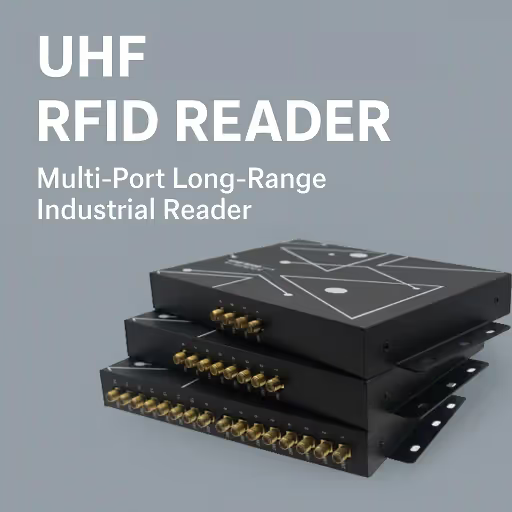
Fixed RFID Reader India and UHF 4-Port Reader Portals
Buy fixed RFID reader India models (865-867 MHz). High-performance 4 port UHF reader for dock doors and conveyor systems. Inquire online now.
RFID Handheld Reader Software for AUTOID Mobile Terminals
Customize asset tracking with RFID handheld reader software. Features Android app for AUTOID scanner and seamless ERP sync. Contact for demo.
RFID Middleware & SDK Integration Services
Enterprise RFID middleware and SDK integration services. LLRP socket listeners, sliding-window deduplication, and direct SAP / TallyPrime pipelines.

RFID Standards Guide India | WPC, GS1 & ISO 18000-6C
Guide to RFID standards in India. Official WPC 865–867 MHz ETA regulations GSR 564(E), GS1 EPC Gen2v2 air-interface, ISO 18000-6C & cryptographic tag security.