
Solution
RFID Asset Tracking Software & Systems: On-Metal IT Audits
Enterprise RFID asset tracking software in India. Mobile Geiger-counter radar, on-metal IT server tagging, and automated FAR audit reconciliation.

Simulate, evaluate, or request turnkey hardware & middleware deployment
-
82% faster
Audit cycle reduction
vs manual barcode scans
-
<0.1%
Unlocated assets
down from 7.5%
-
100%
Compliance readiness
SOX / ISO audit compliance
Industrial Manufacturing Transformation: Manual Paper Route vs. Real-Time RFID WIP
Field measurements for work-in-progress tracking, tool & die localization, and metal assembly gates.
Manual Paper Route Cards & Spreadsheets
Paper cards getting dirty/lost, manual terminal entry, misplaced dies
WIP Station Transition Check
Operator fills paper log & manual barcode scan
Tool / Die Search Time
Searching physical shop floor for custom tooling
Production Bottleneck Visibility
Management discovers line delays 8 hours late
High-Heat / Metal Read Failure
Damaged paper stickers in harsh oily wash bays
RFID Softwares On-Metal & RTLS Gateway
Tuned on-metal PCB tags & automated overhead portal antennas
WIP Station Transition Check
Conveyor portal reads on-metal tag without stopping
Tool / Die Search Time
Sub-meter zone location on shop-floor 3D tablet
Production Bottleneck Visibility
Live queue alert if station cycle exceeds threshold
High-Heat / Metal Read Failure
IP68 ceramic & PCB on-metal UHF tags withstand 200°C
Verified Deployment Outcome
Zero Unplanned Shop Floor Search Time • 100% Traceable Digital WIP History
Asset Management: 3D Zone Model & IT Hardware Video
Track physical assets across facility zones and watch mobile QR/RFID auditing in enterprise IT rooms.
Video Demo: RFID IT Asset Management & Laptop Tracking
Automated data center, server rack, and corporate laptop tracking
3D Isometric Warehouse RTLS & Stock Depletion
Multi-zone overhead reader array tracking live stock depletion as order pickers retrieve boxes.
Edge-to-ERP Data Pipeline Blueprint
How RFID Asset Tracking Software & Systems: On-Metal IT Audits ingests thousands of physical tag reads per minute, suppresses duplicate RF bounces, and synchronizes with your central ERP in sub-second intervals.
The Problem Solved in Plain English:
Standard RFID readers flood servers with 50,000 raw scans every minute, crashing databases with duplicate reads. Our middleware acts as a smart edge filter—it recognizes when the same item sits in front of a scanner, registers it exactly once, and queues the data locally so no scans are lost even if warehouse Wi-Fi drops.
RF Backscatter
UHF tags energize via 865–867 MHz CW carrier wave. Backscatters 96-bit SGTIN EPC identifiers.
• Anti-collision: Q-algorithm
Lock-Free Channel
Reads stream across high-speed LLRP / TCP sockets into an in-memory ring buffer with bounded backpressure.
• Latency: < 2.5ms jitter
Sliding Cooldown
Central 60-second sliding window filters duplicate reflections across adjacent gates before storage.
• Offline auto-reconnect
Enterprise ERP Post
Gzip-compressed batch payloads dispatch via REST webhook or direct OData / XML connector to ERP.
• Retries: Exponential backoff
Architecture Comparison: Traditional vs. OpenRFID Edge Engine
| Operational Factor | Traditional Direct-to-DB Connection | OpenRFID High-Scale Edge Architecture |
|---|---|---|
| Network Downtime / Wi-Fi Loss | ❌ Scans are permanently lost; inventory mismatch occurs. | ✅ Scans buffer to local SQLite WAL queue and auto-sync when restored. |
| Duplicate Tag Reads | ❌ 100+ DB transactions per second for the exact same physical tag. | ✅ 60-second in-memory sliding window suppresses redundant scans. |
| ERP System Load | ❌ Heavy server load causes timeout errors on ERP billing APIs. | ✅ Consolidated 1,000-EPC compressed batches post in single atomic calls. |
Unified Fixed Portal & Mobile Handheld Asset Audits
Enterprise IT departments and corporate offices deploy dual fixed and mobile RFID tracking. Fixed overhead readers monitor high-value asset transit between departments and server rooms, while mobile handheld scanners conduct rapid quarterly physical verification of laptops, workstations, and network switches.
Acoustic Geiger-Counter Proximity Locating for Missing Equipment
When an asset is misplaced, auditors select the item on the mobile scanner app. As the operator walks the office, the reader's directional antenna increases acoustic beeping frequency and visual signal strength as it nears the tag, locating hidden laptops inside locked cabinets or under desks in seconds.
ServiceNow, Jira & Active Directory CMDB Integration
Scanned asset tags automatically synchronize with IT Service Management (ITSM) and Configuration Management Databases (CMDB). Scans update device custody, location history, warranty expiry, and depreciation schedules compliant with ISO 27001 audit standards.
Interactive RFID Engineering Tools & Calculators
Use our free interactive calculators and simulators to model RF physics, calculate link budgets, estimate ROI, and configure EPC tags.
EPC-96 Header & Serial Converter
Encode and decode SGTIN-96, SSCC-96, and GRAI-96 GS1 data structures to/from raw Hex and Binary EPC memory.
TID & Memory Bank Calculator
Inspect EPC Gen2 memory layouts (Reserved, EPC, TID, User memory) across Impinj, NXP, and Alien ICs.
RFID Tag Selection Wizard
Filter through on-metal, wet inlay, cryogenic, laundry, and apparel tags based on surface material and read distance.
Deploying RFID on Metal or Extreme Temperature Production Lines?
High-heat paint shops, robotic welding cells, and engine assembly lines require specialized on-metal tags and tuned circular polarized antennas.
Deployed hardware & software
Products & Hardware Deployed in This Solution
Discover the professional-grade RFID readers, tags, and custom integration software systems implemented in this deployment.

UHF Anti Metal RFID Tags (Pack of 100) | Heavy-Duty Industrial Equipment Tag Pricing
Rugged high-dielectric tags for metal IT assets, servers, and factory machinery.

Chainway C72 UHF RFID Reader: Price in India & Specs
Android mobile terminal for rapid 700+ tags/sec inventory audits.
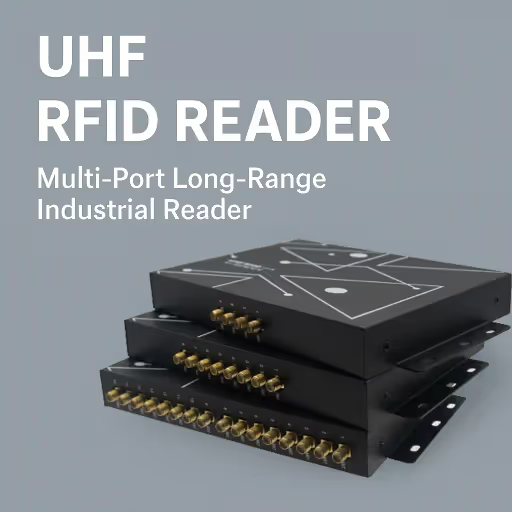
Fixed RFID Reader India and UHF 4-Port Reader Portals
4-port industrial UHF fixed reader for checkpoint portals.

UHF PVC Cards and Long Range RFID Access Badges
Printable long-range PVC cards for asset badges and personnel identification.
Enterprise IT & Datacenter Fixed Asset Audit
Problem
Multi-city corporate offices struggled to audit thousands of server blades, laptops, and networking hardware for annual financial compliance.
Solution
On-metal anti-tamper PCB tags for server racks, flag tags for cabling, Android handheld RFID readers, and automated sync with SAP/Oracle Fixed Asset modules.
Results
- Reduced multi-office IT audit time from 6 weeks to 3 days
- Eliminated ghost assets from financial balance sheets
- Achieved 100% SOX and ISO audit compliance
Frequently asked questions
Why do standard RFID tags fail on metal laptops, and how do on-metal tags fix this?
How does the system track asset transfers between different city branches?
How does on-metal RFID tagging work for IT server blades and rack units?
What is the speed difference between manual asset audits and RFID sweep audits?
Can RFID asset tracking automate fixed asset depreciation and audit reports for tax compliance?
Discover more
You may also like
Hand-picked articles and pages worth your time next.
Enterprise RFID ROI & Payback Calculator
Calculate 3-year labor savings, shrinkage reduction, and investment payback timeline.

RFID for Manufacturing India | WIP & Tool Room Tracking
Manufacturing RFID for WIP, finished goods, and logistics gates with on-metal tags and industrial-grade readers.

RFID for Logistics India | 3PL Cross-Dock & Fleet Gate Automation
Automate 3PL logistics, cross-dock dispatch, and inter-hub freight in India with UHF RFID gate portals, e-seal tracking, and TMS sync.
Fixed RFID Reader India and UHF 4-Port Reader Portals
Buy fixed RFID reader India models (865-867 MHz). High-performance 4 port UHF reader for dock doors and conveyor systems. Inquire online now.
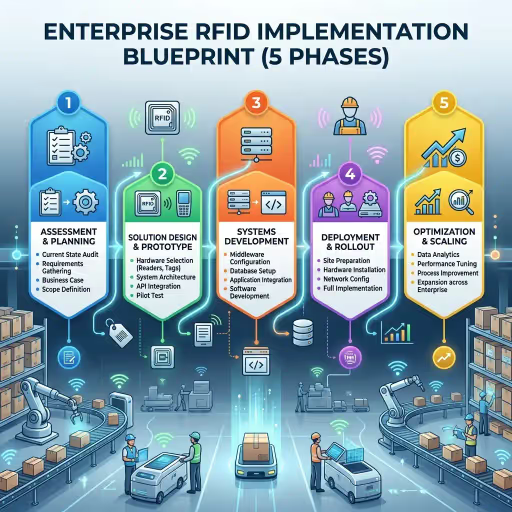
Step-by-Step RFID Implementation Guide India
Comprehensive 5-phase RFID implementation guide for India: RF site survey, tag surface selection, dock portal tuning, WMS sync & hypercare support.
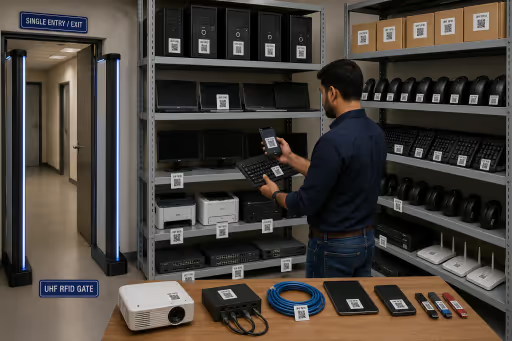
RFID IT Asset Management Case Study | Store Room Control
Case study: How an automated IT asset room with UHF RFID gates & access-controlled doors eliminated IT store shrinkage and automated laptop issue logs.