
Resource
RFID vs RTLS: Zone Presence vs Real-Time Coordinate Tracking
Compare passive RFID zone tracking with active RTLS (BLE, UWB, Wi-Fi). Understand accuracy, battery life, cost per asset, and deployment trade-offs in India.

-
₹5 – ₹40 / Tag
Passive RFID Tag Cost
10-year battery-free lifespan
-
10 – 30 cm Accuracy
RTLS UWB Precision
active coordinate positioning
-
3x – 5x Difference
Infrastructure Capex
choke points vs mesh anchors
Core architectural difference: Choke point zone presence vs continuous X-Y-Z coordinate tracking
Understanding the distinction between Passive RFID and Real-Time Location Systems (RTLS) is essential for industrial system architects. Passive RFID operates on an event-driven interrogation model—it registers when a tagged item physically crosses a fixed choke point (such as a warehouse dock door, tool room portal, or conveyor scanner). In contrast, RTLS operates on a continuous transmission model—active battery-powered beacons continuously broadcast wireless signals to a mesh grid of fixed ceiling receivers (anchors), calculating the object's exact live X-Y-Z coordinates on a facility floor plan using Time of Flight (ToF) or Angle of Arrival (AoA) trilateration.
Passive UHF RFID mechanics: High asset density, zero maintenance, and low tag costs
For facilities tracking tens of thousands or millions of inventory items (apparel cartons, pharmaceuticals, returnable crates, document folders), passive UHF RFID is unmatched in cost-efficiency. Passive tags cost between ₹5 and ₹40 each, require zero batteries, and last for over 10 years in harsh industrial conditions. Fixed readers mounted at doorways provide discrete zone status (e.g. "Carton #4819 entered Aisle 3 at 10:42 AM"), which fulfills 95% of enterprise inventory control and supply chain traceability requirements.
Active RTLS technologies: Ultra-Wideband (UWB), Bluetooth Low Energy (BLE), and Wi-Fi
When a business requires sub-meter live visibility—such as tracking moving forklifts to prevent pedestrian collisions, monitoring hospital crash carts in real time, or tracking work-in-progress aerospace assemblies through assembly bays—active RTLS is required:
- Ultra-Wideband (UWB): Delivers ultra-precise 10 cm to 30 cm positioning accuracy using nanosecond radio pulses and Time Difference of Arrival (TDOA). High hardware and anchor infrastructure costs.
- Bluetooth Low Energy (BLE 5.1 AoA): Delivers 1 to 2 meter accuracy using directional antenna arrays. Moderate tag costs (₹800–₹1,800/beacon) with 3 to 5 year battery lifespans.
- Wi-Fi Fingerprinting: Uses existing enterprise access points to estimate tag location within 5 to 10 meters. High power consumption.
Technical and financial comparison: RFID vs RTLS Technologies
A side-by-side comparison of passive RFID against active RTLS platforms:
| Feature | Passive UHF RFID | BLE 5.1 (AoA) RTLS | Ultra-Wideband (UWB) RTLS |
|---|---|---|---|
| Location Granularity | Zone Presence (Gateway / Door) | 1 – 2 Meters (Room / Bay) | 10 – 30 cm (Exact Coordinate) |
| Tag Cost | ₹5 – ₹40 per tag | ₹800 – ₹1,800 per beacon | ₹2,500 – ₹6,000 per tag |
| Tag Battery Life | 10+ Years (Battery-Free) | 3 – 5 Years (Replaceable cell) | 1 – 3 Years (Rechargeable) |
| Infrastructure Needed | Portal readers at choke points | Dense ceiling BLE locator grid | Synchronized UWB anchor mesh |
| Tag Density Capacity | Millions of SKUs | Hundreds to thousands of assets | High-value specialized assets |
| Best-Fit Deployment | Warehouse WMS, retail, logistics | Hospital equipment, tool tracking | Forklift safety, WIP automotive |
Enterprise decision matrix: Choosing the right technology for your Indian facility
To determine whether passive RFID or active RTLS is optimal for your facility, apply this decision framework:
- Choose Passive RFID if: Your asset count is high (1,000+ items), items have low-to-medium unit value, tracking last-seen choke point status is sufficient, and battery maintenance across thousands of tags is unfeasible.
- Choose Active RTLS if: You need live moving coordinates on a map, assets are high-value movable equipment (hospital ventilators, aerospace tooling), or worker safety and forklift geofencing require real-time alerts.
Interactive RFID Engineering Tools & Calculators
Use our free interactive calculators and simulators to model RF physics, calculate link budgets, estimate ROI, and configure EPC tags.
RFID ROI & Payback Calculator
Calculate 12-month return on investment, shrinkage reduction, and labor hours saved for your facility.
RFID Project Cost Estimator
Estimate turnkey budget breakdown including readers, antennas, tags, cloud software, and on-site engineering.
Site Survey Checklist Generator
Generate a customized engineering checklist covering RF noise floors, power drops, and portal mounting requirements.
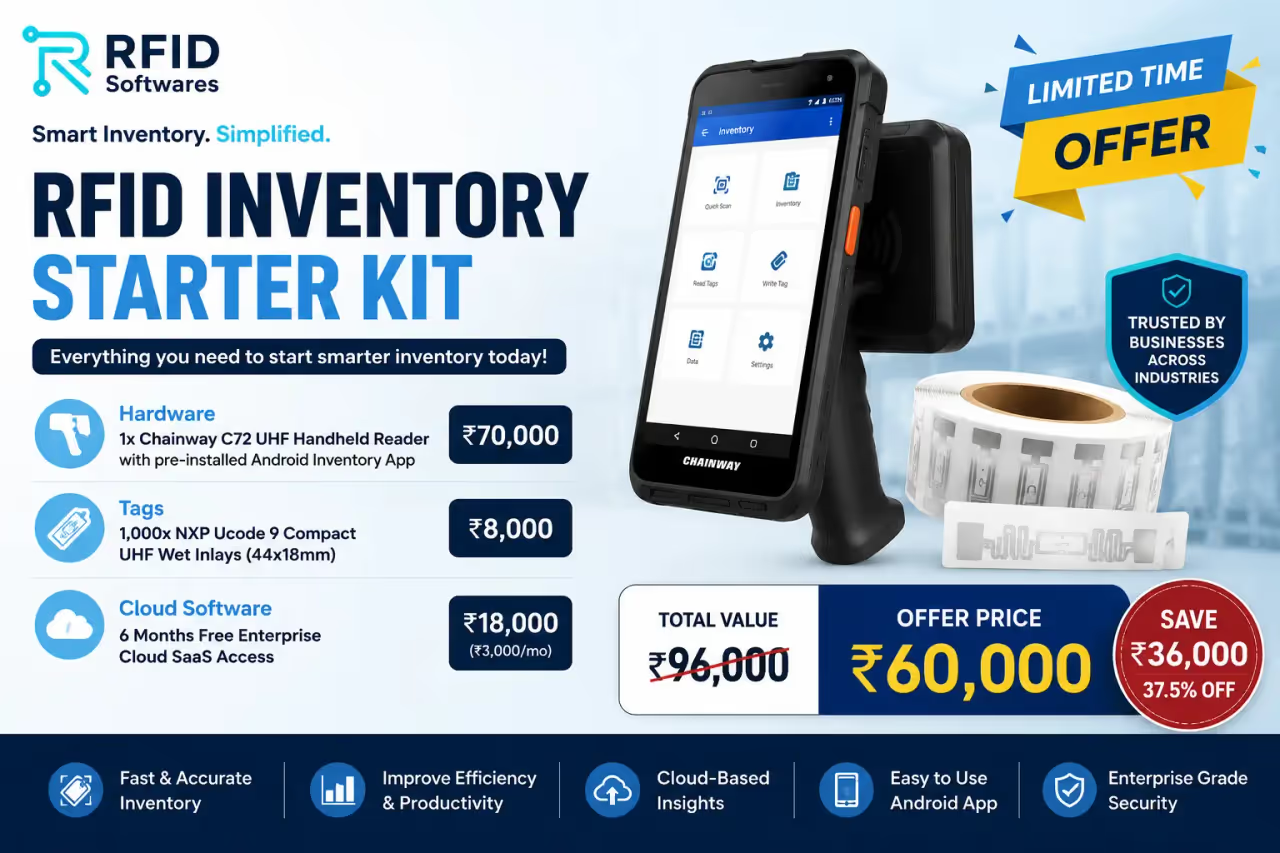
Enterprise RFID Starter Kit (POC Bundle)
Everything your warehouse, retail store, or factory needs to prove RFID feasibility. Complete with industrial hardware, certified tags, and 6 months of cloud platform access.
12–18m read range, IP65 rugged Octa-core Android terminal, 4GB/64GB, fast charger cradle. (C72 / Zebra upgrades available).
High-sensitivity EPC Gen2 inlays for cartons, totes, apparel, and asset tagging.
Real-time mobile sync, cycle counts, stock reconciliation, user roles, and CSV/Excel export.
Need a custom rfid vs rtls: zone presence vs real-time coordinate tracking deployment?
Every environment has distinct RF absorption and ERP sync constraints. Let's review your exact workflow and design an end-to-end blueprint.
Deployed hardware & software
Products & Hardware Deployed in This Solution
Discover the professional-grade RFID readers, tags, and custom integration software systems implemented in this deployment.
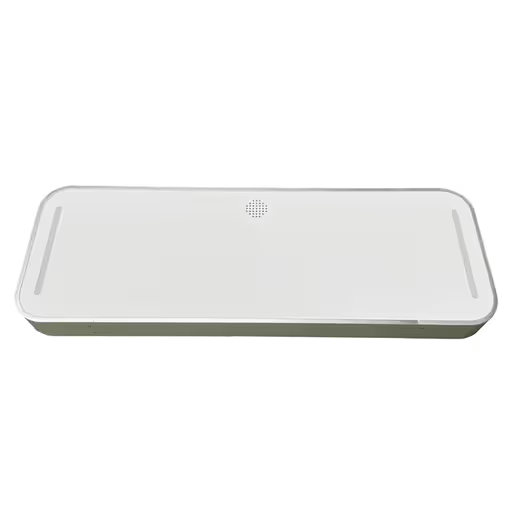
UHF Ceiling RFID Reader for Overhead Asset Tracking
Flush-mount overhead ceiling reader for tracking indoor office assets and clinical corridors.
Frequently asked questions
Can passive RFID show an item moving across a digital floorplan map?
What is the cost difference between RFID tags and RTLS tracking beacons in India?
Can RFID and RTLS be combined in a single hybrid facility deployment?
How accurate is Ultra-Wideband (UWB) RTLS compared to Bluetooth BLE?
Discover more
You may also like
Hand-picked articles and pages worth your time next.

