
Solution
RFID Hospital Management System: Asset & Patient Tracking
Hospital RFID system for ICU equipment tracking, rental asset utilization, and patient safety in Indian healthcare networks.

Simulate, evaluate, or request turnkey hardware & middleware deployment
-
<90 seconds
Equipment search time
down from 35–40 minutes
-
+38% increase
Asset utilization
eliminating unnecessary rental orders
-
99.5%
Audit accuracy
across ICUs and surgical suites
Clinical Asset & Healthcare Transformation: Manual Logs vs. Contactless RFID Tracking
Hospital asset tracking, biomedical calibration logs, and specimen chain of custody.
Manual Logbooks & Barcode Sticking
Missing infusion pumps, uncalibrated instruments, delayed emergency search
Emergency Equipment Hunt Time
Nursing staff searching across hospital wings
Biomedical AMC / Calibration Audit
Physical audit requiring manual serial number checks
High-Value Asset Shrinkage
Wheelchairs, infusion pumps accidentally wheeled out
Audit Compliance Readiness
NABH / ISO audits suffer from incomplete logbooks
RFID Softwares Healthcare RTLS Portal
Zone-level BLE/UHF tags with automated portal exit alarms
Emergency Equipment Hunt Time
Live ward map shows nearest available sterile device
Biomedical AMC / Calibration Audit
Handheld walk-through scans all rooms automatically
High-Value Asset Shrinkage
Immediate acoustic & visual alarm if asset crosses door
Audit Compliance Readiness
Automated digital trail timestamped for every asset
Verified Deployment Outcome
100% Equipment Utilization • Zero Emergency Hunt Delays for Critical Care
Healthcare & Diagnostics: Live System Demonstrations
Watch biomedical equipment tracking, cold-chain smart RFID medical refrigerators, and HL7 hospital laboratory report automation in action.
Video Demo: Hospital Medical Equipment RFID Asset Tracking
Real-Time Healthcare Biomedical Asset Auditing, Ventilator & Patient Monitor Tracking
HL7 v2.5 & ASTM 1394-91 Specimen Tracking Specification
Bidirectional integration architecture bridging ceramic cryo-vial RFID tags to hospital HIS/LIMS databases with zero specimen misidentification.
Manual barcode scanning of hundreds of blood test tubes leads to fatigue, mislabeling, and lost samples. By placing miniature RFID chips on each sample tube, an entire tray of 100 test tubes is identified in 1.5 seconds—instantly verifying patient MRN, collection time, and required tests before entering automated centrifuge and biochemistry analyzers.
Tag Commissioning
Cryo-resistant UHF tag is paired with Patient MRN at bedside. EPC encodes sample tube ID and test profile code.
Tray Bulk Verification
Automated tray reader reads 100 samples simultaneously, verifying rack order against the analyzer batch worklist.
HL7 Auto-Filing
Analyzer posts diagnostic test results via HL7 `OBX` segment, matching the verified RFID sample directly to the patient chart.
MSH|^~\&|RFID_SPECIMEN_GATE|HOSPITAL_LAB|EPIC_HIS|CENTRAL_DB|20260928143000||OUL^R22|MSG009812|P|2.5
PID|1||MRN9824102^^^HOSPITAL||SHARMA^RAHUL^^^MR||19850412|M
SPM|1|E28011606000020478059012||BLD^Whole Blood|||||||||||20260928081500
OBR|1|ORD549102|LAB88210|CBC^Complete Blood Count|||20260928083000
OBX|1|NM|718-7^Hemoglobin||14.2|g/dL|13.5-17.5|N|||FEdge-to-ERP Data Pipeline Blueprint
How RFID Hospital Management System: Asset & Patient Tracking ingests thousands of physical tag reads per minute, suppresses duplicate RF bounces, and synchronizes with your central ERP in sub-second intervals.
The Problem Solved in Plain English:
Standard RFID readers flood servers with 50,000 raw scans every minute, crashing databases with duplicate reads. Our middleware acts as a smart edge filter—it recognizes when the same item sits in front of a scanner, registers it exactly once, and queues the data locally so no scans are lost even if warehouse Wi-Fi drops.
RF Backscatter
UHF tags energize via 865–867 MHz CW carrier wave. Backscatters 96-bit SGTIN EPC identifiers.
• Anti-collision: Q-algorithm
Lock-Free Channel
Reads stream across high-speed LLRP / TCP sockets into an in-memory ring buffer with bounded backpressure.
• Latency: < 2.5ms jitter
Sliding Cooldown
Central 60-second sliding window filters duplicate reflections across adjacent gates before storage.
• Offline auto-reconnect
Enterprise ERP Post
Gzip-compressed batch payloads dispatch via REST webhook or direct OData / XML connector to ERP.
• Retries: Exponential backoff
Architecture Comparison: Traditional vs. OpenRFID Edge Engine
| Operational Factor | Traditional Direct-to-DB Connection | OpenRFID High-Scale Edge Architecture |
|---|---|---|
| Network Downtime / Wi-Fi Loss | ❌ Scans are permanently lost; inventory mismatch occurs. | ✅ Scans buffer to local SQLite WAL queue and auto-sync when restored. |
| Duplicate Tag Reads | ❌ 100+ DB transactions per second for the exact same physical tag. | ✅ 60-second in-memory sliding window suppresses redundant scans. |
| ERP System Load | ❌ Heavy server load causes timeout errors on ERP billing APIs. | ✅ Consolidated 1,000-EPC compressed batches post in single atomic calls. |
Autoclave-Safe Ceramic Tags for Surgical Instrument Trays
Hospital operating rooms require sterilization traceability. Surgical trays and instruments are fitted with miniature high-temperature ceramic UHF RFID tags. These tags withstand repetitive autoclave steam sterilization cycles at +134°C and 2.1 bar pressure, chemical enzymatic washing, and gamma radiation without electronic degradation.
Zero EMI Medical Device Interference Compliance (IEC 60601-1-2)
Deploying RFID in ICUs and cath labs requires strict electromagnetic compatibility. Our UHF readers and antenna arrays comply with IEC 60601-1-2 standards, operating with controlled power emission floors that produce zero electromagnetic interference with cardiac telemetry, ventilators, dialysis machines, or patient monitoring sensors.
HL7 MLLP & FHIR Real-Time Location System (RTLS) Integration
Medical equipment tracking connects directly to Hospital Information Systems (HIS) via HL7 MLLP message streams (ADT, ORU, MDM) and modern REST FHIR endpoints. Scanned infusion pumps, wheelchairs, and portable ultrasound units dynamically update ward location, preventive maintenance schedules, and sterilization expiry dates in real time.
Blood Bank & Vaccine Refrigerator Cold-Chain Tracking
Pathology laboratories and blood banks utilize temperature-logging UHF sensor tags embedded inside refrigerated storage cabinets. The system tracks biological shelf-life, logs temperature compliance curves, and alerts laboratory heads if vaccine storage deviates beyond the +2°C to +8°C safety window.
Enterprise Healthcare RFID Tracking Bill of Materials (BOM)
A multi-speciality hospital rollout includes: (1) 500x Autoclave-Safe Ceramic UHF Surgical Tags, (2) 2,000x Synthetic On-Metal Medical Equipment Tags, (3) Fixed Overhead UHF Portal Choke-Points for OT and ICU exits, (4) Chainway C72 Medical Handheld Scanners (antimicrobial housing), and (5) OpenRFID Healthcare Asset & Sterilization Management Software.
Interactive RFID Engineering Tools & Calculators
Use our free interactive calculators and simulators to model RF physics, calculate link budgets, estimate ROI, and configure EPC tags.
RFID ROI & Payback Calculator
Calculate 12-month return on investment, shrinkage reduction, and labor hours saved for your facility.
RFID Project Cost Estimator
Estimate turnkey budget breakdown including readers, antennas, tags, cloud software, and on-site engineering.
Site Survey Checklist Generator
Generate a customized engineering checklist covering RF noise floors, power drops, and portal mounting requirements.
Need HIPAA & ISO 15189 Compliant Healthcare or Lab Tracking?
From bidirectional ASTM/HL7 analyzer interfacing to cryo-vial UHF RFID tagging, our healthcare engineering team designs validated, audit-proof clinical workflows.
Deployed hardware & software
Products & Hardware Deployed in This Solution
Discover the professional-grade RFID readers, tags, and custom integration software systems implemented in this deployment.

UHF Anti Metal RFID Tags (Pack of 100) | Heavy-Duty Industrial Equipment Tag Pricing
Autoclave-resistant tags for surgical trays, ventilators, and pumps.

Chainway C72 UHF RFID Reader: Price in India & Specs
Android mobile terminal for rapid equipment audits across hospital floors.
HF Desktop RFID Reader & Writer and USB Smart Card Scanner
USB desktop station for nursing station badge and sample tube verification.

HF PVC Cards and 13.56MHz Smart RFID Access Badges
ISO 14443A cards for patient admission and clinical staff authentication.
ICU Ventilator & Emergency Asset Tracking (Apollo & AIIMS Healthcare Pattern)
Problem
Nurses spent over 35 minutes per shift searching for mobile IV pumps and ventilators, causing delays in emergency rooms and unnecessary rental expenditure.
Solution
Autoclavable passive UHF tags, zone ceiling readers at floor choke-points, and HIS (Hospital Information System) integration with real-time locator dashboards.
Results
- Asset retrieval time dropped to under 90 seconds
- Equipment utilization increased by 38%, saving millions in duplicate capital expenditures
- Streamlined biomedical maintenance compliance
Frequently asked questions
Are RFID tags safe around MRI machines and sensitive ICU diagnostic equipment?
Can RFID tags survive repeated chemical sterilization and autoclaving cycles?
How does RFID integrate with existing Hospital Information Systems (HIS)?
Are RFID signals safe around sensitive ICU medical equipment and MRI machines?
How does RFID prevent loss of high-value surgical instruments and rental equipment?
Discover more
You may also like
Hand-picked articles and pages worth your time next.
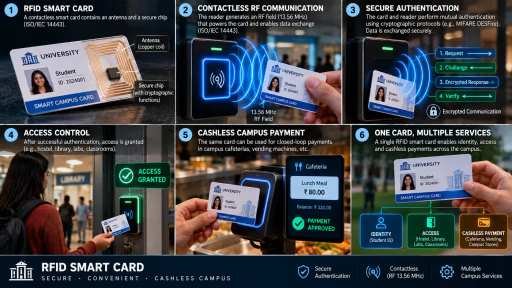
RFID Smart Card Solutions: Cashless Campus & DESFire Auth
Enterprise RFID smart card authentication, cashless canteen POS, and turnstile access control.

RFID for Hospitals India | Medical Asset & Patient Tracking
Hospital RFID in India: track movable medical equipment, optimize rental returns, and tighten audits with UHF and HF options.

Smart RFID Refrigerator: Medical Cold Storage Tracking
Smart RFID refrigerator tracking for vaccines, blood bags & specimens. Automated expiry alerts, closed-door UHF scanning & 21 CFR Part 11 compliant audit logs.

Smart First-Aid Kit Tracking System: RFID Cabinet Case Study
Smart first-aid kit tracking system with UHF RFID. Automated 30-day consumable expiry alerts, instant refill triggers and digital workplace safety audit logs.

Custom RFID Software Development & Mobile Handheld Apps
Custom RFID software development in India. Rugged Android handheld apps, high-throughput desktop scan suites, and cloud portals tailored to your workflows.