
Industry
RFID for Logistics India
Automate 3PL logistics, cross-dock dispatch, and inter-hub freight in India with UHF RFID gate portals, e-seal tracking, and TMS sync.

Simulate, evaluate, or request turnkey hardware & middleware deployment
-
up to 99%
Inventory accuracy (typical UHF rollout)
with tuned tags and processes
-
25–45%
Labor efficiency
vs manual cycle counts (varies by baseline)
-
hundreds/sec
Read throughput
fixed reader portals, SKU dependent
Operational Transformation: Manual Barcode Staging vs. Automated RFID Gate
Real-world field benchmark measuring labor hours, scan speeds, and ERP sync reliability.
Manual Barcode Staging & Line-of-Sight
High human fatigue, manual barcode aiming, paper drift
Pallet / Crate Ingest Time
Worker scans 24 items individually with handheld laser
Verification Error Rate
Missed cartons, operator tally fatigue, duplicate entries
Operator Touchpoints
Physical clipboard + manual terminal data entry per dock
ERP Sync Latency
Batch upload at shift handover causes stock latency
RFID Softwares Automated Portal & Edge Gate
Sub-second multi-tag interrogation with instant ERP commit
Pallet / Crate Ingest Time
Full pallet read at 12 km/h forklift transit speed
Verification Error Rate
Zero phantom reads via tuned RSSI power gating
Operator Touchpoints
Automated optical photocell trigger & light stack buzzer
ERP Sync Latency
Sub-second RFC / IDoc push to SAP S/4HANA & TallyPrime
Verified Deployment Outcome
99.3% Labor Time Cut • 100% Audit-Proof Physical-to-Digital ERP Traceability
3D Logistics & Fleet: Dispatch Simulators & Roll Cage Video
Simulate trailer loading, automated FASTag barriers, and watch roll cage tracking at logistics docks.
Video Demo: Warehouse Trolley Inventory with UHF RFID
High-density metal trolley and roll cage inventory tracking demo
Outbound Freight Trailer Loading
Simulates dual-dock trailer packing, conveyor feeds, and automated BOL verification.
Automated FASTag Parking Barrier Simulation
Watch vehicles approach at 20 km/h, 6-meter tag interrogation, and 1.2s barrier relay actuation.
Edge-to-ERP Data Pipeline Blueprint
How RFID for Logistics India | 3PL Cross-Dock & Fleet Gate Automation ingests thousands of physical tag reads per minute, suppresses duplicate RF bounces, and synchronizes with your central ERP in sub-second intervals.
The Problem Solved in Plain English:
Standard RFID readers flood servers with 50,000 raw scans every minute, crashing databases with duplicate reads. Our middleware acts as a smart edge filter—it recognizes when the same item sits in front of a scanner, registers it exactly once, and queues the data locally so no scans are lost even if warehouse Wi-Fi drops.
RF Backscatter
UHF tags energize via 865–867 MHz CW carrier wave. Backscatters 96-bit SGTIN EPC identifiers.
• Anti-collision: Q-algorithm
Lock-Free Channel
Reads stream across high-speed LLRP / TCP sockets into an in-memory ring buffer with bounded backpressure.
• Latency: < 2.5ms jitter
Sliding Cooldown
Central 60-second sliding window filters duplicate reflections across adjacent gates before storage.
• Offline auto-reconnect
Enterprise ERP Post
Gzip-compressed batch payloads dispatch via REST webhook or direct OData / XML connector to ERP.
• Retries: Exponential backoff
Architecture Comparison: Traditional vs. OpenRFID Edge Engine
| Operational Factor | Traditional Direct-to-DB Connection | OpenRFID High-Scale Edge Architecture |
|---|---|---|
| Network Downtime / Wi-Fi Loss | ❌ Scans are permanently lost; inventory mismatch occurs. | ✅ Scans buffer to local SQLite WAL queue and auto-sync when restored. |
| Duplicate Tag Reads | ❌ 100+ DB transactions per second for the exact same physical tag. | ✅ 60-second in-memory sliding window suppresses redundant scans. |
| ERP System Load | ❌ Heavy server load causes timeout errors on ERP billing APIs. | ✅ Consolidated 1,000-EPC compressed batches post in single atomic calls. |
Automated RFID for logistics in India modernizes multi-client 3PL freight terminals, container freight stations (CFS), and express courier cross-dock hubs. Instead of drivers dismounting to present paper consignment notes, high-gain overhead UHF gate portals scan passing linehaul trucks, returnable shipping assets (stillages, roll cages, pallets), and high-security e-seals at speeds up to 25 km/h. Edge controllers instantly reconcile scanned manifests against active GST e-way bills, opening automated boom barriers in under 30 seconds while streaming real-time transit telemetry to central Transport Management Systems (TMS).
Commercial trucks approaching the logistics yard pass through directional portal antennas mounted on gantry frames or heavy-duty bollards. Optical photocell sensors arm the RFID reader only when a vehicle enters the physical lane, preventing stray reads from parked trailers. The edge gateway captures windshield transponders, cargo bolt seals, and pallet tags, applying sub-15ms Doppler vector filtering to distinguish entering from exiting freight. Once validated against the facility dispatch schedule, GPIO relays open pneumatic boom barriers, illuminate green approach signals, and log timestamped proof-of-handover records.
Logistics networks operating across Indian transport corridors achieve decisive operational gains: vehicle gate turnaround time (TAT) drops from 18 minutes to under 45 seconds, eliminating highway truck queues. Linehaul sorting errors fall to zero because outbound dock tunnels alert operators immediately if a carton bound for Bengaluru is loaded into a Mumbai trailer. Furthermore, automated returnable asset tracking eliminates the annual 12–18% replacement loss typically suffered on wooden pallets, plastic totes, and steel stillages.
High-impact deployments in Indian logistics focus on high-velocity transfer points: (1) Express 3PL cross-dock sortation hubs (e.g. Bhiwandi, Bilaspur, Tauru, Chakan) sorting 20,000+ parcels per hour using RFID-tagged roll cages; (2) Container Freight Stations tracking ISO 17712 tamper-evident RFID bolt seals on customs-bonded export trailers; (3) Open yard fleet management logging shunt tractors and chassis dollies across 50,000+ sq. meter staging areas; and (4) High-value freight tracking with real-time temperature and shock data loggers for cold chain pharmaceuticals.
Outdoor logistics infrastructure requires industrial-grade durability: IP67-rated 4-port and 8-port UHF readers (Zebra FX9600, Impinj Speedway R420) enclosed in NEMA-rated weatherized housings with built-in cooling fans and lightning surge protectors. Antennas utilize 9dBi to 12dBi circular polarization to read tags regardless of orientation on swaying trailers. Consumables feature rugged ABS on-metal tags, vulcanized tyre tags, and single-use cryptographic RFID bolt seals engineered to withstand highway grit, monsoon rain, and severe vibration.
Indicative costs for Indian logistics facilities: A complete automated entry/exit gate portal (including industrial fixed reader, 4 outdoor antennas, mounting gantry, photocell sensors, traffic signal lights, and boom barrier interface) ranges between ₹2,20,000 and ₹3,80,000 per lane. Returnable asset tags (ABS on-metal) cost ₹22 to ₹48 each, while high-security ISO 17712 container bolt seals range from ₹65 to ₹115. Software middleware licensing with pre-built TMS and e-way bill connectors typically budgets between ₹1,50,000 and ₹3,50,000 per hub.
Deploying RFID across logistics networks follows a disciplined 3-phase methodology: Phase 1 conducts dynamic drive-through RF surveys to evaluate gate vehicle speeds, adjacent lane RF cross-talk, and metal container reflection. Phase 2 commissions a single pilot cross-dock lane, tuning photocell trigger timings and validating TMS webhook latency under 500ms. Phase 3 scales proven portal templates across secondary regional transshipment hubs, integrating driver mobile kiosks and automated SMS dispatch notifications.
Legacy logistics operations rely on manual paper manifests and handheld barcode scanning: drivers must dismount, wait in cabin queues, and security guards must scan each crate individually, consuming 15–25 minutes per vehicle with frequent weather-damaged barcode read failures. In contrast, automated UHF RFID gate portals verify full truckloads in under 30 seconds at drive-through speeds, deliver 99.9% read reliability through dirt and plastic wrap, and produce automated cryptographic audit trails for insurance and compliance.
A national express 3PL operator handling 240+ linehaul trucks daily at its Bilaspur hub automated 16 cross-dock receiving and dispatch bays with Zebra fixed RFID portals and NXP Ucode 9 roll cage tags. The deployment slashed average vehicle gate turnaround time by 78%, eliminated mis-routed inter-state dispatches completely, and reclaimed 45 supervisor hours daily previously lost to manual manifest reconciliation.
Cross-talk prevention relies on narrow-beam circular antennas directed inward, optical photocell interlocks that activate RF power only when a truck physically enters the specific lane, and strict RSSI peak thresholding in the edge middleware. This ensures a vehicle passing in Lane 1 is never mistakenly registered on Lane 2.
Yes. Our edge middleware integrates with Government of India GST e-way bill APIs using Transporter ID credentials. When a truck approaches the gate, the gateway reads the vehicle RFID tag, queries active e-way bills for that registration number, verifies consignment validity, and triggers green boom barrier clearance automatically.
Interactive RFID Engineering Tools & Calculators
Use our free interactive calculators and simulators to model RF physics, calculate link budgets, estimate ROI, and configure EPC tags.
RFID Link Budget Calculator
Calculate reader EIRP (+36 dBm WPC), antenna gain (dBi), path loss, and receiver sensitivity threshold (-86 dBm).
Antenna Coverage & Beamwidth Calculator
Model 3dB azimuth/elevation beam footprints and coverage radii for warehouse dock doors and conveyor gates.
RFID Portal Velocity Calculator
Estimate tag dwell times, maximum conveyor transit speeds (m/s), and read rates under dense tag environments.
Optimizing High-Throughput Warehouse Portals & Dock Doors?
Eliminate missed reads and stray tag crosstalk. Talk to our RFID RF engineers about dock door portal design, tag selection, and ERP auto-ingestion.
Representative deployment pattern
Problem
Manual counts and barcode exceptions slowed month-end close and audits.
Solution
Phased UHF tagging, portal readers at dock doors, middleware to WMS, and handheld exceptions.
Results
- Fewer stockouts after 90 days
- Faster cycle counts
- Cleaner audit samples
Frequently asked questions
How fast can commercial trucks drive through the RFID gate portal?
How does the logistics portal perform during heavy monsoon rains and dust?
Can the system track returnable transport items (RTIs) like pallets and cages across third-party yards?
Does the system integrate with proprietary TMS and WMS platforms?
What happens if a vehicle arrives with a torn or missing RFID tag?
Is cellular 4G/5G connectivity supported for remote logistics yards?
Discover more
You may also like
Hand-picked articles and pages worth your time next.

RFID Asset Tracking Software & Systems: On-Metal IT Audits
Enterprise RFID asset tracking software in India. Mobile Geiger-counter radar, on-metal IT server tagging, and automated FAR audit reconciliation.

RFID Warehouse Management System Architecture: Dock Doors & ERP Sync Blueprint
Engineering blueprint for automated RFID warehouse tracking. Dock door portal geometry, 1,200 tag/sec dense reader modes, forklift mounts, and SAP BAPI / Tally sync.
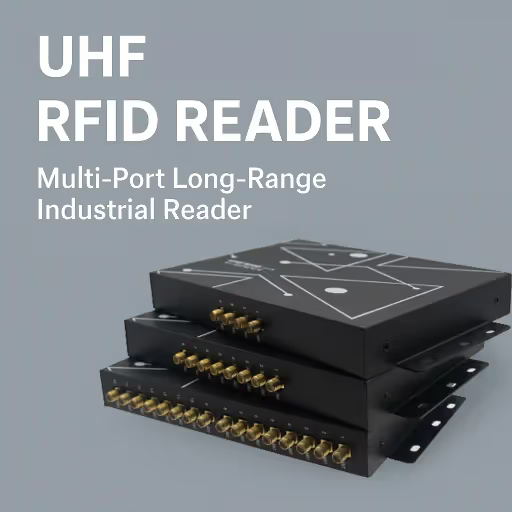
Fixed RFID Reader India and UHF 4-Port Reader Portals
Buy fixed RFID reader India models (865-867 MHz). High-performance 4 port UHF reader for dock doors and conveyor systems. Inquire online now.
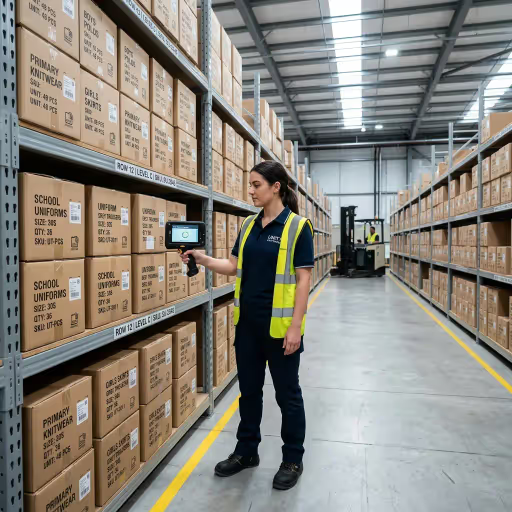
Apparel Warehouse RFID Inventory Automation | Case Study
Case study: School Time Uniforms deploys UHF RFID handheld scanners and automated warehouse middleware for 99.8% dispatch accuracy and zero stock-outs.