
1. The Limitations of Legacy EPC Gen2v1
The original EPC Gen2v1 protocol (ISO/IEC 18000-6C) was engineered for high-throughput logistics, retail supply chains, and bulk warehouse scanning. Tags transmit their Electronic Product Code (EPC) and Silicon Factory TID in unencrypted plaintext over the air.
While Gen2v1 supports a 32-bit PIN for password-protected access and kill commands, it provides zero over-the-air cryptographic authentication. A malicious actor with a handheld software-defined radio (SDR) or commercial UHF reader can sniff the plaintext EPC/TID broadcast from up to 10 meters away and program an emulator chip to replicate the credential.

2. Core Security Pillars of Gen2v2
Gen2v2 introduces three transformative architectural capabilities specifically designed to resolve enterprise security vulnerabilities:
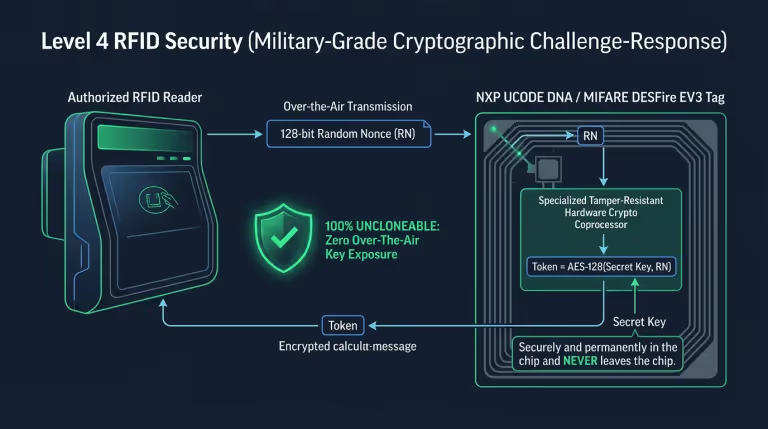
A. Cryptographic Tag Authentication (ISO/IEC 29167-10)
Tags equipped with Gen2v2 crypto silicon hold one or more 128-bit cryptographic symmetric keys in tamper-proof, hardware-isolated memory zones. When the reader issues an Authenticate command, the tag utilizes its onboard AES hardware engine to encrypt the reader's challenge string.
- Zero Secret Leakage: The 128-bit root secret key is burned during manufacturing/provisioning and can never be read via RF commands.
- Replay Attack Immunity: Because the reader sends a unique random nonce on every transaction, captured previous backscatter responses cannot be replayed by an adversary.
B. Untraceable Privacy Mode
In luxury retail and consumer electronics, post-sale privacy is paramount. Gen2v2 introduces the Untraceable command, empowering systems to:
- Truncate EPC: Mask or reduce EPC visibility to zero or basic public category headers.
- Hide TID: Completely conceal silicon factory TID serialization.
- RF Power Attenuation: Drop the tag's backscatter sensitivity so it can only be read at near-field distances (< 0.5 meters) rather than warehouse gate ranges (12 meters).
C. Granular Bank Locking & Permalock
Gen2v2 extends traditional password locking into multi-level access privileges. Memory banks (Reserved, EPC, TID, User) can be locked with distinct keys, configured for write-only access, or permanently read-locked under hardware-enforced fuses.

3. Enterprise Silicon Comparison: NXP UCODE DNA vs Impinj M775
Selecting the correct silicon is critical for balancing read sensitivity, cost, and cryptographic resilience:
| Feature | NXP UCODE DNA | Impinj M775 | Standard EPC Gen2v1 |
|---|---|---|---|
| Crypto Engine | Hardware AES-128 Coprocessor | Protected Mode Crypto | None (Plaintext) |
| ISO Standard | ISO/IEC 29167-10 & Gen2v2 | GS1 Gen2v2 Compliant | ISO/IEC 18000-63 (Gen2v1) |
| Secret Keys | 2x 128-bit Symmetric Keys | 128-bit Protected Keys | None (32-bit PIN only) |
| User Memory | 3,072 Bits | 128 Bits | 0 to 512 Bits |
| Read Sensitivity | -19.0 dBm | -24.0 dBm | -20.0 to -22.0 dBm |
| Ideal Use Case | Defense, Tolling, Brand Protection | High-Speed Secure Retail & Logistics | Basic Inventory Tracking |
4. Enterprise Implementation Architecture
Deploying Gen2v2 cryptographic authentication into enterprise environments (such as SAP EWM, Microsoft Dynamics 365, or Tally Prime) requires a dedicated Key Management Server (KMS) or Hardware Security Module (HSM).
Cryptographic RFID Middleware Integration Flow
- Provisioning Stage: High-security RFID printer/encoders (e.g. Zebra ZT411 RFID) write encrypted EPC data and inject individual AES-128 keys into the tag silicon via secure physical couplers.
- Reader Interrogation: Fixed portal readers (Impinj Speedway R700 / Zebra FX9600) execute an inventory sweep. Upon detecting Gen2v2 capability, the reader triggers an
Authenticatecommand with an HSM-derived challenge. - ERP Synchronization: RFID Softwares C# .NET 8 Middleware validates the returned cryptographic proof against the cloud HSM within 12 milliseconds before committing inventory status updates to SAP/ERP.
5. Summary: When Should You Upgrade to Gen2v2?
If your RFID deployment involves any of the following scenarios, standard Gen2v1 tags represent a critical security vulnerability:
- High-Value IT Assets: Enterprise laptops, server blades, and lab equipment requiring tamper-proof tracking.
- Automatic Vehicle Identification (AVI) & Tolling: Parking barriers and FASTag tolling lanes vulnerable to badge duplication.
- Defense & Aerospace Supply Chains: MIL-STD-129 compliance and counterfeit prevention.
- Luxury Brand Protection: Designer apparel, pharmaceuticals, and wine verification.
Need Secure Cryptographic RFID Integration?
Our engineering team builds custom Gen2v2 middleware, secure HSM key injection pipelines, and SAP/Tally ERP connectors.