
Active RFID: Industrial RTLS, Battery Physics & Sensor Telemetry
When passive backscatter reaches physical range limits: exploring battery-powered Active RFID systems across ISO 18000-7 (433 MHz) and 2.4 GHz RTLS, Li-SOCl2 duty cycle mathematics, and sub-meter TDoA/AoA triangulation across expansive industrial yards.
Passive vs Active RFID Architecture
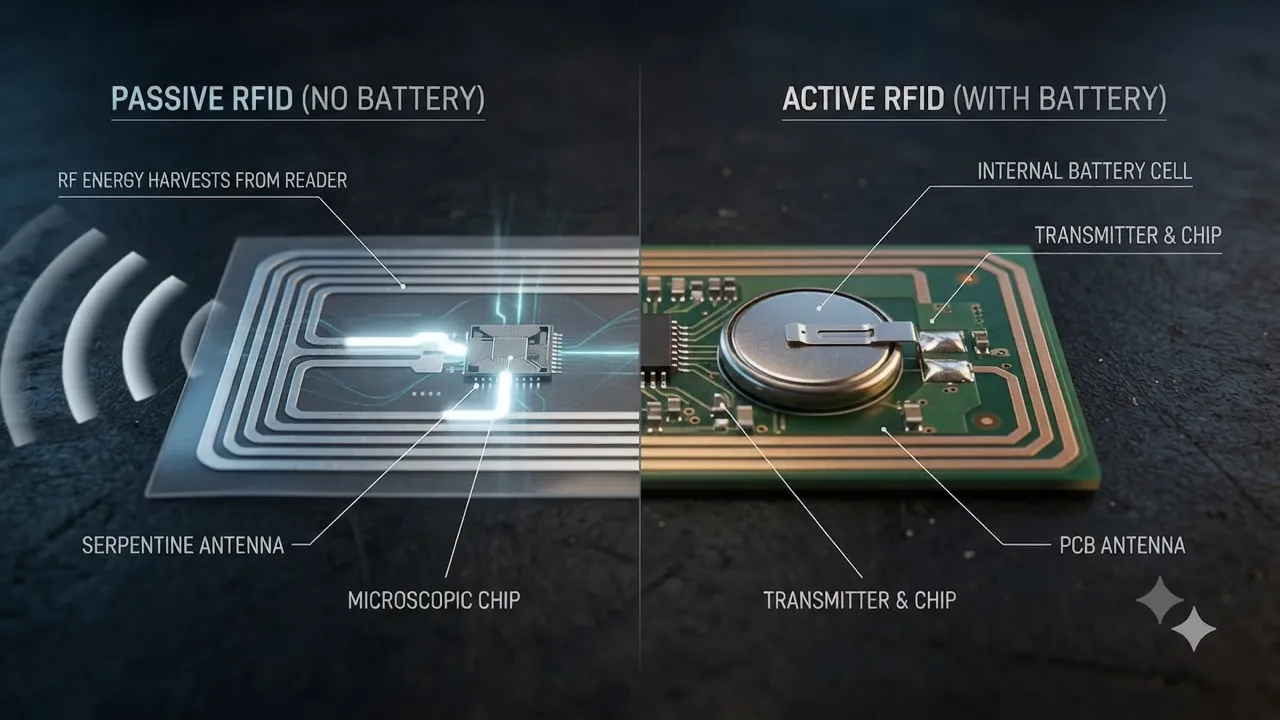
Side-by-side engineering comparison illustrating zero-battery passive backscatter versus battery-assisted active beaconing for long-distance industrial asset visibility.
Power Management Architecture
Li-SOCl₂ Battery Chemistry & The Mathematical Lifespan Model
How micro-ampere sleep states and ultra-short millisecond beacon bursts deliver 8+ years of autonomous operation.
Unlike passive RFID tags that harvest mere micro-watts from an interrogator beam, an Active RFID transponder houses an internal primary battery cell. The industry gold standard is Lithium Thionyl Chloride (Li-SOCl2, 3.6V), renowned for its low annual self-discharge rate (< 1% per year) and operational endurance from -55°C to +85°C.
The Mathematical Duty Cycle Model
Active transponders spend over 99.9% of their operating life in a deep sleep quiescent state, waking only for a tiny fraction of a second to broadcast their RF beacon telegram. The effective average current draw Iavg is calculated as:
Where the duty cycle ratio D is defined by the transmission burst duration ttx over the beacon interval Tinterval:
Empirical Lifespan Calculation
Consider a heavy-duty industrial yard asset beacon with the following parameters:
- Battery Capacity (Cbat): 1,200 mAh (1/2 AA Li-SOCl2 cell).
- Sleep Current (Isleep): 1.8 μA (ultra-low power RTC timer active).
- Transmit Current (Itx): 22 mA at +10 dBm transmit power.
- Burst Duration (ttx): 6 milliseconds (64-byte payload at 250 kbps).
- Beacon Interval (Tinterval): 10 seconds.
Even after factoring in 1% annual electrolyte self-discharge and ambient temperature derating, the transponder reliably achieves 7.5 to 8.2 years of maintenance-free field life!
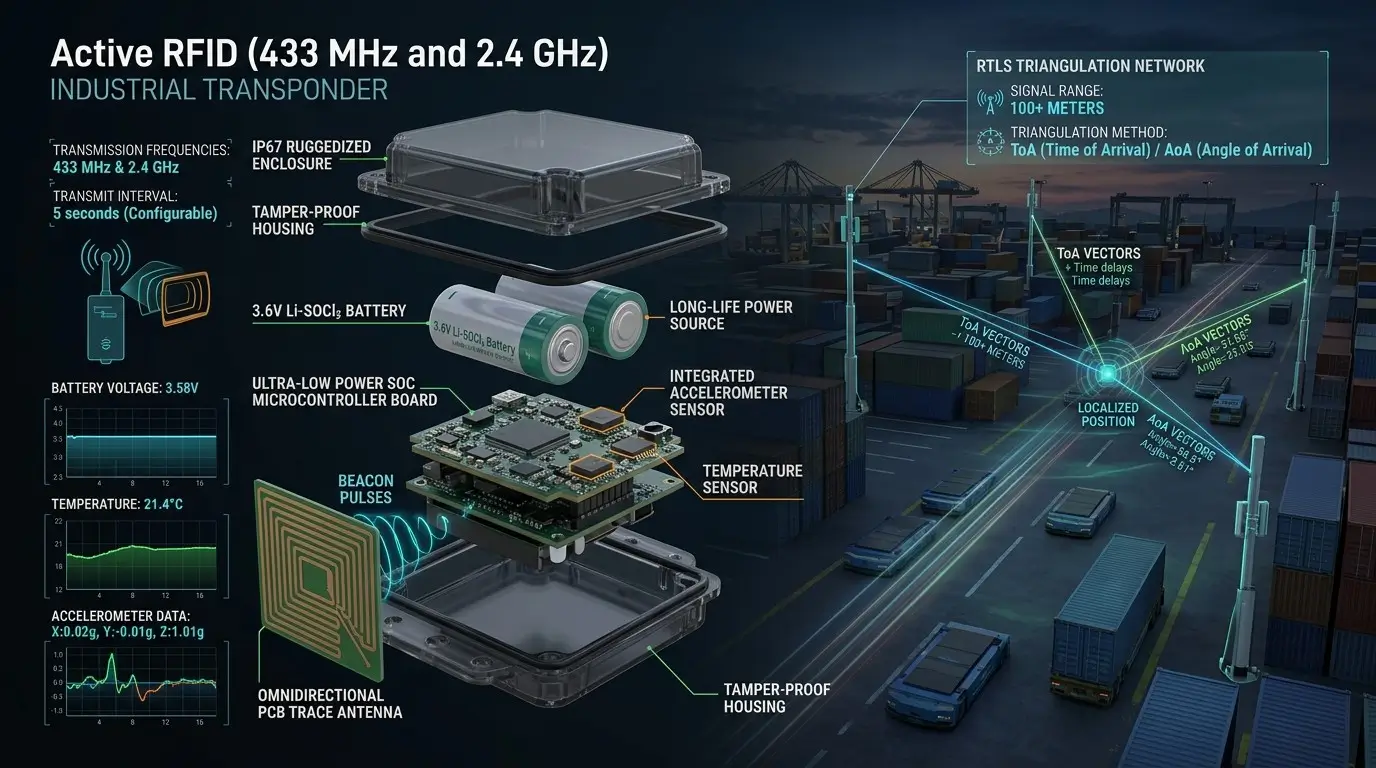
Cutaway showing hermetically sealed Li-SOCl2 cell, ARM Cortex-M4 microcontroller, 3-axis accelerometer for motion-triggered wakeups, and omnidirectional antenna.
Modern active tags incorporate MEMS accelerometers. When an asset (trailer, container, pallet) is stationary, the tag sleeps and beacons once every 60 seconds (12+ year life). Upon detecting vibration/motion, it instantly ramps up to 1-second beacon intervals for real-time yard navigation!
Indoor & Yard Positioning Physics
RTLS Localization Mathematics: TDoA Hyperbolas vs AoA Phase Vectors
Understanding sub-nanosecond timestamp synchronization, multilateration, and antenna array phase differentiation.
Sub-Nanosecond Clock Synchronization
In TDoA systems, the active tag transmits an uncoordinated RF packet. Three or more fixed receiver gateways with known coordinates (xi, yi) receive the packet and record the precise arrival timestamp ti.
Each pair of receivers defines a hyperbolic curve of possible tag positions. The intersection of three or more hyperbolas yields the tag's exact 2D/3D location.
Antenna Array Carrier Phase Vectors
AoA receivers (common in 2.4 GHz Bluetooth 5.1+ RTLS arrays) feature an array of 4 to 16 antenna patches spaced at distance d = λ / 2 (approx. 6.25 cm). As the incoming wave strikes the array at incident angle θ, each patch detects a tiny carrier phase delay ψ:
By applying MUSIC (Multiple Signal Classification) or ESPRIT algorithms across antenna I/Q samples, the locator derives both azimuth (θ) and elevation (φ) angles. A single locator ceiling array can compute 3D position down to ± 0.5 meters!
Comparative Spectrum Analysis
Active 433.92 MHz vs Active 2.4 GHz RTLS: Engineering Matrix
Diffraction over metal obstacles vs wideband telemetry and multi-antenna positioning.
| Technical Parameter | Active 433.92 MHz (ISO 18000-7) | Active 2.4 GHz (ISO 18000-4 / AoA) |
|---|---|---|
| Wavelength (λ) | 69.1 cm | 12.24 cm |
| Diffraction Around Steel & Foliage | Superior (Long wave bends around shipping containers) | Moderate (Requires clearer line-of-sight) |
| Maximum Free-Space Range | 100 to 300+ meters | 50 to 120 meters |
| RF Channel Bandwidth | Narrowband (~200 kHz) | Wideband (2 MHz to 80 MHz) |
| Positioning Accuracy (RTLS) | 2 to 5 meters (Zone / RSSI) | 0.3 to 1.0 meter (AoA / TDoA) |
| Primary Industrial Deployments | Marine container ports, military DoD asset tracking, heavy mining sites | Hospital crash-cart RTLS, smart manufacturing WIP tracking, tool tracking |
Commercial Solutions Catalog
Industrial RTLS & Yard Management Solutions
Explore enterprise tracking solutions connecting active transponders to real-time ERP systems.
Industrial Yard & Fleet Asset Tracking
Autonomous real-time positioning for yard trailers, heavy earthmoving equipment, and marine shipping containers.
Hospital Medical Equipment Tracking
Sub-meter indoor tracking for mobile ventilators, infusion pumps, and crash carts with automated sterilization alerts.
Active vs Passive UHF RFID Guide
Detailed cost, physics, and infrastructure evaluation to decide whether your facility requires active transponders or passive RAIN tags.
Frequently Asked Questions
Active RFID & RTLS Engineering FAQ
Technical answers regarding battery chemistries, duty cycle modeling, and multi-path RF interference.
What frequencies are utilized by Active RFID systems? ↓
How long does the battery last in an Active RFID beacon, and how is it calculated? ↓
What is the difference between ToA, TDoA, and AoA in Real-Time Location Systems (RTLS)? ↓
Why choose Active RFID over Passive UHF RAIN RFID? ↓
What makes Lithium Thionyl Chloride (Li-SOCl2) the preferred battery chemistry? ↓
Electronic toll collection (ETC), DSRC protocols, and narrow microstrip beamforming.
Return to the complete master matrix, material penetration simulator, and global regulatory map.