
Resource
How RFID Works: Visual Guide to UHF Tags, Readers & Frequencies (2026)
Understand how RFID technology works. Learn the physics of electromagnetic backscatter, passive vs active tags, LF/HF/UHF frequencies, and reader antennas.

-
900+ Tags / Sec
Read Speed
multi-tag dense reader mode
-
10+ Years
Passive Tag Lifespan
no battery or internal power
-
99.5%+
Inventory Accuracy
automated line-of-sight free
What does RFID stand for? Core concepts and automatic identification principles
RFID stands for Radio Frequency Identification. It is a wireless automatic identification and data capture (AIDC) technology that uses electromagnetic radio waves to transfer data between an interrogation device (reader) and an electronic transponder (tag) attached to an object, carton, pallet, vehicle, or ID badge. Unlike legacy optical barcodes or QR codes that require manual, direct line-of-sight laser scanning, RFID reads hundreds of tagged items simultaneously through cardboard, plastic, wood, and fabric at distances up to 15+ meters.
How an RFID reader and antenna transmit energy and query tags
An RFID reader consists of an RF transceiver module, a digital signal processor (DSP), and one or more connected antennas. The reader generates continuous sinusoidal radio frequency carrier waves (in India, tuned to the WPC 865–867 MHz band). When transmitted through the antenna, this electromagnetic field creates an energized interrogation zone. The reader modulates its carrier wave to broadcast commands (such as Query, ACK, Select) following international communication protocols like ISO/IEC 18000-6C (EPC Class 1 Gen 2).
How passive RFID tags and microchips harvest power via backscatter coupling
Passive RFID tags do not have an internal battery. Instead, the tag antenna captures energy from the reader's incoming electromagnetic wave. This induces an alternating electrical current that flows into the microscopic tag silicon chip (such as Impinj Monza, NXP UCODE, or Alien Higgs). The chip rectifies this RF energy into DC operating voltage, booting up its logic circuits in under 1 millisecond. The chip then transmits its unique data back to the reader by changing its antenna input impedance—modulating the amount of radio wave energy reflected back to the reader. This physical phenomenon is known as electromagnetic backscatter coupling.
How do you track an RFID tag? Zone presence detection vs continuous location
A widespread misconception is that passive RFID tags function like active GPS satellite beacons. Passive tags cannot transmit on their own and only communicate when physically passing through a reader's energized RF field. Consequently, standard passive RFID delivers zone presence and choke-point tracking—registering exactly when and where a tagged carton passed through a warehouse dock door, entered a cold room, or exited a retail store. For continuous real-time coordinate tracking (X-Y-Z positioning on a map), facilities integrate active Real-Time Location Systems (RTLS) using BLE or UWB.
Security and privacy: Can RFID tags be tracked without permission?
Passive UHF tags have a maximum physical read range of 10 to 15 meters when energized by high-power industrial reader antennas. They cannot be tracked from satellites, cellular towers, or across long city distances without a high-gain reader nearby. Furthermore, enterprise EPC Gen2 tags feature password-protected memory banks with 32-bit Access and Kill passwords. Retailers and enterprises can write-protect EPC data, encrypt user memory, or issue a permanent Kill command upon consumer purchase to completely deactivate the silicon chip forever.
Frequency spectrum breakdown: LF (125 kHz) vs HF (13.56 MHz) vs UHF (865–867 MHz)
RFID systems operate across three primary frequency spectrums, each suited to specific physical media:
- Low Frequency (LF 125–134 kHz): Short read range (< 10 cm), slow data transfer, but near-immune to metal and liquid interference. Common in animal identification ear tags and legacy door access cards.
- High Frequency (HF / NFC 13.56 MHz): Moderate read range (2–10 cm), ISO 14443 / ISO 15693 compliant, high cryptographic security. Standard in library book tracking (KOHA ILS), smart employee ID badges, and smartphone NFC payments.
- Ultra-High Frequency (UHF 865–867 MHz in India / 902–928 MHz US): Long read range (up to 15+ meters), lightning-fast multi-tag reading (900+ tags/second). The undisputed standard for supply chain logistics, warehouse dock doors, apparel inventory, and asset management.
RFID vs Barcode Systems: Engineering & Commercial Comparison
Understanding the technical differences between barcode and RFID technology helps enterprises evaluate automation ROI:
| Operational Metric | Traditional Barcode / QR Code | Passive UHF RFID |
|---|---|---|
| Line of Sight | Strictly required (Laser must see barcode) | Not required (Scans through boxes & packaging) |
| Scan Speed | 1 item at a time (10–30 items/min manually) | Hundreds of items simultaneously (900+ tags/sec) |
| Read Range | 10 cm to 1.5 meters | Up to 15+ meters with fixed reader portals |
| Durability & Environment | Vulnerable to tears, dirt, grease, and moisture | Rugged IP68 hard tags, washable laundry inlays |
| Data Capacity & Rewritability | Read-only static printed pattern | Up to 8KB rewritable EPC, TID, and User memory |
| Automation Level | Requires manual worker aiming scanner gun | 100% automated portal & conveyor gate scanning |
Interactive RFID Engineering Tools & Calculators
Use our free interactive calculators and simulators to model RF physics, calculate link budgets, estimate ROI, and configure EPC tags.
EPC-96 Header & Serial Converter
Encode and decode SGTIN-96, SSCC-96, and GRAI-96 GS1 data structures to/from raw Hex and Binary EPC memory.
TID & Memory Bank Calculator
Inspect EPC Gen2 memory layouts (Reserved, EPC, TID, User memory) across Impinj, NXP, and Alien ICs.
RFID Tag Selection Wizard
Filter through on-metal, wet inlay, cryogenic, laundry, and apparel tags based on surface material and read distance.
Need a custom how rfid works: visual guide to uhf tags, readers & frequencies (2026) deployment?
Every environment has distinct RF absorption and ERP sync constraints. Let's review your exact workflow and design an end-to-end blueprint.
Deployed hardware & software
Products & Hardware Deployed in This Solution
Discover the professional-grade RFID readers, tags, and custom integration software systems implemented in this deployment.
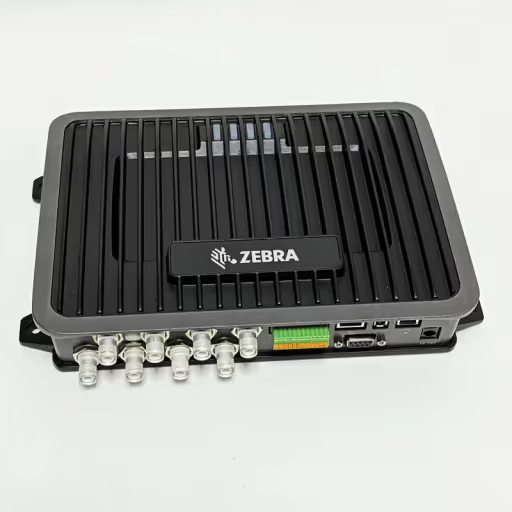
Zebra FX9600 4 port Fixed RFID Reader India
Industrial 4-port and 8-port fixed UHF RFID reader for high-throughput warehouse portals.

UHF Inlay Labels and Printable RFID Tags for Packaging
High-sensitivity printable UHF EPC Gen2 inlays for packaging and inventory.
Frequently asked questions
What is the full form of RFID?
How do passive RFID tags work without an internal battery?
Can RFID read multiple items simultaneously?
What is the standard RFID frequency used in India?
Can RFID replace barcodes completely?
Can RFID tags be read through walls and metal?
Discover more
You may also like
Hand-picked articles and pages worth your time next.

Circular vs Linear RFID Antennas Guide
Understand antenna polarization physics, beam cone coverage, and 12m vs 6m read range.

WPC RFID Frequency India Guide
India WPC 865–867 MHz frequency band, GSR 564(E) compliance, power limits, and licensing.

Turnkey Retail RFID Inventory Tracking Systems
Deploy handheld RFID inventory audits, stocktake in minutes, and eliminate out-of-stock retail shrinkage.

Deploying Handheld RFID Inventory Systems in India
Pan-India RFID inventory system with GST E-way bill mapping and low-latency cloud edge sync.
RFID Read Range & Friis Physics Calculator
Interactive Friis transmission equation calculator for theoretical tag read range and forward link budget.