
Resource
Circular vs Linear RFID Antennas: Polarization & Range
Compare Circular vs Linear RFID reader antennas. Understand electromagnetic polarization physics, 12m+ vs 6m read range, beam angles, and real-world deployment.

-
Up to 12m+
Linear Peak Range
focused on-axis beam energy
-
360° All-Angle
Circular Beam Coverage
orientation-independent read
-
> 20 dB Loss
Polarization Mismatch Loss
cross-polarized linear tag
The physics of electromagnetic wave polarization in passive UHF RFID systems
In passive Ultra-High Frequency (UHF 865–867 MHz) RFID systems, the reader antenna transmits electromagnetic radio waves consisting of oscillating Electric (E-field) and Magnetic (H-field) vectors. The geometric orientation of the electric field vector in space as the wave propagates is defined as its polarization. Because passive RFID tags do not have an internal battery, their silicon microchips must harvest operating voltage entirely from the incoming electric field via backscatter coupling. The efficiency of this power transfer depends directly on the geometric alignment between the reader antenna's radiated E-field and the tag's physical copper/aluminum inlay antenna traces.
How Linear Polarization works: Narrow beam, high energy concentration, and maximum range
A Linearly Polarized Antenna radiates its electric field strictly within a single fixed two-dimensional plane—either purely vertical or purely horizontal. By confining all radiated RF power into a single plane, the antenna produces a tight, highly concentrated pencil/cigar-shaped radiation beam with a narrow half-power beamwidth (typically 30° to 45°). This high power density delivers significantly extended read range (reaching 8 to 12+ meters at standard +30 dBm EIRP limits).
The Critical Limitation: Linear polarization is strictly orientation-dependent. When a passive tag's dipole is parallel to the antenna's electric field, power reception is 100%. However, if the tag is rotated 90° (perpendicular / cross-polarized), the electric field cannot induce current across the tag antenna terminals, causing signal attenuation greater than 20 dB and resulting in an immediate missed read.
How Circular Polarization works: 360° rotating helical spiral and complete orientation freedom
A Circularly Polarized Antenna synthesizes two orthogonal linear electric fields (one horizontal and one vertical) driven with a 90-degree electrical phase shift. As the wave propagates forward through space, the resulting electric field vector rotates continuously in a 360-degree corkscrew spiral—either clockwise (Right-Hand Circular Polarization / RHCP) or counter-clockwise (Left-Hand / LHCP).
The 360° Advantage: Because the electric field rotates continuously, the antenna delivers 100% orientation independence. It effortlessly reads passive tags whether they are mounted vertically, horizontally, diagonally, or tumbling randomly in cartons.
The Power Trade-Off: Because total transmitted RF power is split equally across two rotating orthogonal planes, a circularly polarized antenna experiences a theoretical 3 dB (50%) power division loss compared to an identical perfectly aligned linear antenna. This results in a slightly shorter maximum read range (typically 3 to 6 meters for standard 9 dBi panels), but provides a much wider, dome-shaped interrogation cone (65° to 75° beamwidth).
Real-world performance comparison: Linear vs Circular RFID Antennas
Choosing between linear and circular antenna architectures requires balancing read range against tag orientation predictability:
| Engineering Parameter | Linear Polarized Antenna | Circular Polarized Antenna |
|---|---|---|
| Electric Field Geometry | Single Plane (Vertical or Horizontal) | Continuously Rotating 360° Corkscrew Spiral |
| Radiation Pattern | Narrow, focused pencil / cigar beam | Wide, hemispherical dome / umbrella cone |
| Effective Read Range | Longer (Up to 8 – 12m+) | Moderate (Up to 3 – 6m) |
| Half-Power Beamwidth (HPBW) | Narrow (30° – 45°) | Wide (65° – 75°) |
| Tag Orientation Sensitivity | Strictly required (Tags must match plane) | 100% Orientation Independent (Reads any angle) |
| Power Density on Target | High energy concentration along central axis | Power divided across orthogonal rotating axes (-3 dB) |
| Cross-Lane Bleeding Risk | Low (Easy to constrain to single narrow lane) | Moderate (Requires shielding or angle tuning) |
| Best-Fit Deployment | Vehicle access, tolling, conveyors, high racking | Warehouse dock doors, apparel retail, mixed pallets |
Best real-world use cases for Linear Polarized Antennas
Linear polarized antennas deliver optimal performance in environments where tag orientation is fixed and predictable:
- Automated Vehicle Boom Barriers & FASTag Tolling: Vehicles approach along a single straight lane with windshield tags consistently mounted horizontally. A linear antenna mounted on a side pole concentrates all RF energy straight down the lane, detecting approaching cars at 10–12 meters.
- Fixed Conveyor Packaging Lines: Automated carton tapers and sorters where cartons pass in uniform orientation with labels always facing upright towards the scanner head.
- Narrow High-Bay Warehouse Aisles: Mounting a narrow-beam linear antenna at the end of a long racking aisle allows barcode/RFID hybrid inventory scanners to read bin labels 15 meters down the aisle without scattering energy into metal side racks.
Best real-world use cases for Circular Polarized Antennas
Circular polarized antennas are the undisputed gold standard for real-world enterprise environments with unpredictable tag angles:
- Warehouse Dock Door Receiving Portals: Forklift pallets loaded with 50+ mixed cartons where labels face front, sides, top, or at odd diagonal angles. Paired with 4-port fixed readers like the Zebra FX9600 Fixed Reader, 9 dBi circular panels guarantee 99.5%+ scan accuracy.
- Retail Inventory & Apparel Handlers: Hanging garments on racks, folded clothing stacks on display tables, and apparel bins where tags rotate freely.
- Returnable Transport Items (RTI) & Plastic Totes: Reusable plastic containers, beer kegs, and industrial bins stacked in varying configurations.
- Healthcare, Libraries & File Tracking: Documents in folders, surgical trays, and patient wristbands moving in random orientations.
Multi-port antenna planning and hybrid polarization portal design
Modern industrial fixed readers (such as the 4-port and 8-port Zebra FX9600) support monostatic RF ports with reversible polarity. In challenging dock portal designs, engineers often combine two circular antennas mounted at lower bollards (1.0m height) with two upper circular antennas (2.0m height) tilted 15° to 30° inward. For conveyor tunnels requiring extreme range on mixed SKUs, system integrators can mount dual cross-polarized linear antennas (one vertical + one horizontal) configured to alternate pings, achieving the extended range of linear polarization while eliminating orientation dead spots.
Interactive RFID Engineering Tools & Calculators
Use our free interactive calculators and simulators to model RF physics, calculate link budgets, estimate ROI, and configure EPC tags.
RFID Link Budget Calculator
Calculate reader EIRP (+36 dBm WPC), antenna gain (dBi), path loss, and receiver sensitivity threshold (-86 dBm).
Antenna Coverage & Beamwidth Calculator
Model 3dB azimuth/elevation beam footprints and coverage radii for warehouse dock doors and conveyor gates.
RFID Portal Velocity Calculator
Estimate tag dwell times, maximum conveyor transit speeds (m/s), and read rates under dense tag environments.

Enterprise RFID Starter Kit (POC Bundle)
Everything your warehouse, retail store, or factory needs to prove RFID feasibility. Complete with industrial hardware, certified tags, and 6 months of cloud platform access.
12–18m read range, IP65 rugged Octa-core Android terminal, 4GB/64GB, fast charger cradle. (C72 / Zebra upgrades available).
High-sensitivity EPC Gen2 inlays for cartons, totes, apparel, and asset tagging.
Real-time mobile sync, cycle counts, stock reconciliation, user roles, and CSV/Excel export.
Need a custom circular vs linear rfid antennas: polarization & range deployment?
Every environment has distinct RF absorption and ERP sync constraints. Let's review your exact workflow and design an end-to-end blueprint.
Deployed hardware & software
Products & Hardware Deployed in This Solution
Discover the professional-grade RFID readers, tags, and custom integration software systems implemented in this deployment.
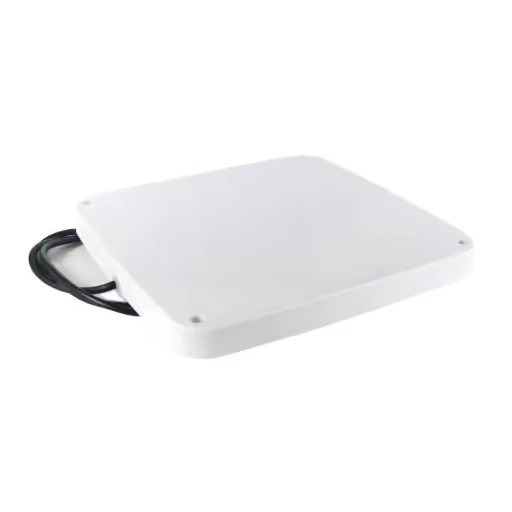
UHF Fixed Reader Antenna and Circular Polarized Panel
High-gain 9 dBi circular polarized panel antenna for warehouse dock doors and fixed portals.
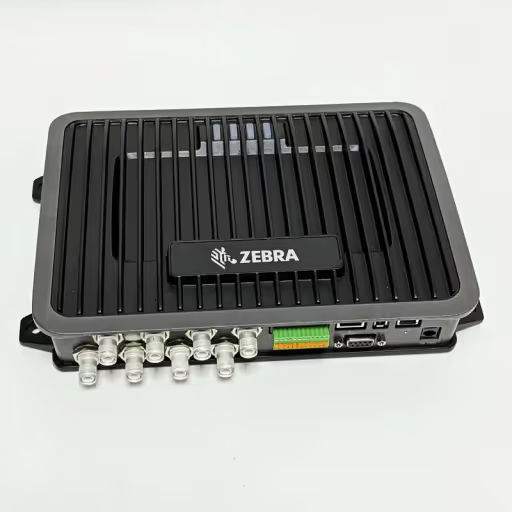
Zebra FX9600 4 port Fixed RFID Reader India
Industrial 4-port and 8-port fixed UHF RFID reader for high-throughput warehouse portals.
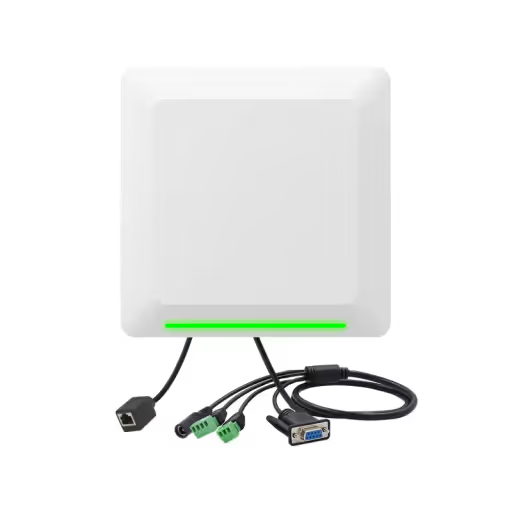
UHF Integrated RFID Reader and Long Range Parking Scanner
Long-range IP66 integrated UHF reader with built-in 9 dBi antenna for automated vehicle boom barriers.
Frequently asked questions
Why does a linear RFID antenna provide more read range than a circular antenna?
What happens when a linear tag is perpendicular to a linear antenna?
Can I connect both linear and circular antennas to the same 4-port or 8-port reader?
What is the difference between RHCP (Right-Hand) and LHCP (Left-Hand) circular polarization?
Which antenna polarization should I choose for warehouse dock door receiving?
Does higher antenna gain (dBi) make the beam wider or narrower?
Discover more
You may also like
Hand-picked articles and pages worth your time next.
