
Case study
Edible Oil Warehouse RFID Pallet Tracking
Case study: How a premier edible oil facility automated 15-SKU carton inventory across freight lifts and basement storage using color-coded UHF RFID tags.

Simulate, evaluate, or request turnkey hardware & middleware deployment
-
100% Automated
Multi-Floor Transit Visibility
sequential lift reader tracking
-
15 Oil Types
SKU Variety Management
color-coded pre-encoded tags
-
Instant / Trolley
Carton Count Speed
zero stop at freight lift doors
Operational Transformation: Manual Barcode Staging vs. Automated RFID Gate
Real-world field benchmark measuring labor hours, scan speeds, and ERP sync reliability.
Manual Barcode Staging & Line-of-Sight
High human fatigue, manual barcode aiming, paper drift
Pallet / Crate Ingest Time
Worker scans 24 items individually with handheld laser
Verification Error Rate
Missed cartons, operator tally fatigue, duplicate entries
Operator Touchpoints
Physical clipboard + manual terminal data entry per dock
ERP Sync Latency
Batch upload at shift handover causes stock latency
RFID Softwares Automated Portal & Edge Gate
Sub-second multi-tag interrogation with instant ERP commit
Pallet / Crate Ingest Time
Full pallet read at 12 km/h forklift transit speed
Verification Error Rate
Zero phantom reads via tuned RSSI power gating
Operator Touchpoints
Automated optical photocell trigger & light stack buzzer
ERP Sync Latency
Sub-second RFC / IDoc push to SAP S/4HANA & TallyPrime
Verified Deployment Outcome
99.3% Labor Time Cut • 100% Audit-Proof Physical-to-Digital ERP Traceability
Edible Oil Warehouse: Dock Simulators & Production Line Video
Simulate forklift dock door ingest and watch live carton dispatch loading.
Dispatch Dock RFID Verification: Truck Loading Carton Tracking
Automated Dispatch Gate Scanning Verifying Consignments in Real Time As Laborers Load Vehicles
Forklift Pallet RFID Dock Ingest
Simulates 24-carton pallet reads, photocell triggers, and sub-second PO validation.
Outbound Freight Trailer Loading
Simulates dual-dock trailer packing, conveyor feeds, and automated BOL verification.
Project Overview: 15-SKU Bottling & Multi-Floor Logistics
A high-capacity edible oil refining and packaging plant produces millions of liters annually across 14 to 15 distinct oil varieties (including Mustard, Refined Sunflower, Groundnut, Soybean, Sesame, and Rice Bran oils). On the packaging lines located on the 1st Floor, bottles are filled, capped, and packed into corrugated cardboard shipping cartons containing 10 to 12 bottles per box.
From the 1st Floor packaging hall, packed cartons are loaded onto multi-tier steel trolleys and transported via heavy-duty industrial freight elevators (lifts) down to the Basement storage and buffer distribution warehouse. The facility faced severe material handling challenges: tracking thousands of moving cartons across multiple vertical floors, preventing mixed-SKU batch errors among 15 lookalike oil varieties, and eliminating tedious manual clipboard tally sheets at lift gates.
Foolproof Tagging: 15-Color Visual Coding & Zebra Thermal RFID Pre-Encoding
To ensure seamless operation by shop-floor personnel without software complexity at packing benches, RFID Softwares designed a hybrid visual-and-digital identification protocol:
- 15-Color Variant Coding: Each of the 14–15 edible oil varieties was assigned a designated high-visibility color banner corresponding to carton artwork.
- High-Speed RFID Pre-Encoding: Using the Zebra ZD621R 300DPI RFID Printer, rolls of UHF Inlay Labels were pre-printed and encoded in automated batches. In a single 1-second pass, the printer writes the unique 96-bit EPC serial ID into the internal chip, prints the corresponding oil color stripe, batch number, MRP, manufacturing date, and a 2D QR code on the label face.
- Box Insertion Workflow: At the packaging conveyor, operators simply select the matching color-coded RFID sticker, place it inside the carton box alongside the 10–12 bottles, and tape the box shut.
Zebra Thermal Encoding & QR Code Synchronization: The Zebra ZD621R 300DPI printer is networked directly to the facility’s central packaging server. When a production work order is released for a specific batch (e.g. 5,000 cartons of 1-liter Refined Groundnut Oil), the printer prints the vibrant color band, encodes the unique GS1-compliant SGTIN-96 EPC serial number into the Monza R6 silicon chip, and prints a corresponding 2D QR code. This dual-layer identification allows warehouse operators to perform quick optical smartphone scans if needed while enabling hands-free automated RFID gate sweeps.

Multi-Floor Freight Lift Gateway Infrastructure
To capture carton transit without altering worker routines or stopping trolleys, RFID Softwares deployed an automated vertical checkpoint network using UHF Integrated RFID Readers with built-in 9 dBi circular polarized antennas:
- Reader 1 (1st Floor Gateway): Mounted directly above the 1st Floor freight elevator entrance, covering the packaging hall exit.
- Reader 2 (Basement Gateway): Mounted above the Basement elevator entrance, covering the main storage shed receiving corridor.
Both readers connect over local industrial Ethernet (PoE+) to the on-premise WMS edge gateway controller.

Directional Sequential Logic: Automated Stock Addition & Deduction
The core innovation lies in the sequential time-of-flight directional algorithm that automatically manages inventory status based on transit path:
1. Inward Stock Addition (Packaging 1st Floor → Basement Storage): When a trolley packed with newly boxed cartons enters the 1st Floor lift, Reader 1 detects the tags first. When the lift descends and the trolley rolls out into the basement, Reader 2 detects the tags second. The middleware identifies the sequence (Reader 1 → Reader 2) as an INWARD STORAGE EVENT, instantly adding the exact carton count, oil SKU types, and batch IDs to the live Basement warehouse inventory.
2. Outward Stock Deduction (Basement Storage → 1st Floor Dispatch): When cartons are pulled from the basement for outbound customer dispatch, Reader 2 detects the tags first, followed by Reader 1 at the 1st Floor exit. The middleware identifies the sequence (Reader 2 → Reader 1) as an OUTWARD DISPATCH EVENT, automatically decrementing stock from the warehouse dashboard and validating the load against the sales order.
All transactions are processed at the edge and reflected on the supervisor’s live web dashboard in sub-second latency.
Trolley Density & Speed Validation: Each custom steel warehouse trolley carries between 40 and 60 packed carton boxes (totaling 400 to 720 individual oil bottles per load). As the trolley moves through the freight elevator door threshold at speeds up to 1.2 m/s, the integrated reader’s circular beam sweeps the entire trolley profile, recording all 40–60 carton tags in under 250 milliseconds with 100% read completeness.
RF Physics Hurdle: Overcoming Edible Oil Dielectric Signal Absorption
A primary hurdle in liquid FMCG tracking is electromagnetic RF wave absorption. Edible vegetable oils possess high dielectric permittivity, which dampens and refracts 865–867 MHz UHF radio signals if tags are stuck flat onto liquid-filled plastic bottles.
The Engineering Solution: By placing the pre-encoded UHF inlay tag on the inner or outer cardboard carton wall rather than directly onto the PET bottle surface, the system maintains a vital air-dielectric spacing boundary. Combined with 9 dBi circular polarized reader antennas that eliminate tag orientation sensitivity, the lift gateways achieve a consistent 100% read rate across 40+ cartons per trolley moving at normal walking speeds.

Operational Impact & Warehouse Management ROI
Deploying the color-coded RFID pre-encoding system and freight lift directional gateways delivered immediate operational dividends:
- 100% Automated Vertical Inventory Visibility: Completely eliminated manual clipboard recording and tally discrepancies between packaging and storage floors.
- Zero Mixed-SKU Shipping Errors: Foolproof 15-color matching combined with automated RFID verification prevented wrong-oil dispatches across thousands of daily cartons.
- Zero Trolley Bottlenecks: Workers push trolleys freely into and out of elevators without pausing for line-of-sight barcode scanning.
- Rapid 3.2-Month Payback: Reduced audit labor, eliminated stock mismatches, and automated WMS inventory updates paid for the entire hardware and software investment in under 100 days.
Interactive RFID Engineering Tools & Calculators
Use our free interactive calculators and simulators to model RF physics, calculate link budgets, estimate ROI, and configure EPC tags.
RFID ROI & Payback Calculator
Calculate 12-month return on investment, shrinkage reduction, and labor hours saved for your facility.
RFID Project Cost Estimator
Estimate turnkey budget breakdown including readers, antennas, tags, cloud software, and on-site engineering.
Site Survey Checklist Generator
Generate a customized engineering checklist covering RF noise floors, power drops, and portal mounting requirements.
Optimizing High-Throughput Warehouse Portals & Dock Doors?
Eliminate missed reads and stray tag crosstalk. Talk to our RFID RF engineers about dock door portal design, tag selection, and ERP auto-ingestion.
Deployed hardware & software
Products Used in This Case Study
Discover the professional-grade RFID readers, tags, and custom integration software systems implemented in this deployment.
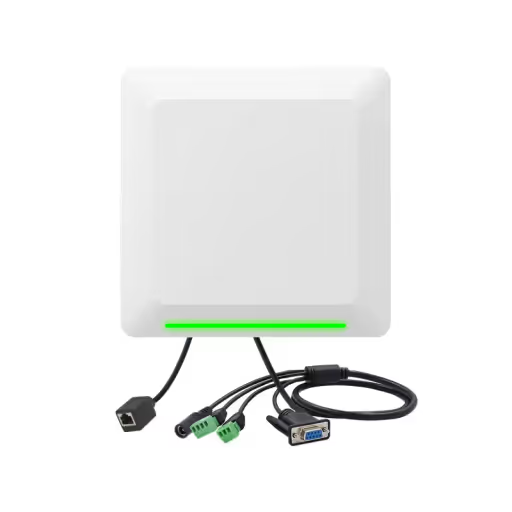
UHF Integrated RFID Reader and Long Range Parking Scanner
Industrial integrated UHF RFID reader with built-in 9 dBi circular antenna for automated freight elevator and choke-point tracking.

UHF Inlay Labels and Printable RFID Tags for Packaging
High-sensitivity printable UHF RFID stickers for corrugated carton boxes and multi-SKU packaging.

Zebra ZD621R 300DPI UHF RFID Thermal Transfer Desktop Printer
High-resolution industrial RFID desktop printer for automated multi-SKU tag printing and EPC encoding.