
Case study
Fertilizer Warehouse RFID Inventory Tracking
Case study: How a Kolkata fertilizer distribution giant automated bag counts across rail rakes, trucks, and warehouse gates using directional UHF RFID portals.
Deployed in: RFID Solutions in Kolkata & West Bengal

Simulate, evaluate, or request turnkey hardware & middleware deployment
-
99.8%
Automated Bag Count Accuracy
directional choke-point gate detection
-
40% Faster
Truck Unloading Turnaround
zero manual clipboard tally delay
-
100% Automated
Wagon Reconciliation
port-to-shed digital audit trail
Operational Transformation: Manual Barcode Staging vs. Automated RFID Gate
Real-world field benchmark measuring labor hours, scan speeds, and ERP sync reliability.
Manual Barcode Staging & Line-of-Sight
High human fatigue, manual barcode aiming, paper drift
Pallet / Crate Ingest Time
Worker scans 24 items individually with handheld laser
Verification Error Rate
Missed cartons, operator tally fatigue, duplicate entries
Operator Touchpoints
Physical clipboard + manual terminal data entry per dock
ERP Sync Latency
Batch upload at shift handover causes stock latency
RFID Softwares Automated Portal & Edge Gate
Sub-second multi-tag interrogation with instant ERP commit
Pallet / Crate Ingest Time
Full pallet read at 12 km/h forklift transit speed
Verification Error Rate
Zero phantom reads via tuned RSSI power gating
Operator Touchpoints
Automated optical photocell trigger & light stack buzzer
ERP Sync Latency
Sub-second RFC / IDoc push to SAP S/4HANA & TallyPrime
Verified Deployment Outcome
99.3% Labor Time Cut • 100% Audit-Proof Physical-to-Digital ERP Traceability
Heavy Warehouse Automation: Dock Ingest & Trailer Loading Models
Simulate 24-bag pallet dock portal reads and outbound freight trailer loading for industrial warehouses.
Forklift Pallet RFID Dock Ingest
Simulates 24-carton pallet reads, photocell triggers, and sub-second PO validation.
Outbound Freight Trailer Loading
Simulates dual-dock trailer packing, conveyor feeds, and automated BOL verification.
Project Overview: Port-to-Shed Supply Chain in Kolkata
A major agrochemical and fertilizer distribution enterprise headquartered in Kolkata, West Bengal, oversees the complex logistics of thousands of metric tons of bagged fertilizer (Urea, DAP, and NPK compounds) arriving via ocean cargo vessels at eastern ports (Kolkata and Haldia). From the port terminals, fertilizer bags are loaded into bulk Indian Railways freight rakes, transported across regional junctions, and transferred into third-party contract trucks for delivery to regional buffer warehouses.
Managing inventory across this multi-modal journey presented severe operational bottlenecks. Because thousands of 50kg polypropylene bags were handled rapidly during narrow railway demurrage windows, traditional manual tally counting with paper clipboards and chalk marks led to persistent discrepancies between port manifests, rail wagon unload counts, and final warehouse stock receipts. The distributor required an automated Auto-ID tracking architecture to verify exact bag quantities at every transshipment stage without slowing down rapid manual labor loading.

Engineering Iteration 1: Rail Siding Handhelds & In-Truck Scanners
The engineering team initially evaluated a field architecture utilizing mobile Handheld RFID Readers at the railway siding, where tally operators attempted to manually sweep tags on bags as they were moved from train wagons into trucks. Additionally, the team prototyped mounting integrated RFID readers and power packs directly inside truck cargo bays to automatically register bags upon entry.
However, field trials revealed major financial and operational limitations. Outfitting hundreds of third-party, contract-hired commercial trucks with permanent reader hardware and power cabling proved cost-prohibitive (CAPEX exceeding ₹25,000 per truck across a non-captive fleet). Furthermore, having manual operators scan bags at the railway siding created severe handling bottlenecks that risked heavy railway rake demurrage penalties.
Refined Architecture: Pre-Encoded Synthetic Inlays & Gate Portals
To establish a commercially viable and bulletproof workflow, RFID Softwares restructured the deployment model:
- Pre-Encoded High-Tack Synthetic UHF Tags: Instead of encoding tags on the fly during transit, bags were fitted with pre-encoded UHF RFID Inlay Labels applied at the bagging and primary sorting point before loading into freight trains.
- Tear-Resistant Synthetic Tag Substrate: Standard paper RFID stickers tore and degraded under the friction of rough woven polypropylene (PP) fertilizer bags and chemical dust. The team switched to heavy-duty synthetic tear-proof polypropylene face-stock coated with high-cohesion industrial hot-melt adhesive, ensuring tags remained firmly bonded through multiple handling cycles.
- Choke-Point Unloading Gates: Automated scanning was centralized at the warehouse entry gate, where local labor carries 50kg bags on shoulders from unloading trucks into the storage shed.

Dual-Antenna Directional Logic: Automated IN vs OUT Counting
At the warehouse receiving entrance, RFID Softwares deployed an intelligent dual-antenna Fixed RFID Reader Portal configured with directional transit logic:
- Antenna A (Exterior-Facing): Focused toward the truck unloading ramp.
- Antenna B (Interior-Facing): Focused toward the warehouse floor aisle.
Directional Classification Algorithm:
- Inward Movement (Stock Receipt): When a laborer carries a bag into the warehouse, Antenna A detects the tag EPC first, followed milliseconds later by Antenna B. The edge controller registers an INWARD / UNLOADING event, incrementing the warehouse inventory and matching against the dispatch challan.
- Outward Movement (Dispatch / Sales): When bags are loaded onto outbound retail delivery trucks, Antenna B detects the tag first, followed by Antenna A, registering an OUTWARD / DISPATCH event.
Edge middleware deduplication filters ensure that even if a worker pauses or lingers in the RF beam, each unique tag is recorded exactly once per physical pass.

Physical RF Hurdle: Fertilizer Chemical Humidity & Signal Absorption
During initial warehouse testing, the client requested periodic cycle counts across stacked fertilizer pyramids inside the shed using long-range handheld terminals. However, scanning static stacks failed to yield 100% read rates.
The Chemical Physics Challenge: Chemical fertilizers (such as Urea, Muriate of Potash, and Ammonium Phosphates) are highly hygroscopic salts that absorb ambient atmospheric humidity. High-density moisture acts as an RF attenuator, absorbing 865–867 MHz UHF radio frequency energy. While tags on the outer perimeter of the stack responded instantly, tags buried 3 to 4 layers deep inside dense 15-tier fertilizer stacks suffered severe signal dampening.
The Engineering Resolution: Rather than fighting RF physics with excessive transmit power that caused multipath reflections, the operational procedure was finalized around 100% gate-level choke-point scanning. Because every single 50kg bag must physically cross the dual-antenna portal during loading or unloading, tags are scanned individually in free air with zero obstruction, guaranteeing a consistent 99.8%+ read accuracy.
24/7 Anti-Theft Protection: Night Sirens, CCTV Triggers & Manager Alerts
Beyond high-speed daytime inventory counting, the directional gate portal functions as an intelligent 24/7 loss prevention barrier. In bulk agrochemical and fertilizer warehouses, night-time theft and unauthorized bag leakage during shift handovers represent significant financial shrinkage.
When any fertilizer bag is detected crossing the gate perimeter outside approved operating hours or without an active WMS dispatch challan, the system initiates an automated three-tier security protocol:
- Local Audible Siren & Strobe Warning: The edge controller instantly activates a 110 dB alarm siren and flashing LED strobe at the dock entrance, alerting on-site security guards and deterring unauthorized removal.
- Instant Manager Notifications: The middleware dispatches real-time priority push alerts, SMS, and WhatsApp notifications to the warehouse supervisor and regional logistics head, containing the exact serialized EPC tag IDs and precise timestamp.
- Automated CCTV Camera & NVR Integration: The RFID gateway sends an ONVIF/RTSP trigger pulse to the warehouse IP surveillance system, automatically bookmarking the NVR video timeline and capturing high-resolution snapshot frames of the gate in real time for immediate visual verification.

Measurable Outcomes & Supply Chain ROI
The deployment of pre-encoded synthetic tags and directional gate portals transformed the Kolkata distributor’s logistics operations:
- 100% Wagon-to-Warehouse Reconciliation: Eliminated discrepancies between railway rake discharge sheets and warehouse receipts, preventing stock diversion and billing disputes.
- 40% Faster Truck Turnaround: Unloading workers no longer pause for manual clipboards or barcode beam aiming. Bags are carried naturally through the portal, cutting truck bay dwell times by nearly half.
- Zero Demurrage & Shrinkage: Automated digital logs provided real-time visibility into transit loss, allowing management to instantly identify transporter shortages.
- Rapid 3.8-Month Payback: By eliminating expensive in-truck hardware in favor of centralized gate portals, the distributor achieved full project ROI across four regional distribution sheds in under four months.
Interactive RFID Engineering Tools & Calculators
Use our free interactive calculators and simulators to model RF physics, calculate link budgets, estimate ROI, and configure EPC tags.
RFID ROI & Payback Calculator
Calculate 12-month return on investment, shrinkage reduction, and labor hours saved for your facility.
RFID Project Cost Estimator
Estimate turnkey budget breakdown including readers, antennas, tags, cloud software, and on-site engineering.
Site Survey Checklist Generator
Generate a customized engineering checklist covering RF noise floors, power drops, and portal mounting requirements.
Optimizing High-Throughput Warehouse Portals & Dock Doors?
Eliminate missed reads and stray tag crosstalk. Talk to our RFID RF engineers about dock door portal design, tag selection, and ERP auto-ingestion.
Deployed hardware & software
Products Used in This Case Study
Discover the professional-grade RFID readers, tags, and custom integration software systems implemented in this deployment.
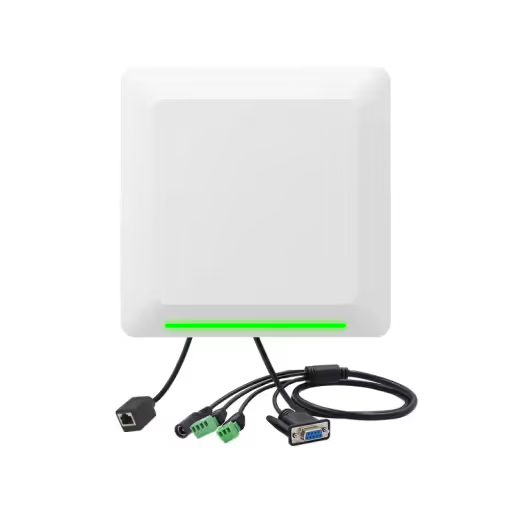
UHF Integrated RFID Reader and Long Range Parking Scanner
All-in-one industrial UHF RFID reader with built-in 9 dBi circular antenna for automated directional gate counting and warehouse choke points.

UHF Inlay Labels and Printable RFID Tags for Packaging
Pre-encoded, tear-resistant synthetic polypropylene UHF labels with industrial adhesive engineered for 50kg woven bags.