Deepak Sharma, Co-Founder at My IT Solutions (admis.co)
Verified Project
"Transformed our municipal waste collection. Bin tag reads at truck lifters are 99.8% accurate."

Click thumbnails to switch media. Click main image for fullscreen.
Asset Tracking
Optimize Municipal & Hospital Waste Tracking with Smart Technology
Wholesale & custom volume pricing available. Get an instant quote below.
Enterprise Assurances
Test the solution in your staging environment before organization-wide rollout. We provide complete sandbox instances, hardware loaners, and architecture walk-throughs.
The RFID Waste Tracking System for Smart Cities & Municipalities (Model: PRD_1748095576140) is an end-to-end IoT and RAIN RFID municipal solid waste management platform engineered for smart city municipal corporations (Swachh Bharat Mission), private waste management concessionaires, commercial bin leasing fleets, and industrial hazardous waste haulers. Designed to automate door-to-door waste collection verification, bin tipping compliance, and pay-as-you-throw (PAYT) billing, this platform connects vehicle-mounted RFID reader lifters, GPS fleet trackers, and rugged container tags into a unified municipal dashboard.
When a waste collection compactor truck's hydraulic comb lifter engages a DIN 30745 RFID-tagged wheelie bin, an IP67 waterproof lifter antenna reads the bin's tag in under 0.5 seconds while the on-board weighing system captures net waste weight. The edge telematics gateway transmits the bin ID, geolocation timestamp, waste weight, and driver ID directly to municipal cloud servers via 4G/5G cellular connections, completely eliminating manual paper logs and ghost collection claims.
The cloud dashboard features AI-powered route optimization algorithms that calculate dynamic collection routes based on real-time bin fullness levels, reducing fuel consumption by up to 25%. It includes a citizen mobile application and municipal grievance portal enabling ward officers to monitor daily collection coverage percentages, SLA contract adherence, and missed bin alerts in real time.
Based on 4 verified client reviews.
"Transformed our municipal waste collection. Bin tag reads at truck lifters are 99.8% accurate."
"GPS route tracking combined with RFID bin tags has given our municipal supervisors complete transparency."
"Rugged UHF waste bin tags survive harsh outdoor weather and automated hydraulic lifters without damage."
"Automated billing based on collection frequency has improved municipal compliance significantly."
Unit Price
₹35,000
Related solutions, hardware specifications, and integration guides.

product
RFID library management system with KOHA integration reduces checkout to 10 seconds, real-time tracking, anti-theft security, self-service kiosks. Contact now
View →

product
Buy UHF RFID Smart Weighing Scale for precise inventory tracking. Features Bluetooth/WiFi, cloud integration. Automate weighing & identification. Order now
View →
blog
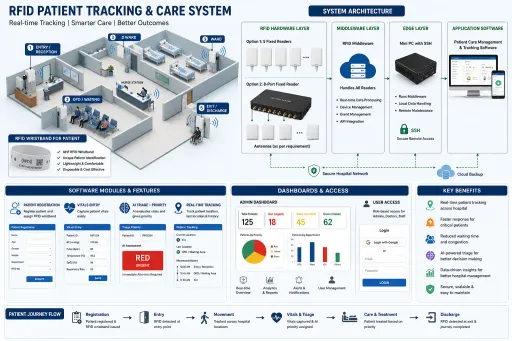
Discover how RFID Patient Tracking Systems enhance hospital operations and patient care with advanced tracking and management features.
View →

blog
This blog highlights the transformative impact of RFID technology in healthcare, focusing on asset tracking, patient management and security.
View →
service
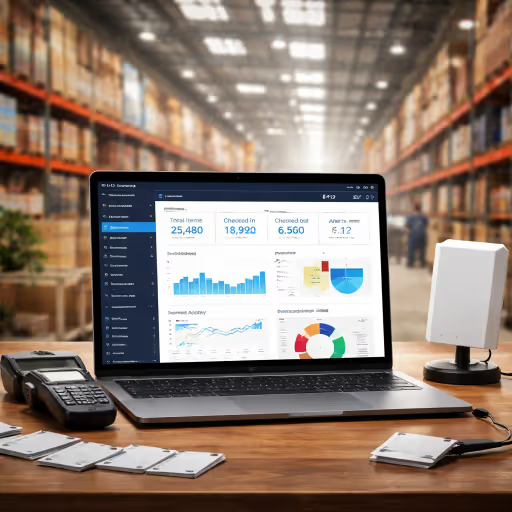
Unlock your business potential with RFID integration solutions. Achieve 99% inventory accuracy and cut costs by up to 50%. Contact us for customized quotes.
View →
Technical Specs & Instant Quotation AI
