
Resource
Handheld RFID Writer & Encoder Guide
Complete guide to handheld RFID writers and portable encoders in India. Learn mobile EPC programming, TID locking, barcode-to-RFID cloning & batch encoding.
Simulate, evaluate, or request turnkey hardware & middleware deployment
-
< 300 ms per tag
Field Tag Encoding Speed
direct 1D/2D barcode to RFID cloning
-
8+ hours continuous
Encoding Battery Autonomy
powered by 8000mAh battery on Chainway C72
-
32-bit password lock
Memory Bank Security
prevents unauthorized field EPC rewrites
What is a handheld RFID writer and mobile tag programmer?
A handheld RFID writer (also called a portable RFID encoder or mobile tag programmer) is a rugged, battery-operated Android mobile computer equipped with an integrated RAIN UHF (865–867 MHz) read/write module and a high-performance 2D barcode scan engine. Unlike stationary desktop RFID printers that require transporting items to an office packing bench, portable RFID writers—such as the Chainway C72 Handheld Reader and Chainway C71 Handheld Reader—empower warehouse and retail associates to commission new tags, update EPC memory, and re-price inventory directly in warehouse storage aisles and retail sales floors.
How mobile RFID tag writing and memory bank encoding operates
Writing data to a passive UHF RFID tag requires transmitting an electromagnetic RF carrier wave that powers the microchip via inductive/backscatter coupling, followed by sending Gen2 protocol write commands (Write EPC, BlockWrite, Lock). The handheld writer focuses its circular polarized antenna beam at close range (typically 5cm to 30cm) to isolate the target tag. The onboard Android application transmits the new hexadecimal string into the tag's non-volatile EEPROM memory bank, verifies write integrity with a read-back checksum check, and logs the transaction in under 300 milliseconds.
Programming EPC, User Memory, TID matching, and Lock/Kill passwords
Passive Gen2 UHF RFID silicon tags contain four standardized logical memory banks:
- Bank 00 (Reserved Memory): Stores the 32-bit Access Password (required to modify locked tags) and 32-bit Kill Password (permanently renders the chip inert for privacy or decommissioning).
- Bank 01 (EPC Memory): Contains the Stored CRC, Protocol Control (PC) bits, and the 96-bit or 128-bit Electronic Product Code (EPC) that identifies the unique physical item.
- Bank 10 (TID Memory): Factory-programmed unalterable silicon serial number (e.g., Impinj Monza or NXP UCODE unique silicon ID).
- Bank 11 (User Memory): Optional extended EEPROM (ranging from 32 to 512 bits) used to write manufacturing batch dates, calibration records, or maintenance logs directly on the tag.
Instant 1D/2D barcode-to-RFID tag cloning workflows
In retail and manufacturing re-tagging operations, the most efficient workflow is direct barcode-to-RFID cloning. An operator scans an existing product barcode (EAN-13, UPC-A, or GS1 DataMatrix) using the handheld's integrated Zebra 2D imager. The software converts the barcode into a compliant GS1 SGTIN-96 format, combines it with an auto-incrementing serial counter, and burns the EPC to a blank tag placed near the scanner tip in a single fluid gesture.
Batch serialization using Excel, CSV, and ERP master databases
When commissioning thousands of tags in a warehouse yard, handheld writers can load CSV/Excel master encoding tables via Wi-Fi or USB. As the operator approaches each pallet or equipment asset, the software prompts for the asset name, writes the pre-assigned EPC from the queue, locks the memory bank, and marks the record as commissioned with timestamp and GPS coordinates.
Chainway C72 vs. Chainway C71: Choosing the right handheld writer
For heavy-duty industrial encoding, the Chainway C72 features an 8,000mAh dual-battery system, pistol-grip trigger, and Impinj E710 module capable of writing tags up to 1 meter away. For ultra-rugged, wet, or dusty environments, the Chainway C71 delivers an IP67 waterproof enclosure with a compact smartphone form factor and integrated Zebra SE4710 2D barcode engine. Explore our complete model comparison on the Chainway C72 Handheld Reader.
Dual-frequency encoding: UHF (865–867 MHz) vs. HF/NFC (13.56 MHz)
While long-range warehouse logistics relies on UHF EPC Gen2, specialized security and healthcare applications utilize High Frequency (HF / NFC 13.56 MHz ISO 14443/15693). Multi-frequency handheld terminals can read and write both UHF inventory tags and HF NFC customer interaction tags (such as NTAG213 and Mifare Desfire), providing maximum versatility across diverse corporate workflows.
Mobile software architecture: OpenRFID SDK and Android APIs
Our handheld writers come pre-loaded with the OpenRFID Mobile Encoder application. For enterprise IT teams building proprietary Android software in Java, Kotlin, Flutter, or React Native, we provide comprehensive SDKs with sample code for single-tag write, block-write, TID-to-EPC serialization, and password locking functions.
Handheld RFID writer pricing and TCO in India
Industrial Android handheld RFID writers in India range from ₹38,000 to ₹72,000 depending on silicon module (Impinj E710 vs standard UHF), battery capacity, and 2D barcode imager options. Turnkey kits include the terminal, charging cradle, SDK documentation, and 1-year replacement warranty with local service center support in Noida.
Field tag encoding standard operating procedures (SOP)
To prevent write failures and accidental multi-tag cross-programming in dense tag environments: 1) Reduce handheld RF transmit power to minimum (e.g., 5 dBm to 10 dBm) during writing; 2) Position the handheld antenna within 10cm of the single target tag; 3) Always enable read-back verification in software before marking the tag as complete; 4) Apply an Access Password if tags will be deployed in open retail environments.
Frequently asked questions about handheld RFID writers and programmers
Common technical inquiries from enterprise IT and warehouse engineering teams regarding tag memory banks, lock security, and mobile encoding best practices.
Interactive RFID Engineering Tools & Calculators
Use our free interactive calculators and simulators to model RF physics, calculate link budgets, estimate ROI, and configure EPC tags.
RFID Read Range Calculator
Simulate maximum open-air vs indoor racking read distances (6m to 25m) based on tag sensitivity and reader power.
Cycle Count & Inventory Calculator
Quantify daily stocktaking labor hours saved by replacing 1D/2D manual scanning with 1,300+ tags/sec UHF sweeps.
RFID Reader Comparison Matrix
Side-by-side spec shootout comparing fixed multi-port readers, Android mobile guns, and modular RFID sleds.
Need a custom handheld rfid writer & encoder guide | mobile programming deployment?
Every environment has distinct RF absorption and ERP sync constraints. Let's review your exact workflow and design an end-to-end blueprint.
Deployed hardware & software
Products & Hardware Deployed in This Solution
Discover the professional-grade RFID readers, tags, and custom integration software systems implemented in this deployment.
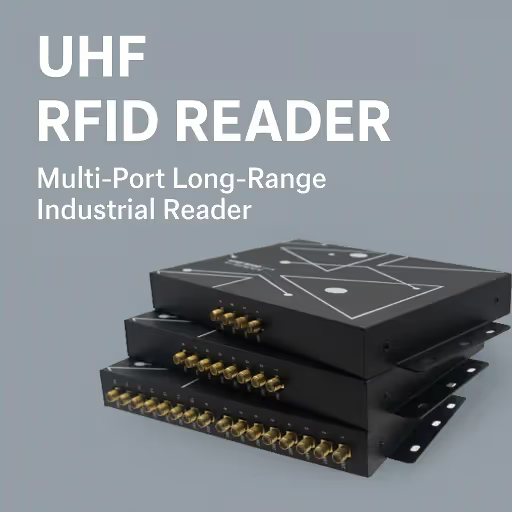
Fixed RFID Reader India and UHF 4-Port Reader Portals
Four-port readers for portals and lines
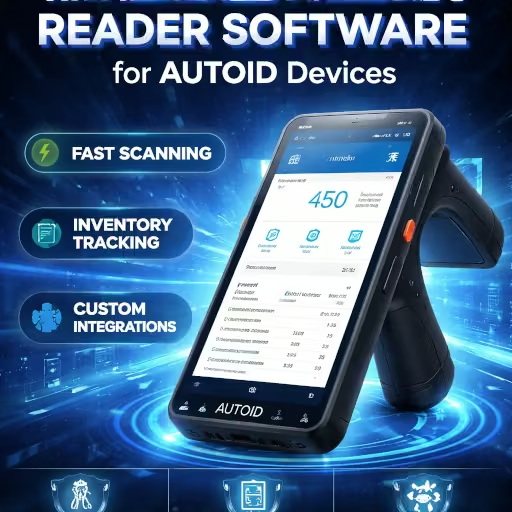
RFID Handheld Reader Software for AUTOID Mobile Terminals
Android app for seamless RFID data capture

NXP U9 Flexible Printable On-Metal RFID Label 80x40mm
1.0mm Flexible Foam On-Metal Smart Label with 6.5m Read Range for IT Assets & Metallic Surfaces
Frequently asked questions
How do you avoid writing data to the wrong nearby tag in a crowded warehouse aisle?
Can a locked RFID tag be modified or unlocked later?
What is the difference between TID and EPC memory on an RFID chip?
Can the handheld writer import batch encoding lists directly from Excel or ERP?
Does the handheld writer support 2D QR codes and barcodes?
What warranty and local technical support are provided in India?
Discover more
You may also like
Hand-picked articles and pages worth your time next.

Chainway C72 UHF RFID Handheld Reader India | AUTOID
Buy Chainway C72 UHF RFID Reader in India. Features Impinj chip, 15m read range, rugged IP65 Android OS & 8000mAh battery. Direct manufacturer price.
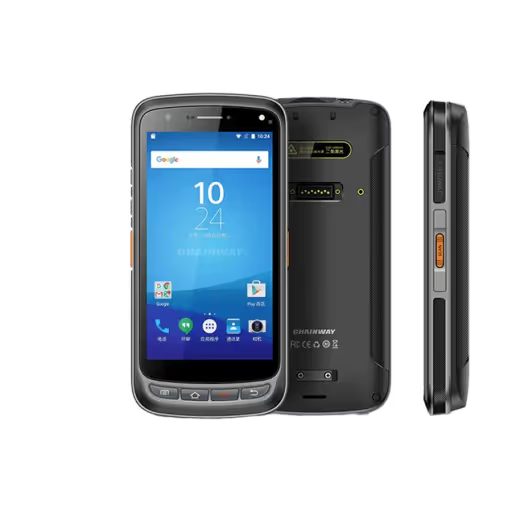
Chainway C71 UHF RFID Handheld Reader India | AUTOID
Buy Chainway C71 UHF RFID Reader in India. Features IP67 rugged build, Impinj RFID module, Zebra 2D barcode scan engine & 5000mAh battery. Best India price.

RFID Standards Guide India | WPC, GS1 & ISO 18000-6C
Complete guide to RFID standards in India: WPC 865-867 MHz notification GSR 564(E), GS1 SGTIN-96 encodings, ISO 18000-6C & HL7 healthcare protocols.