
NXP Semiconductors RFID Silicon Architecture & Benchmarks
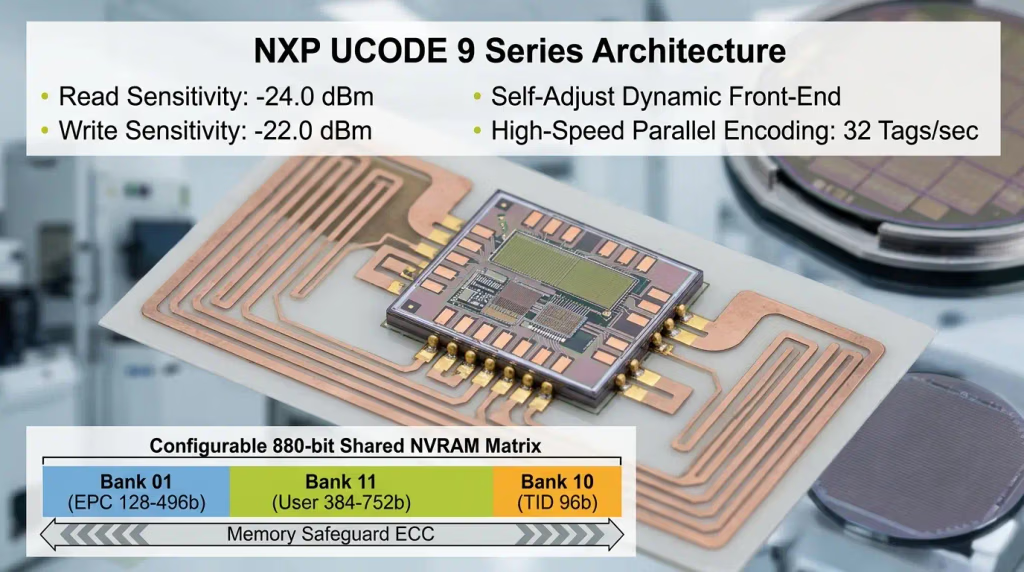
From the ultra-fast industrial converting benchmark UCODE 9 (-24.0 dBm read / -22.0 dBm write)
to the high-memory industrial powerhouse UCODE 9xm and the cryptographic gold-standard NTAG 424 DNA.
Explore on-die Self-Adjust tuning, 32-tag Parallel Encoding, and AES-128 Secure Unique NFC (SUN) dynamic mirroring.
Silicon Model Comparison
NXP Semiconductors RFID Tag IC Benchmark Matrix
Multi-source verified specifications from official NXP datasheets (SL3S1206, SL3S1207, SL3S1205, NT4H2421Gx, SL2S2602).
| Model | Family / Protocol | Read Sens | Write Sens | EPC Bank | User Bank | TID Prefix | Tuning / Engine |
|---|---|---|---|---|---|---|---|
| NXP UCODE 9 | UCODE Series | -24 dBm | -22 dBm | 96 b | 0 b | E28068A0 | Self-Adjust |
| NXP UCODE 9xm | UCODE Series | -24 dBm | -22 dBm | 496 b | 752 b | E28068A... | Self-Adjust |
| NXP UCODE 8 | UCODE Series | -23 dBm | -18 dBm | 128 b | 0 b | E2806894 | Self-Adjust |
| NXP NTAG 424 DNA | NTAG Family | N/A (HF) | N/A (HF) | — | 3328 b | 04... | Static |
| NXP ICODE SLIX2 | ICODE Series | N/A (HF) | N/A (HF) | — | 2528 b | E004... | Static |
Proprietary Hardware Engines
NXP Silicon Engineering Breakthroughs
How NXP engineered industry-leading write sensitivity, parallel converting, and cryptographic NFC security.
UCODE 9 enables writing up to 32 tags simultaneously within a single RF transmission cycle.
With a record-breaking write sensitivity of -22.0 dBm (only a 2 dB gap from read sensitivity),
converters avoid high-power transmitter distortion and eliminate encoding bottlenecks on roll-to-roll label lines.
Designed for heavy manufacturing, automotive WIP, and aviation parts marking. Features 880 bits of flexible NVRAM configurable into three distinct memory configurations: 496b EPC / 384b User, 128b EPC / 752b User, or 96b EPC / 784b User. Includes hardware BlockPermalock security.
EAL4+ certified cryptographic NFC tag silicon. Secure Unique NFC (SUN) dynamically recalculates an AES-128 CMAC token on every smartphone tap, embedding the cryptographic proof into the HTTP URL. Eliminates physical counterfeiting and protects Digital Product Passports (DPP).
Self-Adjust Dynamic Impedance Matching & Brand Identifier
When UHF RFID tags are attached to dense or lossy dielectric materials (such as corrugated cardboard cartons with varying moisture content, garment polybags, or stacked denim), standard fixed-impedance tags suffer severe impedance mismatch. NXP's Self-Adjust feature continuously alters the on-chip capacitive load to compensate for dielectric detuning, preserving up to 5 dB of link margin.
Furthermore, NXP integrates the Brand Identifier feature into the UCODE family. Interrogators can query a cryptographic
origin signature encoded into the TID bank (GS1 Mask Designer Identifier 0x006) to verify that the
tag was manufactured on genuine NXP silicon wafers, preventing counterfeit clones from infiltrating enterprise supply chains.
Foundry FAQs
NXP Semiconductors Silicon Engineering FAQs
Technical questions regarding UCODE 9 converting speeds, memory partitioning, and NTAG cryptographic authentication.
How does NXP UCODE 9 Parallel Encoding work in industrial converting lines?
Traditional Gen2v2 RFID tag encoding requires interrogators to singulate tags sequentially, sending individual BlockWrite or Write commands one-by-one. NXP UCODE 9 features an innovative Parallel Encoding engine that allows an industrial encoder to write up to 32 tags simultaneously within a single RF burst. Because UCODE 9 has an industry-leading write sensitivity of -22.0 dBm (only 2 dB delta from read), converters can run roll-to-roll tag personalization at web speeds exceeding 800 feet per minute without packet collisions.
What is the difference between NXP UCODE 9 and UCODE 9xm?
UCODE 9 is optimized for mass retail item serialization with 96 bits of EPC and zero user memory, minimizing die cost and wafer gate count. UCODE 9xm is engineered for industrial asset tracking, automotive manufacturing, and aerospace maintenance with an 880-bit configurable NVRAM pool. UCODE 9xm supports three flexible memory layouts (e.g., 496b EPC / 384b User, or 128b EPC / 752b User) plus independent BlockPermalock security.
What is NXP Self-Adjust technology and how does it prevent antenna detuning?
NXP Self-Adjust is an on-die analog circuitry block that continuously monitors the RF input impedance at the antenna pads. When tags encounter dielectric shifts (such as proximity to cardboard moisture, stacked jeans, or packaging polymers), Self-Adjust modifies the internal capacitance to maintain resonant tuning across 860–960 MHz, recovering up to 5 dB of link budget and preventing read portal drops.
How does NTAG 424 DNA generate dynamic cryptographic URLs (Secure Unique NFC)?
NTAG 424 DNA is an NFC Forum Type 4 IC featuring a hardware-accelerated AES-128 cryptographic engine. On every tap, the chip increments an internal tap-counter and calculates a unique Cipher-based Message Authentication Code (CMAC) over the tag UID and counter value. This dynamic payload is automatically mirrored into the NDEF URL string. Any standard smartphone web browser validates the URL against a cloud authentication server without requiring a specialized mobile application.
Compare Other RFID Semiconductor Foundries
Explore complete architectural teardowns and sensitivity benchmark matrices for alternative silicon vendors.
Impinj Silicon Cluster →
M800 Series (-25.5 dBm), M700, Monza R6, AutoTune v3 varactor array, and Protected Mode.
Alien Technology →
Higgs-10, Higgs-9 (1024b NVRAM), Sentinel™ hardware ECC, and 200k cycle endurance.
EM Micro & Axzon →
EM4425 dual-frequency (RAIN+NFC), tamper loops, EM4325 BAP, and Magnus-S3 sensing.