
EM Microelectronic & Axzon Specialty RFID Silicon Architecture
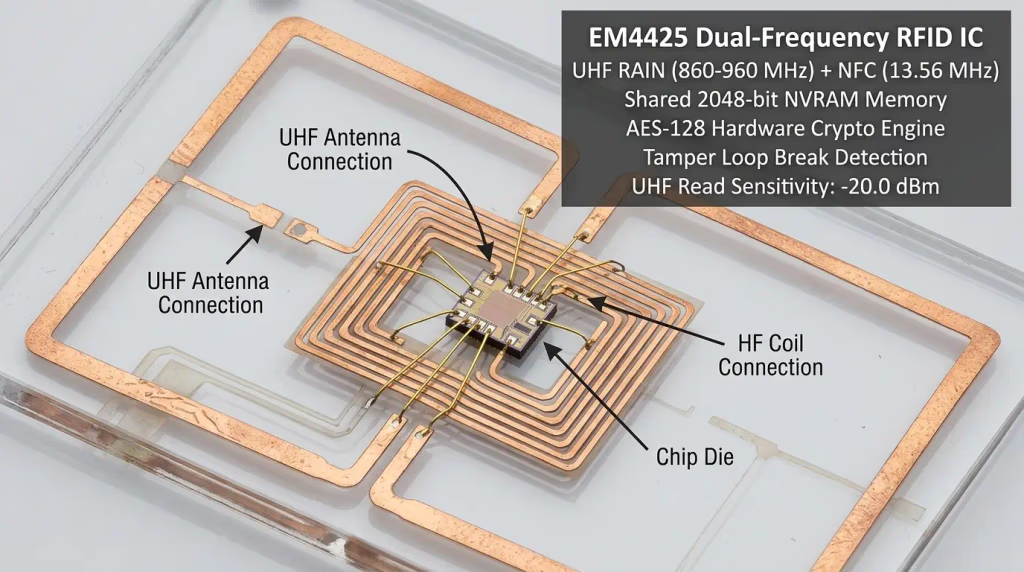
From monolithic Dual-Frequency (RAIN UHF + NFC HF) silicon with hardware tamper detection loops
to extreme-range Class-3 BAP (-31.0 dBm / 50m range)
and battery-free passive environmental sensing.
Explore the intersection of industrial inventory logistics and consumer smartphone engagement.
Specialty Silicon Benchmark
Dual-Frequency & RFID Sensing IC Benchmark Matrix
Multi-source verified specifications from official EM Microelectronic and Axzon datasheets (EM4425, EM4423, EM4325, Magnus-S3).
| Model | Manufacturer | Frequency Band | Read Sens | EPC Bank | User Bank | TID Prefix | Key Capabilities |
|---|---|---|---|---|---|---|---|
| EM Microelectronic EM4425 (em|echo-V) | EM Microelectronic | Dual-Frequency (UHF + NFC) | -20 dBm | 448 b | 2048 b | E28016... | Dual-Port |
| EM Microelectronic EM4423 (em|echo) | EM Microelectronic | Dual-Frequency (UHF + NFC) | -18 dBm | 256 b | 1024 b | E28016... | Dual-Port |
| EM Microelectronic EM4325 | EM Microelectronic | RAIN Sensor | -31 dBm | 496 b | 4096 b | E28016... | Static |
| Axzon Magnus-S3 | Axzon | RAIN Sensor | -16.6 dBm | 128 b | 128 b | E28035... | Chameleon™ |
Proprietary Hardware Engines
Dual-Frequency & Battery-Free Sensing Innovations
Bridging supply chain automation with smartphone user authentication and telemetry.
EM4425 and EM4423 bridge RAIN UHF (ISO 18000-63) and HF NFC on a single chip. Warehouse dock readers scan items in bulk at 10 meters, while end consumers tap individual items with an iPhone or Android phone to access authenticity certificates, care guides, and warranty registration.
Class-3 Battery-Assisted Passive technology. An on-tag coin cell powers the internal CMOS logic and temperature sensor while backscatter communication remains passive. Enables reading over 50 meters and operating reliably inside harsh refrigerated cold-chain containers.
Zero-battery wireless sensor IC. The Chameleon™ engine converts antenna dielectric shifts into a 5-bit digital moisture code, while an on-chip bandgap sensor provides ±0.25°C temperature readings. Ideal for automotive leak detection and electrical switchgear monitoring.
Hardware Tamper Detection Loops & Digital Product Passports (DPP)
In luxury packaging and pharmaceutical serialisation, counterfeiters frequently refill authentic bottles with illicit substances. EM4425 solves this vulnerability with an integrated hardware tamper loop. The chip monitors continuity across two external micro-pads wired across the container seal. When broken, an immutable hardware bit flips in the NVRAM.
When scanned by a consumer smartphone, the NFC URL dynamically changes to display a verified "Packaging Compromised" warning page. Combined with on-die AES-128 cryptographic authentication, EM4425 fulfills European Union Digital Product Passport (DPP) mandates without requiring external cryptographic coprocessors or battery power.
Specialty FAQs
Dual-Frequency & Sensing Silicon FAQs
Technical questions regarding dual-port memory synchronization, tamper loops, and sensor codes.
How does the dual-frequency shared memory bridge work on EM4425 (em|echo-V)?
EM4425 combines a RAIN UHF RF front-end (860–960 MHz, ISO 18000-63) and an HF NFC front-end (13.56 MHz, ISO 15693 NFC Type 5) onto a single monolithic silicon die. Both RF interfaces connect directly to a shared 2,048-bit NVRAM memory matrix. A warehouse dock door can bulk-inventory 500 cartons in seconds over UHF, while a retail consumer or field technician can tap an individual item with a standard iOS or Android smartphone over NFC to read the exact same serialized data with zero cloud synchronization delay.
How does the on-die hardware tamper detection loop function?
EM4425 features two dedicated tamper pads connected to a conductive tear-strip across a pharmaceutical bottle cap, luxury wine seal, or warranty closure. The silicon continuously monitors loop continuity. When an unauthorized user breaks the seal, the loop becomes an open circuit. The silicon instantly sets an unalterable hardware tamper flag in the memory bank and appends the tamper status to the dynamic NFC URL string, alerting consumers and inspectors that the product packaging has been compromised.
How does the EM4325 Battery-Assisted Passive (BAP) achieve a -31 dBm read sensitivity?
Standard passive RFID ICs must rectify harvested RF energy from the reader field to power their internal digital logic and memory. In Class-3 Battery-Assisted Passive mode, a miniature on-board battery powers the internal CMOS logic and temperature sensor, while the tag uses standard passive RF backscatter modulation to communicate with the reader. This drops the required activation field threshold to -31.0 dBm, extending read range past 50 meters and overcoming severe attenuation in cold chain shipping containers.
How does Axzon Magnus-S3 measure moisture and temperature without a battery?
Axzon Magnus-S3 utilizes the proprietary Chameleon™ engine. As external moisture or dielectric material touches the tag antenna, the complex antenna impedance shifts. The Chameleon front-end automatically steps its internal varactor capacitor array to find the new resonance peak. The digital step count required to reach resonance is output as a 5-bit digital Sensor Code representing moisture or liquid presence, while an on-die bandgap circuit yields a calibrated 12-bit temperature code.
Compare Other RFID Semiconductor Foundries
Explore complete architectural teardowns and sensitivity benchmark matrices for alternative silicon vendors.
Impinj Silicon Cluster →
M800 Series (-25.5 dBm), M700, Monza R6, AutoTune v3 varactor array, and Protected Mode.
NXP Semiconductors →
UCODE 9 (-22 dBm write), 880b NVRAM UCODE 9xm, and NTAG 424 DNA AES-128 SUN.
Alien Technology →
Higgs-10, Higgs-9 (1024b NVRAM), Sentinel™ hardware ECC, and 200k cycle endurance.