
NFC vs. QR Code Digital Business Cards:
The Death of Paper & The 99% TCO Revolution
Over 88% of traditional paper business cards are discarded within one week. Discover how dual-mode smart cards combining 13.56 MHz NXP NFC silicon, high-contrast dynamic QR codes, 100 autonomous employee profiles, and lifetime free cloud hosting disrupt overpriced SaaS business models.
Hardware Unit Cost
₹50 (Wholesale)
Per NXP NTAG213 card (or ₹200 single unit)
Pack Minimum (MOQ)
100 Cards
₹5,000 ($60) per 100-card pack
Employee Profiles
100 Staff
100 independent logins
Software Subscription
₹0 / mo
100% Lifetime Free on Cloud
The Traditional Visiting Card Crisis
Why Paper Cards are Costly Corporate Waste
Billions of paper business cards are printed every year, yet virtually all fail to generate tangible commercial follow-ups.
In high-stakes corporate networking, trade shows, and sales meetings, paper cards suffer from three fatal friction points:
- ✕ Instant Friction & Lost Leads: The prospect must manually open their phone, launch Contacts, and type 10 digits, email addresses, and names without typos. Most never do.
- ✕ Static Inflexibility: When an employee gets promoted, changes their phone extension, or company office moves, thousands of pre-printed paper cards become obsolete garbage overnight.
- ✕ Zero Interactivity: Paper cannot showcase your corporate video reel, product PDF catalogs, WhatsApp chat shortcut, or calendar booking link.
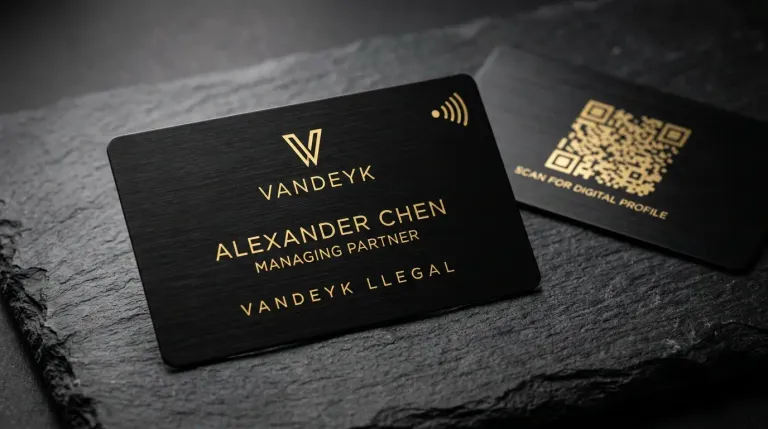
User Experience Comparison
Tap vs. Scan: How Smart Contact Exchange Works
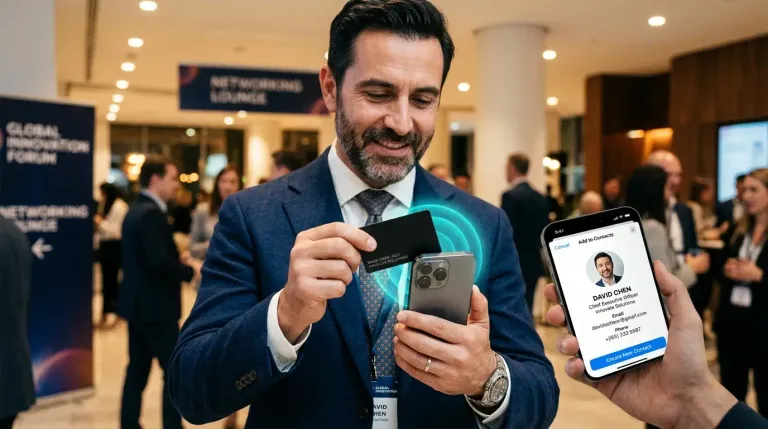
Experience the difference between a sub-50ms contactless NFC handshake and the universal visual optical QR fallback.
1-Tap Professional Handshake
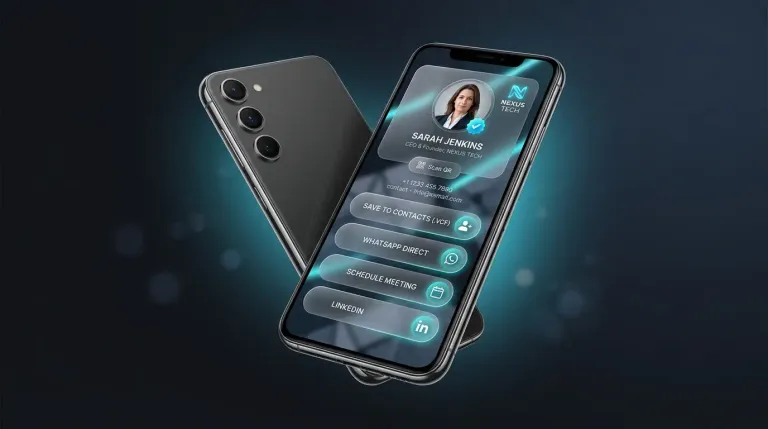
Tap against the rim of an iPhone or Android device. The phone chimes and immediately opens the vCard profile. 1-click downloads full name, direct WhatsApp, and corporate email directly into Apple/Google Contacts.
Universal Camera Fallback
For older smartphones, tablets, or when NFC is disabled in settings, the customer simply flips the card to scan the laser-etched dynamic QR code with their default camera app. Opens the identical digital profile.
Live Hardware Tap Demonstration
Watch the instant tap-to-phone contact saving flow in action without installing any app
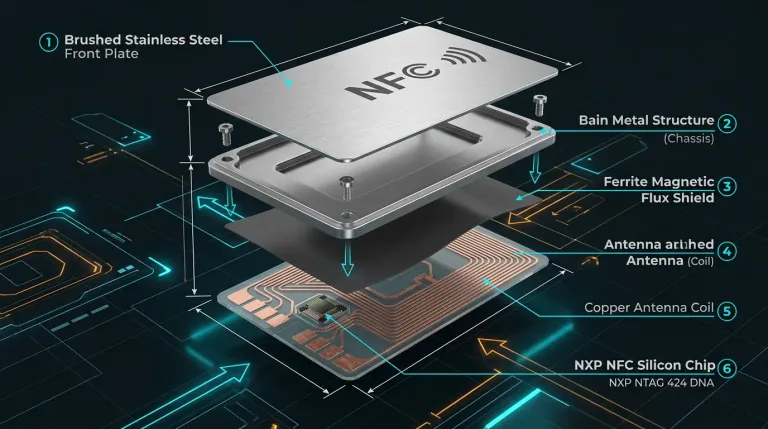
Electromagnetic Physics
Why Metal Cards Kill NFC Signals (And How We Solved It)
Luxury stainless steel and anodized aluminum business cards look stunning, but standard NFC chips fail completely against metal.
When a smartphone creates an alternating 13.56 MHz magnetic field, bringing a bare conductive metal plate into the field induces violent circulating eddy currents.
To overcome this, RFID Softwares incorporates an aerospace-grade ferrite ceramic barrier layer (permeability μr > 150). The ferrite acts as a magnetic conduit, capturing and redirecting the flux lines before they touch the metal substrate.
Each antenna coil is calibrated on an Agilent Vector Network Analyzer (VNA) to resonate cleanly at 13.56 MHz even under capacitive surface loading, restoring full 3–4 cm smartphone sensitivity.
Zero Vendor Lock-in
Dual Update Flexibility: Cloud Sync & Direct On-Tag Reprogramming
We give you complete freedom. Manage profiles remotely via our cloud portal, or reprogram the physical NXP chip directly with your phone.
1. Instant Remote Cloud Updates
Through app.rfidsoftwares.com
- ✓ Update mobile number, designation, or company address anytime
- ✓ Sub-15ms Anycast edge reflection across all customer phones
- ✓ Real-time per-link analytics: tracks vCard downloads and WhatsApp clicks
- ✓ No physical card contact required—updates happen over the air
2. On-Tag Direct NFC Reprogramming
Unlocked NXP NTAG213 Silicon
- ✓ 144 bytes of open EEPROM user memory
- ✓ Reprogram directly using free apps like NFC Tools (iOS / Android)
- ✓ Write custom URLs, raw text, Wi-Fi credentials, or crypto keys
- ✓ 100% unlocked hardware with zero proprietary chip locking
Corporate Fleet Economics
3-Year Enterprise Fleet TCO: Popl / Mobilo vs. RFID Softwares
See why Fortune 500 sales teams and corporate enterprises are saving over 99% in total cost of ownership by eliminating SaaS hostage fees.
| Cost Component | Western SaaS Brands (Popl / Mobilo / V1CE) | Local Print Shops (No Cloud Portal) | RFID Softwares 100-Pack |
|---|---|---|---|
| Per-Card Price | $30 to $50 (~₹2,900 – ₹4,200) | ₹150 – ₹250 | ₹30 (~$0.36 USD) |
| MOQ / Pack Quantity | 1 Card ($35) | 50 – 100 Cards | 100 Cards |
| Hardware Setup (100 Cards) | $3,500 (~₹2,90,000) | ₹15,000 – ₹25,000 | ₹5,000 ($60 Flat) |
| Monthly Software per User | $7.99 to $14.99 / user / mo | ₹0 (No portal) | ₹0 / mo (100% Lifetime Free) |
| 3-Year Software Fee (100 Users) | $35,964 (~₹29,85,000) | ₹0 | ₹0 ($0 Never Billed) |
| Independent Employee Logins | Locked to Enterprise SaaS Tier | None | 100 Independent Staff Logins |
| Direct Smartphone Reprogramming | Locked / Encrypted by SaaS | Generic unauthenticated tags | 100% Unlocked NXP NTAG213 |
| TOTAL 3-Year Corporate Cost | $39,464+ (~₹32,75,000+) | ₹25,000+ | ₹5,000 ($60 Flat) |
Net Enterprise Fleet Savings: > 99%
Equip your entire sales organization, regional branches, and field consultants with genuine NXP NFC smart business cards for starting from just ₹50 per card for 100-packs (or ₹200 single card sample). Zero recurring subscriptions, zero SaaS hostage locks.
Frequently Asked Questions
Smart NFC Business Cards & Corporate Deployment
Clear answers regarding NXP silicon chips, multi-employee provisioning, smartphone compatibility, and on-tag reprogramming.
How does an NFC digital business card work when tapped on a smartphone? ↓
The card contains an authentic NXP NTAG213 silicon chip with an etched micro-antenna. When brought within 2–4 cm of an iPhone or Android phone, the phone's NFC controller powers the tag via electromagnetic induction and reads an NDEF record in under 40 milliseconds. A notification appears on the phone screen that immediately launches the contact profile with a 1-click 'Save to Contacts' (.vcf) button.
Can 100 different employees use independent profiles from a single 100-card pack? ↓
Yes, 100% independently. When an enterprise purchases our ₹5,000 (100-card pack @ ₹50/card), the organization receives 100 unique credential tokens. Each employee can log in to app.rfidsoftwares.com to set up their own headshot photo, designation, direct phone number, personal WhatsApp link, and social channels with zero overlap.
Does the recipient need to download an app to read an NFC business card? ↓
No. Modern smartphones (iPhone XR and newer running iOS 14+, and all NFC-enabled Android devices) feature native background NFC tag detection at the operating system level. When tapped, the phone automatically displays a system notification banner that opens directly in Safari or Chrome. The recipient simply taps 'Add to Contacts' to save the .vcf contact card into their address book without downloading any app or creating an account.
Do NFC business cards have batteries or run out of charge, and do they expire? ↓
No. NFC business cards are 100% passive transponders containing no batteries, charging ports, or chemical cells. They are powered entirely by electromagnetic induction generated by the smartphone's RF field (13.56 MHz) during a close-proximity tap (2–4 cm). The physical NXP NTAG silicon chip lasts 10 to 25+ years with a retention rating of over 100,000 write cycles.
Do NFC business cards work offline without an active internet connection? ↓
Yes, when configured in direct vCard mode. You can write your primary contact information (Name, Telephone, Email, Company) directly into the card's 144–888 byte NDEF EEPROM storage using free apps like NFC Tools. In this mode, the contact imports into the recipient's phone address book with zero internet or cellular connectivity. If using the cloud profile mode (which hosts rich portfolios, LinkedIn links, and booking calendars), the recipient's phone requires internet connectivity to render the webpage.
Is NFC contact sharing secure? Can someone hack my phone with an NFC card? ↓
NFC contact sharing is exceptionally secure. Because NFC communication requires physical proximity of under 4 cm, accidental or drive-by scans are impossible. Furthermore, an NFC tag is an unpowered data carrier that can only transmit standardized NDEF records (such as a URI or vCard text); it cannot execute arbitrary code, trigger malicious downloads, or access private files or financial wallets on the receiving device.
Can an NFC business card be locked or password-protected against accidental overwriting? ↓
Yes. Authentic NXP NTAG213/215 chips feature hardware-level 32-bit password protection (PWD) and 16-bit PACK with configurable AUTH0 lock bytes. Corporate IT administrators can lock cards with a master password to prevent employees or third parties from wiping or altering the contact data, while still allowing unlimited frictionless public reads.
Can I reprogram or rewrite the NFC card directly with my smartphone? ↓
Yes. In addition to instant cloud profile updates, each card features unlocked, genuine NXP NTAG213 silicon with 144 bytes of rewritable EEPROM. Using free smartphone apps like NFC Tools (iOS and Android), users or IT administrators can directly write custom URLs, plain vCard text, or access credentials directly onto the physical tag.
Why do standard metal cards block NFC signals, and how does RFID Softwares solve this? ↓
Solid metal surfaces induce destructive eddy currents that cancel out 13.56 MHz RF signals according to Lenz's law. RFID Softwares solves this by inserting a high-permeability flexible ferrite magnetic shielding layer (permeability µr > 150) between the metal faceplate and the copper antenna coil, preventing eddy currents and ensuring reliable 3–4 cm smartphone read range.
Are there any monthly subscription fees or software renewals? ↓
Zero. Unlike Western digital card platforms (such as Popl, Mobilo, or V1CE) that charge $7.99 to $14.99 per employee every month, RFID Softwares provides 100% lifetime free profile hosting on app.rfidsoftwares.com. An enterprise with 100 sales reps pays ₹5,000 flat once, saving over ₹32,00,000 ($39,000+) over 3 years.
How can RFID Softwares afford to offer 100% lifetime free software? Is this a catch or scam? ↓
There is zero catch. RFID Softwares is an established industrial software engineering firm, not a drop-shipping middleman. Our dedicated full-time engineering and DevOps team actively maintains large-scale cloud ERP platforms including AILaboratorySystem.com (AI LIMS for medical labs), RFIDSchools.com (automated student attendance ERP), and MyFlashcards.in for years. For standard users and SMBs, hosting dynamic URL redirects on our Google Cloud edge serverless architecture costs fractions of a cent per month. Our engineering infrastructure is fully funded by our annual enterprise software maintenance and SLA contracts (custom SSO, SAP connectors, and dedicated private VPCs for large corporations), while we earn an honest manufacturing profit on physical hardware.
How does the cloud gateway protect against security threats, phishing, and DDoS attacks? ↓
We have not compromised on security. Our cloud routing operates on multi-zone Google Cloud Platform (GCP) and Firebase infrastructure backed by a 99.95% uptime SLA. The gateway features automatic edge rate-limiting to mitigate DDoS floods, end-to-end TLS 1.3 encryption, and automated integration with Google Web Risk / Safe Browsing APIs to actively inspect destination URLs and block phishing attempts. On the physical card layer, genuine NXP NTAG213 chips feature 32-bit hardware password protection (PWD) to block unauthorized on-site overwrites.
📚 Continue Reading: In-Depth Technical Guides
NFC vs. QR Code Speed & Physics
13.56 MHz inductive coupling vs. 2D camera scanning latency race.
ArchitectureDynamic vs. Static QR Codes & The 14-Day Trap
HTTP 302 redirects, edge analytics, and zero-paywall cloud software.
Enterprise MatrixRFID vs. NFC vs. QR vs. Barcode AIDC Benchmark
700 tags/sec throughput, dock door portals, and SAP/Tally sync.