
RFID vs. NFC vs. QR Code vs. Barcode:
The Enterprise Asset Tracking Architecture Matrix
Choosing the wrong Auto-ID technology creates severe throughput bottlenecks and labor waste. Benchmark read range (0cm vs. 15m), anti-collision bulk throughput (1 vs. 700 tags/sec), environmental durability, and direct SAP/Tally middleware integration.
UHF Read Range
Up to 15m
Zero line-of-sight needed
UHF Bulk Read Speed
700+ tags/s
Anti-collision Q-algorithm
NFC Consumer Reach
100% Phones
Native 1-tap app-free
ERP Sync Latency
< 10ms
SAP BAPI & Tally Prime
AIDC Spectrum
Understanding the Four Automatic Identification Technologies
From visual optical labels to electromagnetic far-field transponders, each technology serves distinct operational tiers.
In enterprise asset tracking, supply chain logistics, and retail management, confusion arises because all four technologies store data and identify items. However, their physical operational mechanisms are fundamentally different:
- 1 1D Barcodes: Linear optical bars (UPC, Code 128) encoding 12–20 characters. Requires line-of-sight laser alignment and reads strictly 1 tag at a time.
- 2 2D QR Codes: Matrix optical codes with 2D error correction. Universally accessible via smartphone cameras, ideal for menus, stands, and public URLs.
- 3 13.56 MHz NFC: High-Frequency radio operating via near-field inductive coupling (2–4 cm). Native to all modern smartphones; frictionless 1-tap customer interaction.
- 4 UHF Passive RFID: 865–868 MHz / 902–928 MHz far-field radio. Powers tags up to 15 meters away; reads 700+ tags simultaneously through boxes and shrink-wrap.
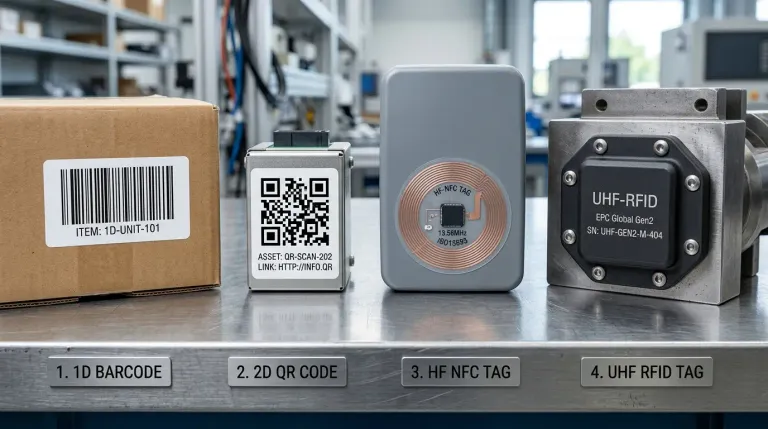
Objective Engineering Benchmark
The 8-Axis Technology Scorecard (Rated 1 to 10)
Comprehensive evaluation based on physical operational constraints, scanning speeds, hardware costs, and enterprise readiness.
| Evaluation Axis | 1D Barcode | 2D QR Code | 13.56 MHz NFC | UHF Passive RFID |
|---|---|---|---|---|
| Speed to Digital Link | 4 / 10 | 6 / 10 | 10 / 10 (<50ms) | 10 / 10 (<10ms) |
| Zero App Smartphone Access | 2 / 10 (Needs app) | 9 / 10 (Camera app) | 10 / 10 (Native 1-tap) | 1 / 10 (Dedicated reader) |
| Scratch & Grease Immunity | 2 / 10 (Fails easily) | 4 / 10 (Reed-Solomon) | 9 / 10 (Encapsulated) | 9 / 10 (Inside box/label) |
| Low Light / Dark Scanning | 5 / 10 | 3 / 10 (Camera fails) | 10 / 10 (Zero light) | 10 / 10 (Zero light) |
| Anti-Cloning & Security | 1 / 10 (Easily photocopied) | 1 / 10 (Easily photocopied) | 9 / 10 (AES-128 Crypto) | 8 / 10 (Factory locked TID) |
| Bulk Throughput (100+ tags) | 1 / 10 (Sequential) | 2 / 10 (Sequential) | 2 / 10 (Sequential tap) | 10 / 10 (700+ tags/sec) |
| Per-Unit Tag Cost Economy | 10 / 10 (₹0.05) | 10 / 10 (₹0.10) | 6 / 10 (₹8 – ₹18) | 8 / 10 (₹2.50 – ₹5.00) |
| ERP Automation Readiness | 3 / 10 (Manual wedge) | 4 / 10 (Manual wedge) | 7 / 10 (Kiosk/Badge) | 10 / 10 (Automated LLRP) |
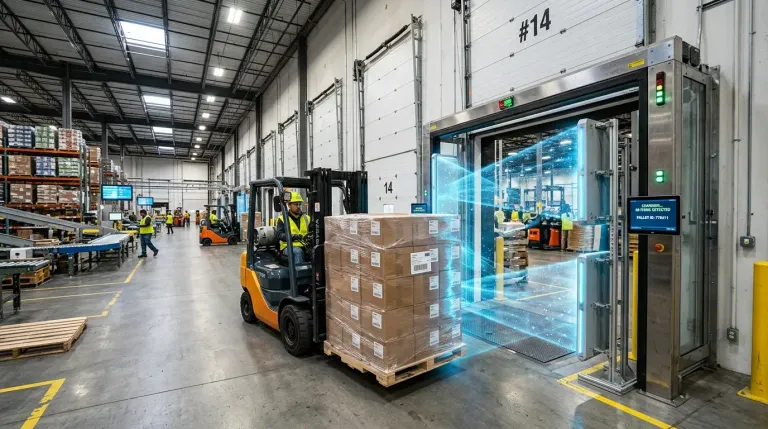
Why Optical Barcodes & QR Codes Fail on Pallets
In high-velocity distribution centers, palletizing creates an optical nightmare. When 200 cartons are stacked on a wooden pallet and sealed in transparent stretch-wrap:
- ✗ Boxes facing inward have their barcodes hidden from sight, requiring a worker to tear the wrap and restack every carton manually (15–25 minutes per pallet).
- ✗ Scratches, road grime, and torn labels during transit cause 3–7% no-read failures that halt conveyor lines.
- ✓ The RFID Solution: UHF radio waves penetrate cardboard and plastics instantly. A fixed dock portal inventories all 200 items in 2.5 seconds with 99.9% read accuracy.
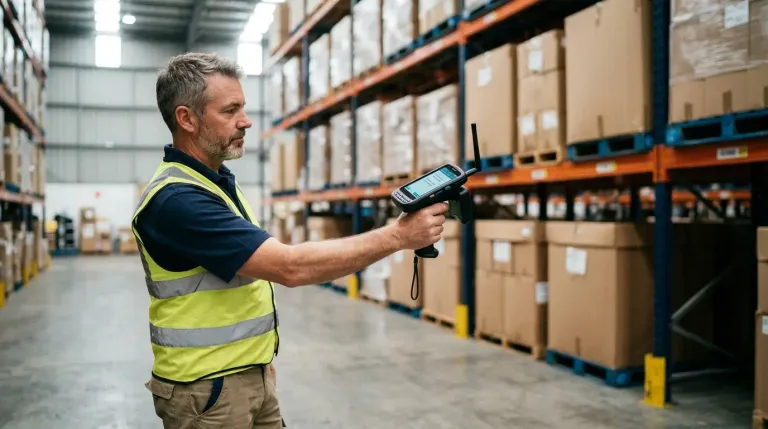
Chainway C72 Handheld: Audit 10,000 Items in 30 Minutes
Conducting physical retail or warehouse audits with barcode guns requires aiming at every single garment tag or carton barcode. A 10,000-item store audit takes an entire team 2 full days.
With the Chainway C72 Rugged Handheld RFID Reader, an operator simply walks down aisles waving the terminal antenna. The terminal reads tags up to 10 meters away through clothing racks, boxes, and high shelves at 200+ tags per second.
Verified Audit Benchmark:
10,000 apparel SKUs audited in 28 minutes with 99.8% accuracy and real-time ERP reconciliation.
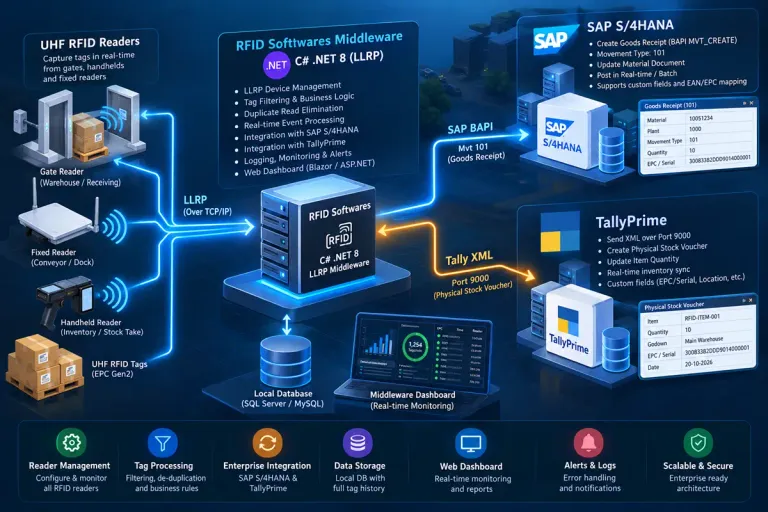
Sub-10ms Middleware Sync to SAP & Tally Prime
A raw RFID reader produces thousands of duplicate tag reads every second. Flooding an ERP like SAP S/4HANA or Tally Prime with raw tag chatter will crash database connections.
RFID Softwares Edge Middleware Architecture:
- • Reader Abstraction Layer: Connects to Zebra, Impinj, and Chainway readers via native LLRP sockets.
- • High-Performance Deduplication: In-memory sliding time window filters out millions of duplicate tag reads.
- • Direct BAPI / XML Dispatcher: Directly posts goods receipt (MIGO) and dispatch invoices into SAP and Tally within 10 milliseconds.
Decision Architecture
Which Auto-ID Technology Should You Deploy?
Follow this simple operational rule of thumb to select the right tool for your specific business use case.
NFC & Dynamic QR Dual Stand
Best For: Google review stands, restaurant menus, retail counters, and digital smart business cards. 100% app-free consumer interaction on any smartphone.
UHF Passive RFID Portals
Best For: Pallet tracking, dock door automation, carton sorting, high-volume apparel manufacturing, and returnable transport item (RTI) tracking.
Rugged Handheld Readers
Best For: Fast cycle counts, item locating with Geiger-counter audio mode, asset tagging, and field equipment maintenance verification.
Frequently Asked Questions
AIDC Hardware, Tags & Protocol Comparisons
Key engineering answers on read ranges, frequencies, smartphone limitations, and ERP middleware integration.
What is the primary difference between UHF RFID and NFC? ↓
Both operate via radio frequency, but at vastly different bands and physics. NFC operates at 13.56 MHz (High Frequency) via magnetic inductive coupling with a strictly limited read range of 2–4 cm, designed for secure 1-on-1 smartphone taps. UHF RFID operates at 865–868 MHz (India) or 902–928 MHz (US) in the electromagnetic far-field, allowing readers to read 700+ tags per second simultaneously at distances up to 12–15 meters without line-of-sight.
Why can't QR codes or barcodes be used for automated warehouse dock doors? ↓
Barcodes and QR codes require direct optical line-of-sight. For a forklift carrying a shrink-wrapped pallet of 200 boxes, a worker must manually rotate and scan each box sequentially, taking 15–25 minutes. A UHF RFID dock portal reads all 200 tags simultaneously in under 2 seconds as the forklift drives through at 10 km/h with zero manual scanning.
Can smartphones read UHF RFID tags? ↓
No, standard consumer smartphones do not possess UHF RFID antennas or transceivers; they only support 13.56 MHz NFC. To read UHF RFID tags, enterprises use rugged Android handhelds with integrated RFID modules (such as the Chainway C72 or Zebra TC26/RFD40 sled) or fixed industrial reader portals (like the Impinj Speedway or Chainway UR4).
How do RFID dock reads integrate into ERP systems like SAP or Tally? ↓
Raw RFID tag read events are captured by fixed portal readers via LLRP (Low Level Reader Protocol) or TCP/IP sockets. Our lightweight enterprise RFID middleware deduplicates reads, validates EPC tags against production orders, and maps data directly into SAP S/4HANA via BAPI/RFC calls or Tally Prime via XML POST requests within 10 milliseconds.
What are the unit tag costs across these four technologies? ↓
Standard 1D barcodes and printed QR codes cost virtually nothing (₹0.05–₹0.10) because they are printed on ordinary paper labels. UHF Passive RFID labels cost approximately ₹2.50 to ₹5.00 ($0.03–$0.06), while HF/NFC inlays cost ₹8.00 to ₹18.00 ($0.10–$0.22) due to higher copper etching complexity and larger silicon dies.
📚 Continue Reading: In-Depth Technical Guides
NFC vs. QR Code Speed & Physics
13.56 MHz inductive coupling vs. 2D camera scanning latency race.
ArchitectureDynamic vs. Static QR Codes & The 14-Day Trap
HTTP 302 redirects, edge analytics, and zero-paywall cloud software.
Smart CardsNFC vs. QR Digital Business Cards & TCO
₹30/card, 100 autonomous employee profiles, and ferrite shielding.