
Industry
RFID for Corporate & Industrial Canteens
Automate cafeteria operations in industrial factories, IT tech parks & SEZ food courts. Resolve contractor meal disputes, enforce shift quotas & automate subsidies.

Simulate, evaluate, or request turnkey hardware & middleware deployment
-
< 3 minutes
Lunch queue wait time
down from 18+ minutes in manual lines
-
0% error
Contractor billing leakage
shift-verified meal entitlement logs
-
25% average
Food preparation savings
demand-driven raw material planning
Operational Transformation: Manual Barcode Staging vs. Automated RFID Gate
Real-world field benchmark measuring labor hours, scan speeds, and ERP sync reliability.
Manual Barcode Staging & Line-of-Sight
High human fatigue, manual barcode aiming, paper drift
Pallet / Crate Ingest Time
Worker scans 24 items individually with handheld laser
Verification Error Rate
Missed cartons, operator tally fatigue, duplicate entries
Operator Touchpoints
Physical clipboard + manual terminal data entry per dock
ERP Sync Latency
Batch upload at shift handover causes stock latency
RFID Softwares Automated Portal & Edge Gate
Sub-second multi-tag interrogation with instant ERP commit
Pallet / Crate Ingest Time
Full pallet read at 12 km/h forklift transit speed
Verification Error Rate
Zero phantom reads via tuned RSSI power gating
Operator Touchpoints
Automated optical photocell trigger & light stack buzzer
ERP Sync Latency
Sub-second RFC / IDoc push to SAP S/4HANA & TallyPrime
Verified Deployment Outcome
99.3% Labor Time Cut • 100% Audit-Proof Physical-to-Digital ERP Traceability
Corporate Cafeteria: Cashless POS & Meal Billing Video
Watch cloud canteen management software handle employee meal tokens and smart card POS billing.
Cloud Canteen Management Software | Cashless POS & Meal Billing
Enterprise Cashless Cafeteria Software POS, Mobile Wallet & Caterer Settlement System
Edge-to-ERP Data Pipeline Blueprint
How RFID for Corporate & Industrial Canteens | Shift & Contractor Meal Management ingests thousands of physical tag reads per minute, suppresses duplicate RF bounces, and synchronizes with your central ERP in sub-second intervals.
The Problem Solved in Plain English:
Standard RFID readers flood servers with 50,000 raw scans every minute, crashing databases with duplicate reads. Our middleware acts as a smart edge filter—it recognizes when the same item sits in front of a scanner, registers it exactly once, and queues the data locally so no scans are lost even if warehouse Wi-Fi drops.
RF Backscatter
UHF tags energize via 865–867 MHz CW carrier wave. Backscatters 96-bit SGTIN EPC identifiers.
• Anti-collision: Q-algorithm
Lock-Free Channel
Reads stream across high-speed LLRP / TCP sockets into an in-memory ring buffer with bounded backpressure.
• Latency: < 2.5ms jitter
Sliding Cooldown
Central 60-second sliding window filters duplicate reflections across adjacent gates before storage.
• Offline auto-reconnect
Enterprise ERP Post
Gzip-compressed batch payloads dispatch via REST webhook or direct OData / XML connector to ERP.
• Retries: Exponential backoff
Architecture Comparison: Traditional vs. OpenRFID Edge Engine
| Operational Factor | Traditional Direct-to-DB Connection | OpenRFID High-Scale Edge Architecture |
|---|---|---|
| Network Downtime / Wi-Fi Loss | ❌ Scans are permanently lost; inventory mismatch occurs. | ✅ Scans buffer to local SQLite WAL queue and auto-sync when restored. |
| Duplicate Tag Reads | ❌ 100+ DB transactions per second for the exact same physical tag. | ✅ 60-second in-memory sliding window suppresses redundant scans. |
| ERP System Load | ❌ Heavy server load causes timeout errors on ERP billing APIs. | ✅ Consolidated 1,000-EPC compressed batches post in single atomic calls. |
Operational challenges in corporate, factory, and SEZ food services
Industrial manufacturing plants, multi-tenant IT parks, hospital campuses, and corporate SEZ cafeterias face complex operational, financial, and regulatory challenges around food service. Managing meals for rotational 24/7 manufacturing shifts, preventing contractor agency billing leakage, avoiding employee queues during strict 30-minute factory lunch breaks, and settling multi-vendor food court revenue splits require specialized operational policies. RFID automation replaces friction-heavy paper food coupons and unhygienic, slow biometric readers with contactless employee smart badges, transforming cafeteria management into an auditable, dispute-free facility operation.
Tackling the 30-minute factory shift lunch rush without production delays
In high-capacity industrial plants (automotive assembly, textiles, electronics, and engineering units), 500 to 1,500 workers exit production lines simultaneously for a 30-minute meal break. Manual coupon distribution or biometric fingerprint scanners create 15-to-20-minute line delays, forcing workers to rush through meals or return late to assembly lines, directly compromising shift production schedules. With RFID tap-and-go turnstiles and counter POS units, workers claim their meal in under 0.8 seconds. This 400% increase in checkout velocity empties dining queues in under 6 minutes, ensuring workers enjoy their full break and return to the shop floor punctually.
Contract labor subsidy reconciliation & eliminating contractor agency disputes
Managing meal subsidies for third-party contract labor (such as staffing supplied by TeamLease, Quess, or regional manpower agencies) is a primary source of administrative disputes in Indian manufacturing hubs like Manesar, Pune, Sriperumbudur, and Sanand. Staffing agencies often dispute cafeteria invoices, claiming meals were billed for absent workers or that caterers inflated headcounts. Our operational model links cafeteria POS meal claims directly with shop-floor turnstile attendance records. If a contractor worker was not present on the factory floor for an active 8-hour shift, the canteen POS automatically rejects subsidized claims, eliminating ghost claims and providing HR and contractors with an irrefutable, digital shift-verified audit log.
Multi-vendor IT park food courts & concessionaire revenue clearinghouse
In commercial IT parks and corporate tech campuses where multiple independent food brands and catering concessionaires operate side-by-side, employee dining requires a unified payment clearinghouse. Employees use a single corporate smart badge or digital mobile wallet to order from any vendor stall. The backend software acts as a financial clearinghouse: recording vendor-wise daily sales, deducting facility management commissions and maintenance fees, calculating applicable GST splits, and generating automated bank settlement files for daily or weekly caterer payouts.
Indian statutory compliance & tax audit trails for employee meal allowances
Under Indian labor welfare regulations (such as the Factories Act 1948) and corporate tax guidelines for employee fringe benefits and perquisites, subsidized meals provided by employers require verifiable attendance and consumption records. Automated RFID canteen logging generates tamper-proof transaction logs detailing employee ID, timestamp, card UID, subsidy value, employee payroll co-pay, and catering vendor ID. These records provide one-click statutory compliance reports for corporate tax audits, labor inspectors, and internal financial governance.
Explore the technical architecture blueprint and software POS licensing
To examine the technical engineering blueprint—including turnstile gate wiring, reader frequencies, and edge SQLite buffering—see our RFID Canteen Management System Solution. For software licensing packages, POS modules, and employee mobile apps, view our Cloud Canteen Management Software and POS Product.
Interactive RFID Engineering Tools & Calculators
Use our free interactive calculators and simulators to model RF physics, calculate link budgets, estimate ROI, and configure EPC tags.
RFID ROI & Payback Calculator
Calculate 12-month return on investment, shrinkage reduction, and labor hours saved for your facility.
RFID Project Cost Estimator
Estimate turnkey budget breakdown including readers, antennas, tags, cloud software, and on-site engineering.
Site Survey Checklist Generator
Generate a customized engineering checklist covering RF noise floors, power drops, and portal mounting requirements.
Need a custom rfid for corporate & industrial canteens | shift & contractor meal management deployment?
Every environment has distinct RF absorption and ERP sync constraints. Let's review your exact workflow and design an end-to-end blueprint.
Commercial IT Park Food Court Automation (Bengaluru)
Problem
14 corporate tenants and 12 third-party food vendors suffered from slow cash queues, reconciliation disputes, and lost dining productivity.
Solution
Unified cashless cafeteria platform with 18 POS terminals, 6 self-service recharge kiosks, and automated vendor revenue clearinghouse.
Results
- Reduced average food court queue wait times by 75%
- Achieved 100% automated monthly vendor revenue reconciliation and GST reporting
- Increased daily lunch dining throughput by 30%
Frequently asked questions
How does the system handle multi-caterer food courts with different pricing and menus?
Can employees recharge their canteen cards using UPI or corporate web portals?
How does the software prevent contractor agencies from overbilling meal subsidies?
Is the hardware durable enough for hot, humid factory canteen environments?
How quickly can a 5,000-employee corporate campus be transitioned to RFID canteen automation?
Does the system support guest meals and visitor meal coupon vouchers?
Discover more
You may also like
Hand-picked articles and pages worth your time next.

RFID Canteen Management System: Cashless Food Tokens & POS Billing
Technical engineering blueprint for enterprise RFID canteen systems: turnstile flap barriers, 13.56 MHz smart card readers, offline SQLite edge sync & ERP connectors.
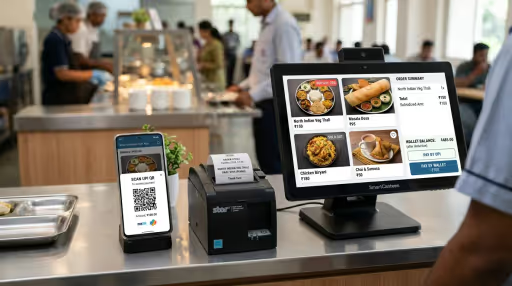
Cloud Canteen Management Software | Cashless POS & Meal Billing
Cloud canteen management software for corporate offices & factories in India. High-speed cashless POS billing, UPI wallet recharge, KOT printing & ERP sync.

RFID Asset Tracking System India: Fixed & Mobile IT Audits
Track IT equipment, datacenter server blades, and fixed assets across Indian offices with on-metal RFID tags and SAP/Oracle ERP integration.
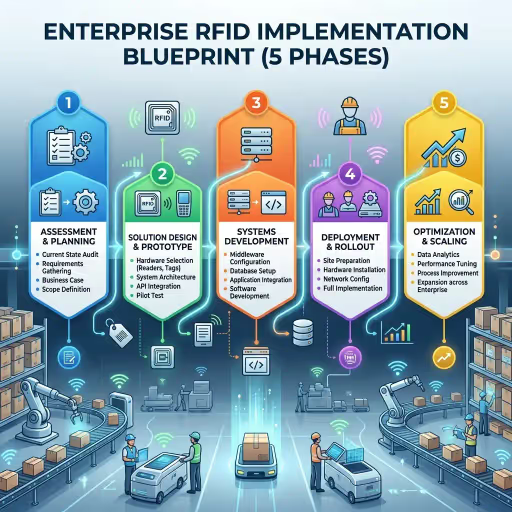
Step-by-Step RFID Implementation Guide India
Comprehensive 5-phase RFID implementation guide for India: RF site survey, tag surface selection, dock portal tuning, WMS sync & hypercare support.