
RFID vs Barcode: Speed Benchmarks & TCO Comparison 2026
In-Depth Technical Evaluation of Optical Barcodes vs Passive UHF RFID for Warehousing, Manufacturing & Retail Automation

Akash Arora
Technical Contributor & Engineer
- #RFID Technology
- #Barcode Systems
- #Asset Tracking
- #RFID vs Barcode
- #RFID Softwares
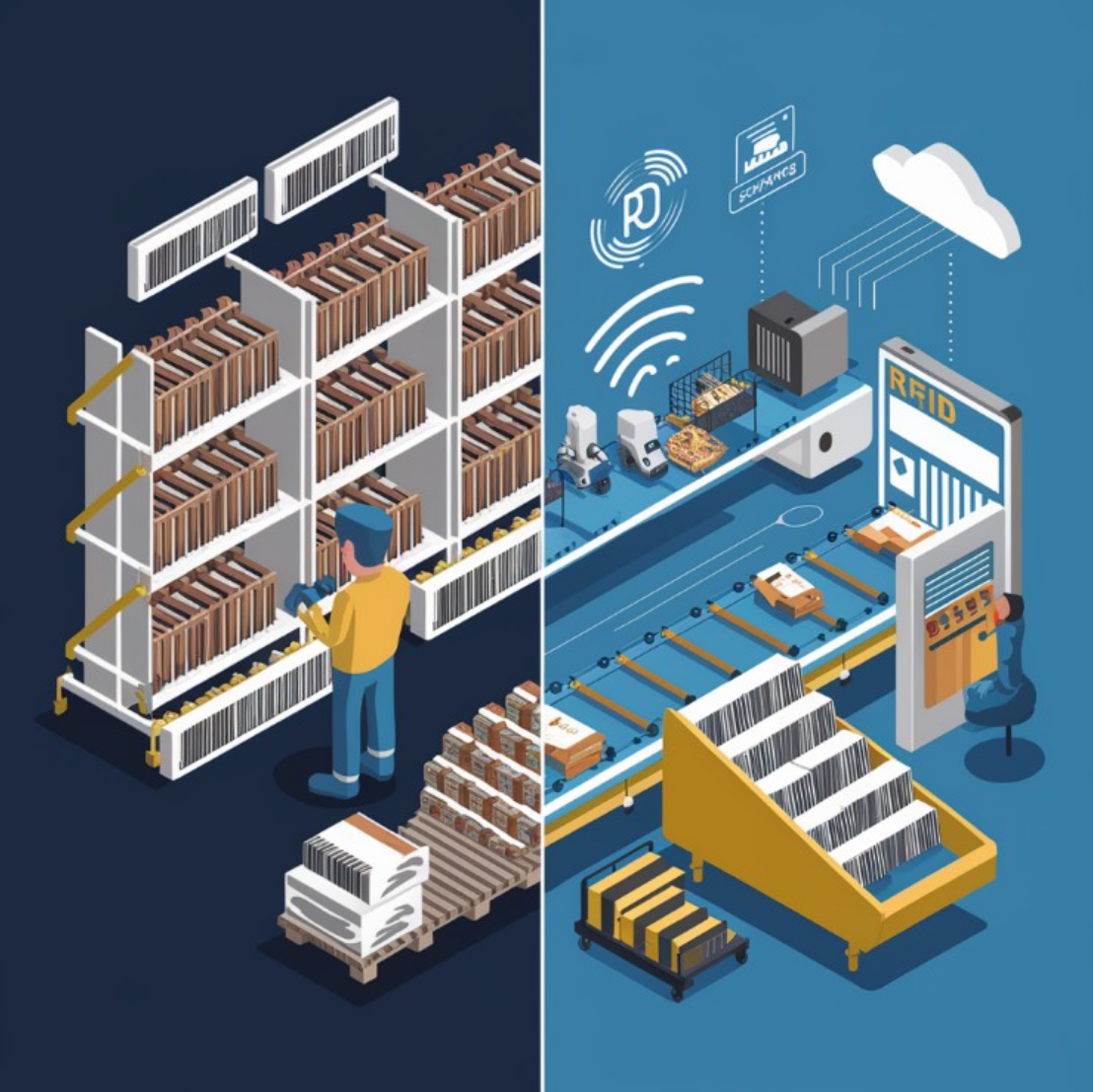
For decades, 1D linear barcodes and 2D QR codes have served as the foundational standard for automatic identification and inventory tracking across Indian supply chains. However, as modern supply chains face soaring labor costs, same-day delivery expectations, and omnichannel fulfillment demands, the physical limitations of optical scanning—requiring line-of-sight, manual orientation, and one-by-one scanning—have become major operational bottlenecks. Radio Frequency Identification (Passive UHF RFID) has emerged as the definitive enterprise upgrade, enabling simultaneous bulk scanning of hundreds of items without line of sight. Explore our turnkey Enterprise RFID Starter Kit to pilot UHF technology in under two weeks, or learn how our Retail RFID Inventory Solutions achieve 99.8% stock reconciliation. This comprehensive 2026 guide provides an exhaustive technical and financial comparison between RFID and Barcode systems, analyzing read speeds, environmental durability in harsh Indian conditions, labor cost economics, and total cost of ownership (TCO) break-even timelines.
Executive Summary: The Fundamental Auto-ID Paradigm Shift
The core operational difference between barcodes and RFID lies in their underlying physics:
- Optical Line-of-Sight (Barcode / QR): Requires an optical red laser or CMOS image sensor to physically inspect the printed black-and-white contrast lines or 2D matrix. If a barcode is obscured, oriented away from the operator, covered in dust, or placed inside a sealed carton, it cannot be read.
- Electromagnetic Wave Propagation (RFID): Passive UHF RFID readers emit an electromagnetic field (865–867 MHz in India) that wirelessly energizes miniature microchips embedded in tags. The chips modulate the reflected RF signal (backscatter), transmitting unique EPC identifiers through cardboard boxes, wooden pallets, plastic totes, and clothing stacks in milliseconds without opening packaging or aligning labels.
Comprehensive Technical Comparison Matrix: RFID vs Barcode (2026)
The following structured engineering matrix evaluates the 12 critical parameters distinguishing barcode systems from enterprise RFID deployments:
| Evaluation Metric | Traditional Barcode / QR Codes | Enterprise Passive UHF RFID | Operational Impact in India |
|---|---|---|---|
| Scanning Mechanism | Optical (Red Laser / 2D Imager) | Radio Frequency Electromagnetic Backscatter | RFID eliminates physical aiming and manual label positioning |
| Line-of-Sight Requirement | Mandatory 100% direct visual line-of-sight | Not required; reads through cartons, wood & plastic | Entire pallets can be scanned without unstacking shrink wrap |
| Scanning Speed & Throughput | 1 item at a time (15–30 items / minute) | Up to 700+ tags simultaneously per second | 95% faster intake, dispatch, and cycle counts |
| Read Range | Contact to 1.5 meters (Extended range: up to 10m) | Up to 12 meters with fixed portals; 6m with handhelds | Enables drive-through dock doors and high-bay rack scanning |
| Data Capacity | 20–100 characters (1D) / ~2,000 chars (2D QR) | 96 to 496 bits EPC + up to 512 bits User Memory | Stores unique item-level serials (SGTIN-96), batch numbers, expiry |
| Read / Write Rewritability | Read-Only (Once printed, data is static) | Read / Write (Memory banks can be locked/rewritten) | Allows dynamic status updates (e.g. Inwarded, QA Passed, Dispatched) |
| Durability in Harsh Environments | Easily scratched, torn, or obscured by dust/oil | Immune to surface dust, grease; rugged IP68 housings | Withstands industrial manufacturing, wash cycles & outdoor monsoons |
| Human Labor Requirement | High (Laborer must handle every single box) | Low (Automated portal or single handheld sweep) | Reduces warehouse inventory staffing requirements by up to 80% |
| Security & Encryption | Low (Easily photocopied, cloned, or faked) | High (AES-128 crypto, tamper-fracturing antennas) | Eliminates counterfeiting and unauthorized product diversion |
| Unit Tag Cost | Very Low (₹0.15 – ₹0.50 per paper label) | Moderate (₹3.50 – ₹7.00 inlay / ₹45+ on-metal) | Barcodes remain cheaper on consumable unit packaging |
| Interrogation Hardware Cost | Low (₹2,500 – ₹15,000 for handheld scanners) | Moderate to High (₹39,000 handheld / ₹1.2L+ portal) | Higher upfront capex requiring ROI justification |
| Inventory Accuracy Benchmark | 65% to 78% in typical fast-moving warehouses | 99.2% to 99.8% with automated middleware | Eliminates phantom stockouts and safety stock hoarding |
Speed, Throughput & Labor Productivity Benchmarks
Real-world field trials across Indian retail and manufacturing warehouses demonstrate the massive productivity gap between optical scanning and radio frequency automation:
1. Inbound Truck Unloading (500 Master Cartons)
- Manual Barcode Process: 2 warehouse workers manually orient and scan each carton with handheld barcode guns. Total time: 45 to 65 minutes.
- Automated RFID Dock Portal: Forklift drives through a UHF Integrated RFID Reader Portal. All 500 cartons across 10 pallets are verified in under 4 minutes.
2. Retail Store Stock Audit (25,000 Apparel Items)
- Manual Barcode Stocktake: Store associates scan individual price tags one by one. Total time: 48 hours (requiring 2 full days of store shutdown).
- Handheld RFID Sweep (Chainway C72): Associate walks the aisles sweeping shelves. Total time: 25 minutes during normal operating hours.
3. POS Counter Checkout (5 Garments / Accessories)
- Barcode Checkout: Cashier locates and aligns barcodes on 5 items. Total time: 45 to 60 seconds.
- RFID Countertop Checkout: All 5 items placed on an RFID checkout pad are recognized in sub-200 milliseconds.
Durability & Performance in Harsh Indian Industrial Environments
Indian industrial environments present harsh conditions that quickly degrade printed optical barcodes:
- Dust, Grease & Chemical Exposure: In automotive forging plants, textile dyeing units, and chemical warehouses, airborne dust and grease settle on barcode labels, causing optical scanners to misread or require repeated label wiping. RFID tags are completely immune to surface grime, reading through opaque oil layers and paint.
- Abrasion & Physical Tearing: Paper barcode labels on returnable transport items (pallets, plastic crates, steel trollies) tear and scrape off during transit. Encapsulated UHF Anti-Metal RFID Tags encased in rugged IP68 ABS or ceramic housings survive heavy impact, pressure washing, and vibration for over 10 years.
- Extreme Temperatures & Monsoons: High humidity and outdoor monsoon rain turn paper barcodes into illegible pulp. Industrial RFID tags operate reliably from -40°C to +85°C.
Financial TCO & Break-Even Analysis (Capex vs. Opex)
While barcode labels cost significantly less per unit (₹0.20 vs. ₹4.00 for RFID), looking solely at tag cost is a common financial pitfall. The total cost of ownership (TCO) equation must account for ongoing labor overhead, shipping error penalties, and phantom inventory holding costs.
When Does RFID Break Even?
- Labor Cost Reduction: A facility employing 8 full-time inventory counting staff at ₹22,000/month spends ₹21.12 Lakhs annually on manual barcode scanning. Reducing audit labor by 85% saves over ₹17.9 Lakhs annually.
- Mis-Ship Dispute Elimination: In Tier-1 automotive and retail distribution, shipping wrong parts results in debit notes and supplier chargebacks. RFID dock portals guarantee 99.8% dispatch accuracy, eliminating tens of lakhs in reconciliation penalties.
- Break-Even Horizon: For facilities handling over 15,000 items monthly or managing high-value returnable assets, RFID investments typically achieve full capital payback within 3 to 6 months.
The Hybrid Blueprint: Combining Barcode and RFID for Maximum ROI
Enterprise digital transformation does not require an all-or-nothing choice. The most successful Indian supply chain architectures utilize a Hybrid Coexistence Model:
- Dual-Layer Smart Labels: Using an industrial RFID printer such as the Zebra ZD621R 300DPI UHF RFID Printer, companies print human-readable text, 1D barcodes, and 2D QR codes on the label surface while encoding the internal UHF RFID inlay chip simultaneously.
- Tiered Supply Chain Scanning: Upstream automated distribution centers use RFID dock portals for instant pallet verification, while downstream small retail stores without RFID infrastructure can still scan the surface 1D/2D barcode with existing barcode guns.
- Phased Migration: Businesses can deploy RFID first at critical choke points (manufacturing dispatch, high-value asset storage, returns processing) and expand outward as operational ROI is established.
Explore more
Useful links and hardware solutions frequently visited next.

blog
Leading RFID Companies: A Comprehensive Guide to Industry Leaders
Explore the world's leading RFID companies, from Zebra Technologies to Impinj, and discover their specialized solutions for retail, healthcare, logistics, and industrial applications.
View →
blog
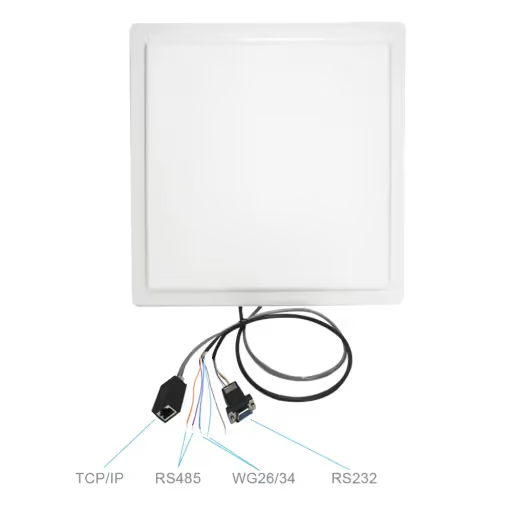
RFID Readers and Antennas: A Complete Guide to Selection and Implementation
Comprehensive guide to RFID reader and UHF RFID reader types, antennas, and selection. Covers fixed readers, handheld devices, UHF RFID reader software, integration software, and antenna types for optimal RFID solutions.
View →

blog
RFID Wallet & RFID Protection Wallet: Digital Security Guide
RFID wallet and RFID protection wallet essentials: how they block electronic pickpocketing and protect your cards and personal information from unauthorized scanning.
View →

service
RFID Integration Solutions for Your Business
Unlock your business potential with RFID integration solutions. Achieve 99% inventory accuracy and cut costs by up to 50%. Contact us for customized quotes.
View →
product
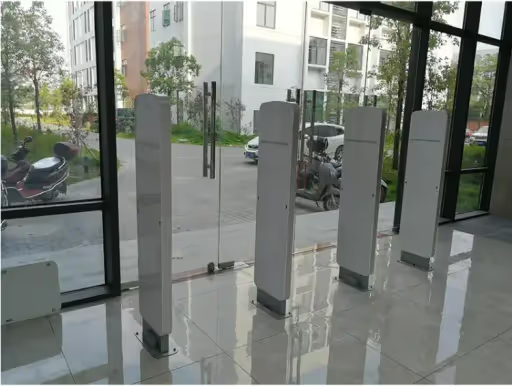
UHF RFID Gate for Warehouse Anti-Theft & Real-Time Stock Management
UHF RFID Gate anti-theft system for Indian warehouses - Real-time stock tracking, ceiling-mounted design covers 6m range. MRP ₹200,000 now ₹190,000. Pan-India delivery & integration.
View →
Frequently Asked Questions
What are the main advantages of RFID over traditional barcode systems?
Is RFID always better than barcodes for all business use cases?
How much faster is RFID compared to manual barcode scanning?
Can RFID tags and barcodes be used together on the same product?
How do metal and liquid surfaces affect RFID compared to barcodes?
What is the typical cost difference between barcode labels and RFID tags in India?
Reader Comments
Be the first to share your thoughts.