
Free RFID Simulator & Virtual Reader: OpenRFID Web & CLI
High-performance modular open-source RFID simulation framework for LLRP, TCP/IP, and Serial interfaces with bulk EPC Gen2 tag inventory emulation.
Try OpenRFID Simulator in your Web Browser
Need to simulate 5,000 tags/sec, test EPC Gen2 memory banks, or emulate LLRP streams immediately? Launch our interactive browser playground without downloading anything.
Watch Video Walkthrough Before Using
OpenRFID Simulator Tutorial: Virtual Reader & EPC Gen2 Emulation
View Dedicated Video Page & Notes →Step-by-step tutorial on launching headless virtual reader nodes via CLI, configuring 1-16 antenna ports with Gaussian noise, and encoding GS1 SGTIN-96 tags.
Project Overview & Architecture
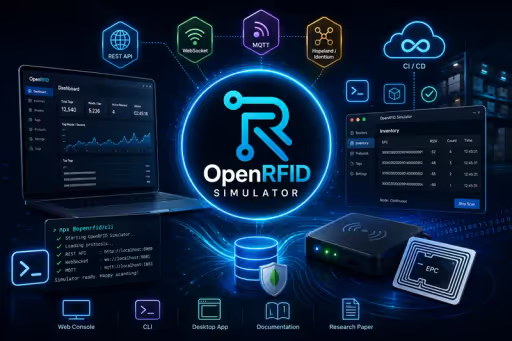
Production-grade, modular open-source RFID simulation framework engineered for full-stack IoT testing, supply chain automation, and protocol research without acquiring expensive physical RFID readers or tags. Built with a decoupled high-throughput event loop benchmarking 5,000+ tag reads per second and persistent SQLite WAL logging, it emulates fixed industrial readers (Impinj Speedway R420/R700, Zebra FX9600, Alien ALR-F800) across LLRP (Low Level Reader Protocol v1.0.1/v1.1), TCP/UDP raw sockets, and Serial RS232 interfaces. Features comprehensive EPC Class 1 Gen 2 (ISO 18000-6C) memory bank emulation, GS1 SGTIN-96/GRAI-96/GIAI-96 encoding, software-adjustable RSSI Gaussian noise, antenna port switching (1–16 ports), Fastify REST APIs, real-time WebSocket streams, and MQTT telemetry broker bridges for zero-dependency CI/CD test automation.
4-Tier Edge Pipeline Architecture
Socket Emulation
Binds LLRP (TCP 5084), Raw TCP/UDP (Port 8088), and Serial COM ports to simulate physical reader connections.
EPC & GS1 Engine
Generates synthetic 24-hex EPC tags, GS1 SGTIN-96 encoded identities, and multi-bank memory structures.
Antenna & RSSI Noise
Simulates 1-16 antenna multiplexing, dwell times, reader TX power (0-30 dBm), and Gaussian RSSI signal attenuation.
REST, WebSockets & MQTT
Broadcasts simulated reads in real-time to Fastify HTTP endpoints, WebSocket UI clients, and cloud MQTT brokers.
Monorepo Packages (12)
NPM MonorepoCore dependency injection, event bus, config validation, and SQLite storage.
npm i @openrfid/core EPC Class 1 Gen 2 memory bank bitwise encoding, decoding, and CRC-16 calculation.
npm i @openrfid/epc GS1 SGTIN-96, GRAI-96, GIAI-96, and SSCC-96 binary schema converters.
npm i @openrfid/gs1 Virtual multi-antenna fixed reader engine with TX power and RSSI noise models.
npm i @openrfid/readers High-throughput tag inventory cycle engine with event loops and debounce queues.
npm i @openrfid/simulator Fastify REST API server plugin exposing /readers, /tags, and /inventory endpoints.
npm i @openrfid/rest Real-time WebSocket server broadcasting live tag detection streams to frontends.
npm i @openrfid/websocket MQTT IoT telemetry client publishing tag read JSON payloads to cloud brokers.
npm i @openrfid/mqtt Headless command-line binary tool for CI/CD test automation.
npm i -g @openrfid/cli RFID tag domain models, synthetic tag batch generator, and memory inspector.
npm i @openrfid/tags Shared React UI component library and telemetry visualization widgets.
npm i @openrfid/ui Gaussian math distributions, hex converters, and low-level bitwise helpers.
npm i @openrfid/utils Feature Benchmark: OpenRFID Solution vs. Proprietary Alternatives
| Feature Capability | OpenRFID Solution (MIT) | Commercial Paid Solutions | Hardware Rig / Manual |
|---|---|---|---|
| License & Commercial Cost | 100% Free & Open Source (MIT) | $499 - $1,200 / Developer Seat | $1,500 - $3,500 / Physical Reader |
| Throughput Benchmark | ✓ 5,000+ Tags/Sec (Zero Allocation Byte Buffers) | 100 - 500 Tags/Sec Max | 300 - 1,200 Tags/Sec (Physics Limited) |
| LLRP & Socket Emulation | ✓ 1:1 Impinj & Zebra LLRP Server + TCP/Serial | Partial LLRP (Proprietary format only) | ✓ Hardware LLRP implementation |
| CI/CD & Headless Automation | ✓ Zero-Dependency NPX CLI & Docker Container | ✗ Windows GUI only / No CLI flags | ✗ Requires physical hardware rig in office |
| GS1 TDS 2.0 Encoders | ✓ Built-in SGTIN-96, GRAI-96, GIAI-96, SSCC-96 | Add-on Module ($299 extra) | Manual tag encoding required |
CLI Arguments & Configuration Reference
| Parameter / Flag | Type | Default | Description & Action |
|---|---|---|---|
| --port <number> | integer | 5084 | LLRP TCP listening port for client connection. |
| --antennas <1-16> | integer | 4 | Number of simulated virtual antenna ports. |
| --rate <tags/sec> | integer | 500 | Tag inventory streaming rate per second. |
| --protocol <type> | string | "llrp" | Reader protocol standard: llrp, tcp-raw, serial-ascii, or json-stream. |
| --tx-power <dBm> | number | 30.0 | Simulated reader transmitter RF power level (0 to 30 dBm). |
| --rssi-noise <sigma> | number | 2.5 | Gaussian standard deviation for realistic RSSI signal jitter. |
Code & Integration Blueprint
Copyable starter templates, CLI flags, and CI/CD pipelines:
Technical Specifications & Runtime Environment
| Target Architecture | TypeScript / Node.js 20+ / React • MIT Open Source License |
| Supported Protocols | LLRP (Low Level Reader Protocol), TCP/IP, Serial, MQTT |
| Emulation Standard | EPCglobal Class 1 Gen 2 / ISO 18000-6C |
| Simulated Reader Models | Impinj Speedway R420/R700, Zebra FX9600, Alien ALR-F800 |
| Memory Banks | EPC, TID, User Memory, Reserved (Kill/Access Passwords) |
Key Features & Capabilities
- ✓ High-Throughput Simulation Loop (5,000+ Tags/Sec with Decoupled Event Architecture)
- ✓ Bi-Directional Bitwise GS1 Encoders (SGTIN-96, GRAI-96, GIAI-96, SSCC-96)
- ✓ Full EPC Gen2 4-Bank Memory Emulation (Reserved 00, EPC 01, TID 10, User 11)
- ✓ LLRP Protocol & Multi-Vendor TCP Socket Emulation (Impinj, Zebra, Alien, Identium)
- ✓ Software-Tunable Antenna Port Multiplexing (1–16 Ports) with RSSI Gaussian Noise
- ✓ Hot-Swappable Protocol Plugins: Fastify REST API, WebSocket Broadcaster & MQTT Bridge
- ✓ Zero-Dependency Headless CLI (npx @openrfid/cli) for Automated CI/CD Pipelines
- ✓ Cross-Platform Native Desktop Application powered by Tauri and Rust
Related Hardware & Commercial Solutions
Explore compatible RFID readers, pre-built warehouse inventory software, and asset management systems developed by RFID Softwares:
Frequently Asked Questions
How does OpenRFID Simulator benchmark 5,000+ tag reads/sec in CI/CD without burning RAM? ↓
OpenRFID Simulator utilizes a decoupled simulation event loop with non-blocking asynchronous generators and an in-memory SQLite Write-Ahead-Log (WAL) buffer. It micro-batches tag events using zero-allocation byte buffers, keeping memory consumption strictly under 40 MB even during massive simulated warehouse inventory sweeps.
What RFID reader protocols and fixed hardware models does it emulate? ↓
It emulates LLRP (Low Level Reader Protocol v1.0.1 / v1.1), multi-vendor TCP raw socket streams, and serial RS232 connections. This enables 1:1 hardware drop-in simulation for Impinj Speedway R420/R700, Zebra FX9600, Alien ALR-F800, and Identium 4-port readers.
Can it encode GS1 standard barcodes like SGTIN-96, GRAI-96, and GIAI-96? ↓
Yes! The @openrfid/gs1 package includes full bi-directional bitwise conversion for GS1 EPC Tag Data Standards (TDS 2.0). It converts standard GTIN-14 and EAN-13 barcodes into 24-hex EPC Gen2 memory bank representations.
How do I connect external MQTT brokers or WebSockets to the simulation stream? ↓
The simulator includes modular plugins (@openrfid/mqtt and @openrfid/websocket). By passing flags like `--broker mqtt://broker.emqx.io:1883 --topic rfid/portal1`, the engine broadcasts live tag reads, antenna IDs, and RSSI telemetry to cloud dashboards in real time.
Can OpenRFID Simulator simulate antenna multiplexing and RSSI signal noise? ↓
Yes. You can configure 1 to 16 antenna ports per virtual reader, configure TX power (0 to 30 dBm), and inject Gaussian signal fading (e.g. -35 dBm to -75 dBm) to test middleware filtering and directional transit algorithms.
Is OpenRFID Simulator free and open-source under the MIT license? ↓
Yes, OpenRFID Simulator is 100% open-source under the permissive MIT license. You can freely integrate, customize, and deploy it in automated commercial CI/CD pipelines and enterprise software testing rigs.
Application & SDK Preview
Tested Hardware Devices
Paid Customization & Free Help
We offer free community help on GitHub issues and discussions. If you need bespoke features, customized mobile apps, or dedicated on-site deployment, contact us for paid enterprise integration services.