
Chipless RFID & Printable Tags Guide
How Sub-Cent Printable Resonators, Spectral Signatures, and Eco-Friendly Smart Labels are Transforming Supply Chains, FMCG, and Industrial IoT

Akash Arora
Technical Contributor & Engineer
- #RFID Technology
- #Chipless RFID
- #Printable Electronics
- #Affordable Tags
- #Asset Tracking
- #RFID Softwares

60-Second Executive Summary & Architecture Blueprint
- ✓ Fixed Reader: Zebra FX9600 or Impinj Speedway R420
- ✓ Antennas: 4x 8.5–9.0 dBiC Circular Polarized Array
- ✓ Inlays: Alien Higgs-9 / Impinj Monza R6-P
- ✓ Edge Middleware: OpenRFID Gateway (.NET 8 Daemon)
Architectural blueprint covering RF antenna power tuning, RSSI multi-path filtering, GPIO photocell triggers, and sub-second ERP transaction commits.
For decades, passive Radio Frequency Identification (UHF RFID) has stood as the gold standard for wireless item-level inventory management and supply chain automation. However, widespread adoption on low-cost everyday consumer items has faced an insurmountable economic ceiling: the Silicon Integrated Circuit (IC) Bottleneck. Standard silicon-based RFID tags require semiconductor wafer fabrication, microchip dicing, precision pick-and-place flip-chip bonding, and conductive strap welding. These physical manufacturing steps impose a hard minimum cost floor of $0.04 to $0.12 (₹3.50 to ₹10.00) per tag—far too expensive for disposable packaging, pharmaceutical blister packs, fast-moving consumer goods (FMCG), and single-use post packages.
Chipless RFID represents a transformative paradigm shift in automatic identification and data capture (AIDC). By eliminating the semiconductor microchip entirely, Chipless RFID encodes digital data directly into the electromagnetic resonance, spectral notches, or temporal reflections of printable conductive geometries. Manufactured using high-speed roll-to-roll (R2R) flexographic, gravure, screen, or inkjet printing with eco-friendly silver nanoparticle, carbon, or graphene inks, chipless tags slash unit costs to under a fraction of a cent ($0.001 to $0.005 / ₹0.10 to ₹0.40). This comprehensive guide explores the physics behind spectral signature encoding, printable electronics manufacturing, seminal IEEE research papers, and cross-industry applications across smart packaging, healthcare, extreme industrial environments, and the circular economy.
The Fundamental Physics: Chipped vs. Chipless RFID Encoding

To understand how data can be transmitted wirelessly without a microchip or transistor logic, we must analyze the core electromagnetic mechanisms governing Chipless RFID systems:
- Frequency-Domain (FD) Spectral Signature Encoding: This is the most prevalent chipless architecture. The tag consists of an array of multi-resonant planar metallic structures—such as C-shaped resonators, split-ring resonators (SRRs), U-shaped slots, or spiral stubs. When illuminated by an ultra-wideband (UWB) frequency interrogation pulse from a reader, each individual resonator traps and attenuates energy at its specific natural resonant frequency (f0 = 1 / (2 * π * √(L * C))). This creates distinct transmission dips or reflection nulls (spectral notches) in the backscattered radar cross section (RCS) spectrum. The presence of a resonant dip represents binary bit 1, while an absent or detuned resonator represents 0.
- Time-Domain (TD) Reflectometry & Delay Lines: Instead of frequency notches, time-domain tags (including Surface Acoustic Wave / SAW devices and transmission line tapped delay structures) receive an interrogation pulse and reflect a train of time-delayed acoustic or electromagnetic echo pulses. The precise microsecond or nanosecond arrival times and amplitudes of the reflected pulses encode the digital identifier.
- Spatial Domain & Radar Imaging (SAR): Millimeter-wave (mmWave, 30–300 GHz) chipless systems use focused radar beams to spatially scan reflective conductive pixels or geometric code matrices printed directly on packages, operating like an RF-transparent, non-line-of-sight microwave 2D barcode.
- Phase & Polarization Diversity: Advanced chipless tags introduce polarization transformation—reflecting horizontal polarization back as vertical circular polarization—effectively separating the weak tag backscatter signal from massive environmental background clutter.
Comprehensive Technical Matrix: Chipless RFID vs Traditional RFID vs Optical Barcodes
The following engineering matrix compares the operational, physical, and financial characteristics of Chipless RFID against traditional silicon UHF RFID and optical barcodes:
| Operational Parameter | Optical Barcode / 2D QR | Standard Silicon UHF RFID | Chipless Printable RFID |
|---|---|---|---|
| Unit Tag Cost | Negligible (₹0.10 – ₹0.30) | Moderate (₹3.50 – ₹9.00) | Ultra-Low (₹0.15 – ₹0.60) |
| Semiconductor IC Requirement | None (Purely optical ink) | Mandatory Silicon IC Chip | None (Purely electromagnetic resonant geometry) |
| Manufacturing Method | Standard commercial printing | Multi-step silicon bonding & inlay laminating | Roll-to-Roll (R2R) flexo/inkjet conductive printing |
| Line-of-Sight Dependency | Mandatory (100% direct visual line-of-sight) | None (Reads through cartons, wood, plastics) | None (Penetrates opaque packaging, liquids & dust) |
| Data Capacity | 20–2,000 characters | 96–496 bits EPC + User Memory | 8–64+ bits (Spectral notches / phase coding) |
| Reading Speed & Throughput | 1 item at a time (manual alignment) | Up to 700+ tags/sec simultaneous bulk scan | Fast continuous scanning (10–100+ tags/sec) |
| Read Range | Optical contact up to 1–2m | Up to 12 meters with high-gain antennas | 10 cm to 2.5 meters (depending on frequency & power) |
| Thermal & Harsh Durability | Degrades with soot, oil, abrasion | Fails above 150°C (Silicon junction breakdown) | Survives 400°C+ and cryogenic temperatures |
| Radiation Immunity (Gamma / E-Beam) | Immune | Sensitive (Silicon flash memory corrupted) | 100% Radiation-Hardened (No silicon memory) |
| Environmental Recyclability | High (Direct paper recycling) | Low (E-waste: silicon, copper etching, microchips) | Maximum (100% biodegradable substrate + carbon ink) |
Printable Electronics: Roll-to-Roll (R2R) Manufacturing at Scale
The primary economic catalyst for Chipless RFID is the rapid advancement of Printable Electronics and Functional Conductive Inks:
1. High-Speed Printing Technologies
- Flexography & Gravure Printing: Enables continuous roll-to-roll (R2R) web speeds exceeding 100 meters per minute. Resonant circuit arrays are transferred directly onto paper reels, corrugated cardboard liners, or polymer films at standard commercial print house speeds.
- Screen Printing: Ideal for high-thickness conductive layers requiring high conductivity and high Q-factor resonance with silver flake formulations.
- Digital Inkjet Printing: Enables on-demand printing of serialized, customized resonator geometries without physical printing plates, directly driven by software algorithms.
2. Advanced Conductive Ink Formulations
- Silver Nanoparticle Inks (AgNP): Delivers electrical conductivity near bulk copper after low-temperature photonic or thermal curing (120°C–150°C).
- Graphene & Carbon Nanotube (CNT) Inks: Metal-free, environmentally pristine conductive formulations that allow 100% repulpable paper tags with zero hazardous heavy metals.
- Conductive Polymers (PEDOT:PSS): Flexible, transparent, and ductile materials suitable for stretchable packaging and smart biomedical patches.
Seminal IEEE Research Papers & Academic Breakthroughs
Chipless RFID technology has matured through rigorous peer-reviewed electromagnetic engineering research. Below are landmark IEEE and academic papers that defined the fundamental principles and modern state of the art:
- Preradovic, S., & Karmakar, N. C. (2012). Chipless RFID: Barcode of the Future. IEEE Microwave Magazine, 13(7), 87-97.
- Key Contribution: The seminal paper from Monash University establishing the mathematical foundation of frequency-domain multiresonator spectral signatures, cross-polarization isolation, and RF notch filtering techniques.
- Vena, A., Babar, A. A., Sydänheimo, L., Ukkonen, L., & Perret, E. (2013). Design and Realization of a Chipless RFID Tag on Cardboard Substrate. IEEE Transactions on Antennas and Propagation, 61(12), 5827-5834.
- Key Contribution: Demonstrated the world's first high-reliability chipless RFID tag directly inkjet-printed onto everyday recycled cardboard packaging, solving dielectric loss and surface roughness issues.
- Perret, E. (2014). Radio Frequency Identification System: Chipless RFID Based on RF Encoding Particles. John Wiley & Sons / IEEE Press.
- Key Contribution: Comprehensive monograph establishing electromagnetic scattering matrices, high-density radar cross section (RCS) encoding particles, and physical unclonable function (PUF) security.
- Amin, E. M., & Karmakar, N. C. (2014). Development of a Chipless RFID Temperature Sensor Tag. IEEE Transactions on Antennas and Propagation, 62(1), 381-391.
- Key Contribution: Proved that chipless resonant tags can serve as simultaneous wireless sensors by correlating thermal dielectric permittivity shifts with resonant frequency drift without battery power.
- Tedjini, S., et al. (2020). Recent Advances in Chipless RFID Technologies for IoT and Smart Sensing Applications. IEEE Journal of Radio Frequency Identification, 4(4), 312-325.
- Key Contribution: Survey of millimeter-wave radar integration, machine learning decoders, and multi-parameter sensing (humidity, gas, mechanical strain, and temperature).
Transforming Key Industries: Industrial Applications & Smart Sensing

Chipless RFID unlocks massive new market opportunities where silicon RFID was previously disqualified by cost, temperature, radiation, or recyclability constraints:
1. FMCG & Fast-Moving Consumer Goods Packaging
For consumer goods priced at ₹10–₹50 ($0.15–$0.60)—such as snack packets, soda cans, dairy containers, and shampoo sachets—adding a ₹5 chipped RFID tag is economically unfeasible. Direct roll-to-roll printed chipless tags allow consumer brands to enable full automated warehouse checkout, smart shelf replenishment, and real-time inventory tracking for less than ₹0.25 per package.
2. Pharmaceuticals, Cold Chain & Passive Environmental Sensing
Because chipless resonators are highly sensitive to physical dielectric changes, specialized substrates act as wireless sensors without any active circuitry:
- Thermal Threshold Verification: Temperature-sensitive polymers coating the resonators shift their resonance permanently if a cold-chain vaccine or biologic exceeds safe storage temperature.
- Humidity & Freshness Tracking: Hydrophilic materials detect moisture vapor transmission inside sealed pharmaceutical blister packs or food cartons.
3. Harsh & High-Radiation Industrial Environments
Silicon semiconductor microchips degrade or suffer immediate memory erasure under high heat (>150°C), cryogenic storage (-196°C), or ionizing radiation. Chipless metallic structures printed on ceramic, polyimide, or high-grade alumina substrates easily withstand:
- Autoclave Steam Sterilization (134°C) & Medical Surgical Tool Tracking
- Gamma Radiation & E-Beam Medical Sterilization
- Automotive Paint Baking Ovens & Metal Heat Treatment Foundries (300°C–500°C)
4. Zero-Waste Circular Economy & Anti-Counterfeiting
- Pristine Paper Recycling: Silicon chips and glued copper antennas contaminate paper recycling pulpers. Chipless carbon-ink tags dissolve safely in standard paper recycling workflows.
- Physical Unclonable Functions (PUF): Microscopic variations in printed conductive ink edges create unique, uncopyable electromagnetic fingerprints, providing unbreakable anti-counterfeiting verification for luxury packaging, pharmaceuticals, and legal certificates.
Current Technical Challenges, Reader Hardware Architecture & Future Roadmap
While Chipless RFID holds immense promise for item-level tracking, real-world deployment requires understanding the reader hardware ecosystem, signal processing pipeline, and cost economics:
1. Reader Hardware Architecture & Interrogation Pipeline
Because chipless tags contain no silicon microchip, all RF intelligence is transferred to the reader hardware. A modern chipless RFID reader consists of:
- Wideband Transceiver Front-End: Uses FMCW (Frequency Modulated Continuous Wave) radar or IR-UWB (Impulse Radio Ultra-Wideband) transceivers (operating at 3.1–10.6 GHz or 24–60 GHz mmWave) to generate broadband microwave sweeps or sub-nanosecond pulses.
- Cross-Polarized Antenna Pairs: Employs dual-orthogonal antennas (e.g. Vivaldi, broadband horn, or cross-polarized patch arrays) to isolate transmitting power from the receiving port, eliminating the reader self-jamming effect.
- Real-Time DSP & FPGA Engine: High-speed ADCs capture backscatter reflections, feeding them into FPGA/DSP processors executing Fast Fourier Transforms (FFT), Matrix Pencil algorithms, and dynamic vector background subtraction.
2. Reader Hardware Cost & Deployment Matrix
| Reader Hardware Tier | Hardware Architecture | Typical Price Range | Primary Use Case |
|---|---|---|---|
| Laboratory Benchtop | High-Precision VNA (Vector Network Analyzer) | $10,000 – $45,000 (₹8L – ₹35L+) | S-parameter tag characterization & university research |
| Industrial FMCW Portal | Dedicated FMCW Radar + DSP/FPGA Board | $1,500 – $5,000 (₹1.2L – ₹4L) | High-speed automated conveyor belts & warehouse gates |
| SDR / Prototyping | Software-Defined Radio (PlutoSDR, USRP, NanoVNA) | $150 – $1,200 (₹12k – ₹95k) | Custom pilot builds & R&D lab prototyping |
| Next-Gen mmWave ASIC | Integrated CMOS Single-Chip Radar Transceiver | $50 – $250 (₹4k – ₹20k) (Projected) | Handheld mobile scanners & retail POS integration |
3. Environmental Clutter & AI-Powered Spectral Decoding
Reflections from metallic racking, nearby liquids, and overlapping packaging create background radar clutter. Modern enterprise solutions deploy Deep Learning / Convolutional Neural Networks (CNNs) trained on spectral notch signatures to isolate and classify resonant tags with 99.5%+ decoding accuracy even in low Signal-to-Noise Ratio (SNR) industrial environments.
4. Hybrid Supply Chain Synergy
In modern supply chains, enterprises combine Chipless RFID printed on unit-level consumer items with standard Passive UHF RFID Tags on master cartons and pallets, achieving end-to-end multi-tier visibility from factory floor to retail shelf.
Explore more
Useful links and hardware solutions frequently visited next.

blog
RFID vs Barcode Systems: Complete Comparison & Speed Benchmarks
Explore our in-depth evaluation of optical barcodes vs passive UHF RFID for warehousing, manufacturing, and retail automation.
View →
blog
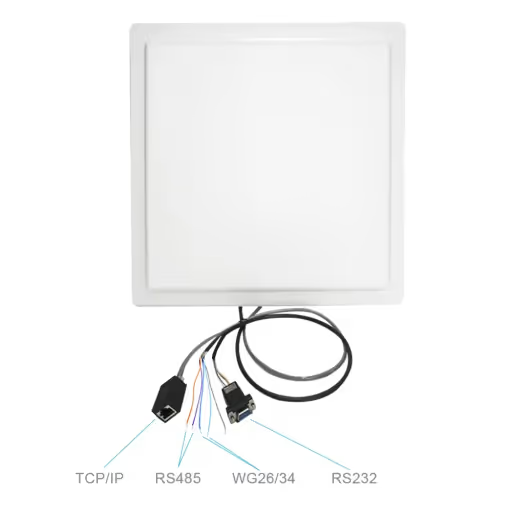
RFID Readers & Antennas Guide | Selection & Setup India
Comprehensive guide to RFID reader types, fixed portals, handheld scanners, and antenna selection for enterprise automation.
View →

service
RFID Integration Solutions for Your Business
Unlock enterprise visibility with customized RFID integration solutions. Achieve 99% inventory accuracy across supply chains.
View →
product
UHF RFID Tags & Printable Smart Labels
High-performance UHF RFID inlays, printable thermal transfer smart labels, and anti-metal tags for industrial tracking.
View →
Frequently Asked Questions
What is the main difference between standard RFID and Chipless RFID?
How much do Chipless RFID tags cost compared to chipped tags?
What hardware is required to read Chipless RFID tags?
How much does Chipless RFID reader hardware cost?
Can standard UHF RFID readers or NFC smartphones read Chipless RFID tags?
Why is Chipless RFID reader hardware more complex than conventional chipped RFID readers?
How do Chipless RFID readers eliminate background clutter and metallic reflections?
What is the difference between Time-Domain (IR-UWB) and Frequency-Domain (FMCW) Reader Hardware?
Can Chipless RFID tags be printed directly onto cardboard and paper?
What frequencies do Chipless RFID systems operate on?
Can Chipless RFID tags withstand extreme heat and radiation?
How do Chipless RFID tags function as wireless sensors?
Are Chipless RFID tags environmentally friendly and recyclable?
How long can a Chipless RFID tag be read (Lifespan & Data Retention)?
How far can Chipless RFID tags be read (Read Range & Distance)?
Does Chipless RFID store unique identification like an EPC code, or is it like a 1-bit EAS tag?
Reader Comments
Be the first to share your thoughts.